Volume solids converts a coating’s wet volume into the dry film volume that remains on the substrate. By combining volume solids with the target dry-film thickness and actual transfer efficiency, laboratory staff can calculate the coating volume required for a defined vessel area. This is critical when metering coatings through PFA/PTFE vessels and transfer lines because small volume errors can cause insufficient coverage, excess material use, or loss of expensive coating.
The key calculation is: required wet volume = substrate area × dry-film thickness ÷ (volume-solids fraction × transfer efficiency × 1,604). Accurate volume-solids data makes the coating requirement predictable; chemically resistant, low-loss PFA/PTFE equipment helps deliver that calculated amount consistently.
How Volume Solids Determines Coverage
What volume solids means
Volume solids is the percentage of a coating’s original liquid volume that remains as non-volatile material after drying.
For example, a coating with 60% volume solids leaves approximately 0.60 gallons of dry film for every gallon applied, before accounting for transfer losses. Volume solids is measured using ASTM D2697.
The remainder is volatile material that leaves during drying. Therefore, wet coating volume cannot be used directly to predict final film thickness.
The coverage relationship
The basic theoretical coverage equation is:
[ \text{Coverage}=\frac{1604 \times V \times E}{I} ]
Where:
- Coverage = theoretical coverage in square feet per gallon
- 1,604 = square feet-mils per gallon
- V = volume-solids fraction, such as 0.60 for 60%
- E = transfer efficiency as a decimal, such as 0.95
- I = target dry-film thickness in mils
If volume solids is entered as a percentage rather than a fraction, use:
[ \text{Coverage}=\frac{16.04 \times S \times E}{I} ]
Here, S is the numerical percentage, such as 60 rather than 0.60.
Calculating the required coating volume
For a known substrate area, rearrange the equation:
[ \text{Required volume in gallons}= \frac{A \times I}{1604 \times V \times E} ]
Where A is the substrate area in square feet.
Using volume solids as a percentage instead:
[ \text{Required volume in gallons}= \frac{A \times I}{16.04 \times S \times E} ]
This is the practical metering equation because it determines how much liquid must be prepared and dispensed.
Example calculation
Assume:
- Vessel area: 10 square feet
- Target dry-film thickness: 2 mils
- Volume solids: 60%, or 0.60
- Transfer efficiency: 95%, or 0.95
The required liquid volume is:
[ \frac{10 \times 2}{1604 \times 0.60 \times 0.95} =0.0218\text{ gallons} ]
That is approximately 82.5 milliliters.
The corresponding coverage is approximately:
[ \frac{1604 \times 0.60 \times 0.95}{2} =457\text{ square feet per gallon} ]
Why the Calculation Matters in PFA/PTFE Laboratory Vessels
It connects wet dispensing to dry performance
The coating specification is usually based on the dry film, but the laboratory meters the liquid coating. Volume solids provides the conversion between those two conditions.
Without this conversion, a measured liquid volume may appear sufficient while producing a dry film below the required thickness.
It reduces waste of high-value coatings
Specialty coatings can be expensive, and unnecessary over-dispensing increases material cost and disposal requirements.
A volume-solids calculation establishes a defensible starting quantity instead of relying on rough estimates or excess preparation.
It supports consistent metering
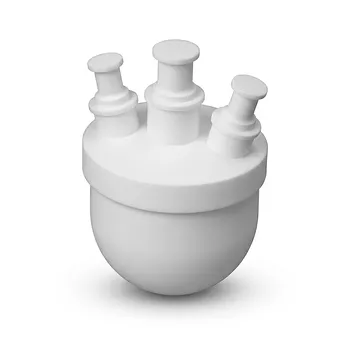
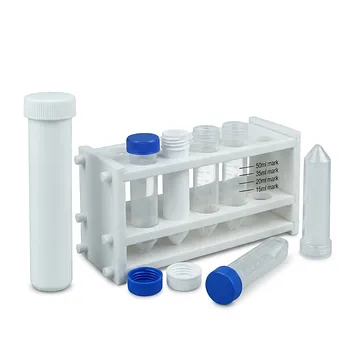
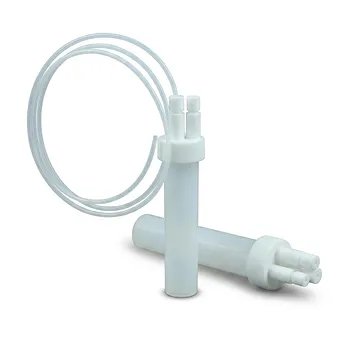
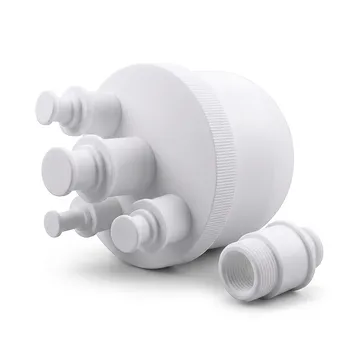
PFA and PTFE vessels, cylinders, and transfer lines can be used to prepare and dispense high-purity coating liquids while minimizing concerns about sample loss and cross-contamination.
The equipment does not change the coverage equation. Its value is that chemically resistant, high-purity fluoropolymer contact surfaces help preserve the material quantity and cleanliness assumed by the calculation.
It accounts for transfer losses
The transfer-efficiency factor represents the portion of coating that actually reaches the intended substrate.
Material retained in a vessel, cylinder, hose, or transfer line—or otherwise not deposited on the substrate—reduces effective coverage. Using an efficiency factor below 1.00 prevents the calculation from assuming that every dispensed molecule reaches the part.
Avoiding Formula and Measurement Errors
Do not confuse percentage with fraction
A frequent error is mixing the two forms of volume solids.
Use either:
- 0.60 with 1,604, or
- 60 with 16.04
Do not use 60 with 1,604, because that overstates the result by a factor of 100.
Area belongs in the required-volume equation
The area of the vessel or substrate determines the total quantity required, not the intrinsic coverage in square feet per gallon.
Coverage is calculated as:
[ \frac{1604 \times V \times E}{I} ]
Area is then included when calculating gallons or milliliters required:
[ \frac{A \times I}{1604 \times V \times E} ]
A formula that places area in the denominator of the coverage expression is dimensionally inconsistent unless it is being used for a separately defined quantity.
Do not treat theoretical coverage as guaranteed coverage
The calculation is a planning value. Actual results can differ because of transfer losses, application uniformity, residual material in the fluid path, and variation in the applied film thickness.
For laboratory metering, the transfer-efficiency value should reflect the actual dispensing process rather than an idealized application method.
Verify the dry-film target
Volume solids cannot compensate for an incorrect dry-film specification.
The target thickness must be defined in mils, and the resulting applied film should be verified using the appropriate inspection method for the vessel and coating system.
Understanding the Trade-offs
Higher volume solids generally require less wet volume
For the same dry-film thickness and transfer efficiency, a higher-volume-solids coating requires less liquid.
However, volume solids alone does not determine application behavior, viscosity, flow, or the amount retained in the transfer system.
Higher transfer efficiency improves material utilization
A well-controlled process can reduce the quantity needed to achieve the target film.
Using an unrealistically high efficiency factor, however, can understate the required preparation volume and lead to insufficient coating.
PFA/PTFE improves cleanliness but does not eliminate losses
Fluoropolymer equipment is useful for high-purity fluid handling because it helps reduce contamination and material interaction.
It does not guarantee zero hold-up or complete recovery. Vessel geometry, tubing dimensions, fittings, and dispensing technique still influence how much coating reaches the substrate.
Applying the Calculation to Your Process
Use the calculation as a controlled material-balance step before preparing or metering the coating.
- If your primary focus is accurate dry-film thickness: Use the measured volume-solids value, the specified substrate area, and the target thickness to calculate the required wet volume.
- If your primary focus is minimizing coating waste: Measure or estimate actual transfer efficiency, including material retained in PFA/PTFE vessels and fluid lines.
- If your primary focus is high-purity processing: Use compatible PFA/PTFE contact equipment to reduce contamination and sample loss while preserving the calculated material quantity.
- If your primary focus is process validation: Compare calculated volume with actual dispensed volume, recovered residue, and measured dry-film thickness.
With consistent units, realistic transfer efficiency, and controlled PFA/PTFE fluid handling, volume solids turns coating metering into a predictable and auditable process.
Summary Table:
| Parameter | Definition | Why It Matters |
|---|---|---|
| Volume Solids (%) | Percentage of liquid coating that remains as dry film after drying (ASTM D2697) | Converts wet volume to dry film volume; basis for coverage calculations |
| Substrate Area (ft²) | Surface area of the vessel or object to be coated | Determines total coating required |
| Dry Film Thickness (mils) | Target thickness of the dried coating (1 mil = 0.001 inch) | Specified by coating requirements; directly affects volume needed |
| Transfer Efficiency (%) | Fraction of coating that actually deposits on the substrate | Accounts for losses in equipment and process; prevents under-dispensing |
| Required Wet Volume | Gallons (or mL) of liquid coating to prepare | Practical quantity to meter using PFA/PTFE vessels and lines |
| Coverage (ft²/gal) | Theoretical area covered per gallon at specified film thickness | Helps plan material usage and compare coatings |
Optimize your coating process with precision-engineered PFA/PTFE labware from KINTEK. Our high-purity vessels, cylinders, and fluid handling components minimize coating loss and contamination, ensuring your volume solids calculations translate into consistent, high-quality results. Whether you need standard labware, custom CNC-machined parts, or complete fluid transfer systems, KINTEK delivers the reliability and performance your lab demands. Contact us today to discuss your requirements and discover how KINTEK can enhance your coating applications. Contact KINTEK
Related Products
- PFA Reaction Jar Corrosion Resistant Wide Mouth PTFE Lab Bottle High Purity Chemical Vessel
- High Performance Customizable PTFE Reaction Vessel and Corrosion Resistant Polytetrafluoroethylene Flask for Chemical Laboratory Use
- High Purity PTFE PFA Microwave Digestion Vessels Custom Acid Digestion Tanks for Laboratory Sample Preparation
- Corrosion Resistant PFA Translucent Reaction Bottle with PTFE Screw Cap and Standard 19 24 Ground Joint Neck for High Temperature Lab Applications
- Custom PTFE Flask Large Volume 18L Corrosion Resistant Low Background High Purity Chemical Vessel
People Also Ask
- Role of reaction vessels in alkali treatment for oil palm waste: Achieve High-Purity Cellulose with PTFE Vessels
- Why are well-sealed reaction vessels necessary for superacid-promoted Friedel-Crafts polycondensation? Optimize Synthesis
- How do the material choice and sealing integrity of the reaction vessel affect the growth of NiFe-LDH? Optimize Synthesis
- Why is the choice of reaction vessel material critical during B-NiBDC synthesis? Optimize MOF Purity & Performance
- What is the role of high chemical inertness reaction vessels in the organic synthesis of acylhydrazone ligands? | Guide