Fluoropolymer-silica nanocomposites can substantially outperform pure PTFE in extreme-temperature testing. Pure PTFE is exceptionally heat resistant for an organic polymer, but it begins significant thermal decomposition at roughly 600–700°C, depending on atmosphere, heating rate, and measurement method. By contrast, specially prepared fluoroalkyl end-capped oligomer/silica nanocomposites can show virtually no measured weight loss after calcination at 800°C under the reported sol-gel conditions.
The difference is structural, not simply a stronger fluoropolymer chain: silica nanodomains aggregate and encapsulate the fluorinated oligomers, while in situ ammonium hexafluorosilicate formation helps prevent fluorine loss and stabilizes the hybrid network at temperatures where unmodified PTFE decomposes.
Why Pure PTFE Is Already Thermally Stable
Strong carbon-fluorine bonding
PTFE benefits from the high activation energy of its C-F bonds, dense fluorine shielding, and a rigid helical chain conformation. These features limit chain mobility and make thermal attack more difficult than in conventional hydrocarbon polymers.
High fluorine content
Perfluorinated polymers are generally more thermally stable than partially fluorinated materials because fluorine replaces more reactive hydrogen atoms along the polymer backbone. PTFE therefore withstands substantially higher temperatures than materials such as ETFE, PVDF, or ordinary polyethylene.
Thermal stability has practical limits
PTFE has a melting point near 342°C and a thermal decomposition midpoint reported near 505°C. Decomposition may begin gradually at lower temperatures and become substantial around 600–700°C, so “high temperature resistance” should not be confused with indefinite serviceability at those temperatures.
How the Nanocomposite Extends Thermal Endurance
Fluoroalkyl chains aggregate inside silica
During sol-gel processing, the fluoroalkyl end-capped oligomers form molecular aggregates within a nanometer-scale silica gel matrix. The silica phase acts as a rigid, inorganic framework around the fluorinated material.
This architecture restricts the movement and escape of volatile decomposition products. It also distributes the fluorinated domains through a thermally resistant matrix rather than leaving them as an exposed, continuous organic phase.
Ammonium hexafluorosilicate forms in situ
Under the appropriate chemical conditions, reactive fluorinated groups participate in reactions involving ammonia and silica to form ammonium hexafluorosilicate. This inorganic fluorosilicate phase helps immobilize and protect the fluorinated oligomer aggregates.
The result is a hybrid structure in which fluorine is incorporated into a more thermally stable environment instead of being readily removed from the organic component.
Encapsulation suppresses fluorine loss
A key degradation pathway for fluorinated materials is dehydrofluorination or related fluorine-elimination chemistry. Encapsulation within the silica-derived network reduces access to the reactive pathways that would otherwise cause chain breakdown and volatile product formation.
This suppression explains why the nanocomposite can retain its measured mass after treatment at 800°C, while unhybridized PTFE undergoes substantial decomposition in the same general temperature range.
What the 800°C Result Actually Means
It demonstrates exceptional thermal retention
Virtually zero weight loss after calcination indicates that the treated hybrid material has exceptional resistance to volatilization and mass loss under the specified test conditions. It confirms that the silica-fluorinated architecture is much more thermally enduring than ordinary organic polymer structures.
It does not mean PTFE can operate unchanged at 800°C
The result should not be interpreted as an 800°C continuous-use rating for bulk PTFE or necessarily for every nanocomposite component. Calcination is a specific laboratory condition, and the retained material may include a substantial inorganic silica or fluorosilicate framework.
Application limits still depend on atmosphere, mechanical load, heating duration, thermal gradients, dimensional stability, and the exact formulation.
The comparison must use the same test conditions
Thermogravimetric weight retention, decomposition onset, decomposition midpoint, and long-term mechanical service temperature are different measures. Reported PTFE limits vary with oxygen availability, heating rate, sample geometry, and the definition of “decomposition.”
The most defensible comparison is therefore qualitative: the specialized silica hybrid resists mass loss at 800°C far better than pure PTFE under the reported calcination conditions, rather than claiming a universal operating temperature.
Related Structural Stabilization Strategies
Crosslinking and ladder formation
Other high-temperature fluoropolymers can gain endurance through interchain crosslinking, structural rearrangement of cyclic perfluoro groups, and formation of ladder-like architectures. These mechanisms reduce chain mobility and create more thermally persistent structures.
Such materials may retain a large fraction of their mass at 800°C, but this behavior is mechanistically distinct from the silica nanocomposite’s inorganic encapsulation and fluorosilicate formation.
Inorganic-organic synergy
The broader principle is that an organic fluorinated phase becomes more resistant when combined with a rigid inorganic network. The organic component supplies fluorine-rich chemical resistance, while silica and fluorosilicate structures provide physical confinement and thermal persistence.
This is a materials-design strategy, not merely an incremental change to PTFE chemistry.
Understanding the Trade-offs
Extreme thermal retention can reduce processability
Pure PTFE is difficult to melt-process but remains a recognizable thermoplastic. A silica-crosslinked or encapsulated hybrid is more likely to behave as a rigid network, which can limit remolding, welding, or conventional melt fabrication.
The formulation is highly condition-dependent
The reported performance depends on specific oligomer end groups, ammonia and silica chemistry, sol-gel conditions, and formation of the appropriate fluorosilicate phase. Simpler carboxyl or amido groups may not produce the same no-weight-loss behavior.
Mass retention is not the same as mechanical integrity
A sample can retain mass while becoming brittle, porous, cracked, or structurally altered. High-temperature qualification must therefore include dimensional, mechanical, chemical, and permeability testing in addition to TGA or calcination measurements.
Making the Right Choice for Your Goal
The appropriate material depends on whether the priority is conventional fluoropolymer service, extreme thermal exposure, or chemical containment.
- If your primary focus is conventional high-temperature chemical service: Use PTFE or PFA within their validated temperature and load limits, recognizing that decomposition becomes important well below 800°C.
- If your primary focus is minimum mass loss during extreme thermal treatment: Consider a purpose-designed fluoroalkyl oligomer/silica nanocomposite whose synthesis produces silica encapsulation and ammonium hexafluorosilicate.
- If your primary focus is long-term mechanical performance: Evaluate the complete hybrid formulation under the actual atmosphere, load, heating duration, and thermal cycling conditions rather than relying on calcination data alone.
- If your primary focus is melt-processability: Favor a suitable perfluoropolymer such as PFA where its processing window and temperature limits meet the application, because inorganic crosslinking may reduce reworkability.
The decisive advantage of the nanocomposite is its confined, fluorosilicate-reinforced molecular architecture, which enables thermal mass retention at 800°C beyond what pure PTFE can normally provide.
Summary Table:
| Material | Thermal Stability | Key Mechanism |
|---|---|---|
| Pure PTFE | Decomposes ~600-700°C; m.p. 342°C | Strong C-F bonds, but loses fluorine at high temps |
| Nanocomposite | No weight loss up to 800°C (calcination) | Silica matrix encapsulates fluoropolymer; ammonium hexafluorosilicate forms in situ |
| Comparison | Nanocomposite vastly exceeds PTFE | Structural confinement vs. unprotected polymer chain |
Enhance your lab's thermal endurance with KINTEK's advanced PTFE/PFA products.
Our exclusive high-performance fluoropolymers, including custom CNC-machined parts and bespoke assemblies, provide superior reliability for extreme conditions. Whether you need standard labware (beakers, crucibles, digestion vessels) or complex reaction apparatus (electrochemical cells, microwave digestion vessels), our materials resist harsh chemicals and high temperatures. We support OEM/ODM with certifications and reliable supply. Contact us today to discuss your requirements and elevate your research capabilities.
Related Products
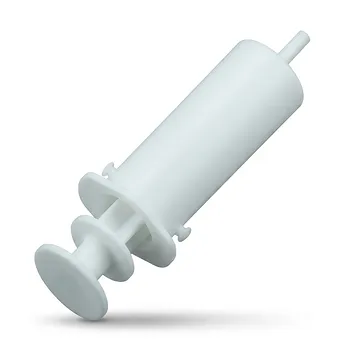
- Corrosion Resistant PFA Syringe Translucent Visual Fluoropolymer Labware 10ml Chemical Handling Tool
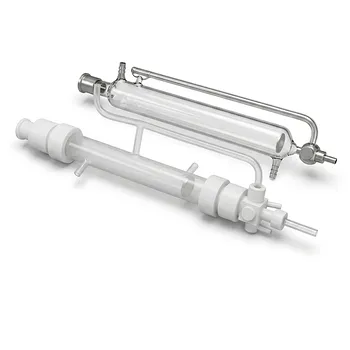
- High Purity PFA Chromatography Column with Collection Bottle Corrosion Resistant Fluoropolymer Filtration System for Trace Analysis
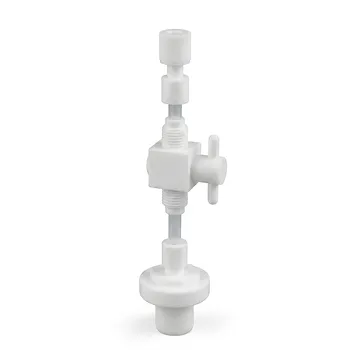
- High Purity PFA PTFE Flare Stop Valves Customizable 2-Way 3-Way Reducing Fluoropolymer Fluid Control Solutions
- High Purity Laboratory Grade PTFE Syringe Chemical Resistant Fluoropolymer Injector for Trace Analysis
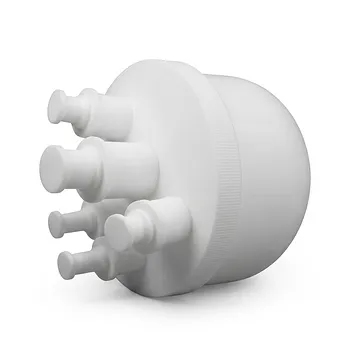
- Custom Multi Neck PTFE Flask for Chemical Engineering and High Purity Laboratory Synthesis Applications
People Also Ask
- How does the incorporation of comonomers such as perfluoropropyl vinyl ether (PPVE) alter the molecular structure and processing characteristics of TFE-based fluoropolymers like PFA compared to standard PTFE?
- Why do PFA fluoropolymer laboratory products offer different melt-processability and structural toughness compared to standard PTFE labware?
- PFA vs FEP: Which is Better for High-Temperature Lab Equipment?
- How does the removal of C8 (APFO) processing aids impact the chemical purity of solid fluoropolymer laboratory tools and fluid handling products? Discover the key benefits of C8-free PTFE, PFA, and FEP for trace analysis and high-purity applications.
- How does increasing fluorine content affect the physical and chemical performance of fluoropolymer laboratory supplies and components?