PTFE thermal degradation can be converted into a co-monomer recovery process rather than treated solely as waste disposal. Under controlled high-temperature vacuum pyrolysis, PTFE first decomposes into fluorocarbon fragments, with tetrafluoroethylene (TFE) as a major product. At higher temperatures, TFE-derived intermediates undergo rearrangement reactions, including a 1,2-fluorine shift, forming hexafluoropropene (HFP). Direct PTFE pyrolysis at approximately 860 °C and 20 torr can produce about 58% HFP, while separately cracking recovered TFE at 700–800 °C can produce up to 82% HFP.
The key mechanism is staged conversion: PTFE depolymerizes to TFE-rich gases, and sufficiently hot, oxygen-free conditions transform part of that TFE into HFP through fluorine-shift chemistry and related radical reactions.
How PTFE Becomes a Source of HFP
PTFE depolymerizes into fluorocarbon gases
PTFE consists of repeating tetrafluoroethylene units. When exposed to temperatures far above its normal processing range, the polymer chains undergo thermal depolymerization, breaking carbon-carbon bonds and regenerating smaller fluorocarbon molecules.
Under vacuum or an inert atmosphere, the decomposition is largely non-oxidative. This favors the formation of fluorocarbon monomers and related fluorocarbon products rather than carbonyl oxides produced during oxidation in air.
TFE is the main initial building block
The principal product under many vacuum-pyrolysis conditions is tetrafluoroethylene, or TFE. Conceptually, the PTFE chain is converted back toward its original monomer structure:
[ \text{–CF}_2\text{–CF}_2\text{–}_n \rightarrow n,\text{CF}_2=\text{CF}_2 ]
The actual product stream is a mixture rather than perfectly pure TFE. It can also contain difluorocarbene-derived species, octafluorocyclobutane (OFCB), and other fluorocarbon intermediates.
High temperature enables HFP formation
TFE does not need to remain the final product. At temperatures above approximately 750 °C, TFE-derived intermediates can undergo rearrangement involving a 1,2-fluorine shift. These reactions alter the carbon-fluorine arrangement and generate the three-carbon olefin hexafluoropropene:
[ \text{CF}_2=\text{CF}_2 + \text{fluorocarbon intermediates} \rightarrow \text{CF}_2=\text{CF–CF}_3 ]
This is the critical chemical step that converts a two-carbon TFE-rich stream into the three-carbon HFP co-monomer.
Two Practical Recovery Routes
Direct pyrolysis of solid PTFE
The simplest route is to heat the PTFE feed directly under vacuum. The polymer decomposes in the reactor, and the resulting gases are removed and separated downstream.
The cited operating point is approximately 860 °C at 20 torr, producing roughly 58% HFP. This route is operationally direct, but its product distribution depends strongly on temperature, pressure, residence time, heat transfer, and the composition of the remaining fluorocarbon stream.
TFE recovery followed by cracking
A potentially higher-yield route separates the process into two stages. First, PTFE is pyrolyzed to recover TFE-rich gas; second, that TFE is cracked in a stainless-steel tube under vacuum at approximately 700–800 °C.
This approach can reach up to 82% HFP at TFE conversions of up to 72%. The main manageable byproduct identified in this process is octafluorocyclobutane, which can be handled as part of the downstream fluorocarbon separation scheme.
Why staged processing can improve control
Separating PTFE depolymerization from TFE conversion gives the operator more control over each reaction environment. The first stage is optimized for releasing monomeric fluorocarbons, while the second is optimized for converting TFE into HFP.
This also makes it easier to monitor conversion, recycle unreacted TFE, and manage byproducts than in a single reactor processing solid PTFE and all secondary intermediates simultaneously.
Why Vacuum and Thermal Balance Matter
Vacuum limits unwanted oxidation
Vacuum removes oxygen and reduces the likelihood of oxidative PTFE degradation. In air, PTFE can form carbonyl difluoride and, in the presence of moisture, secondary products such as hydrofluoric acid and fluoroform.
A vacuum or inert atmosphere instead favors endothermic fluorocarbon decomposition and reduces the formation of oxygen-containing contaminants. This is essential when the objective is recovery of a usable fluorinated co-monomer.
Pressure changes the product distribution
At lower temperatures, TFE molecules and intermediates can recombine or cyclize to form OFCB. The supplementary reference indicates that increasing reaction pressure reduces OFCB formation, demonstrating that pressure is an important selectivity variable.
The optimal pressure therefore depends on the desired balance between TFE recovery, HFP production, cyclic byproduct formation, and reactor stability.
Endothermic and exothermic reactions must be balanced
TFE cracking is strongly heat-consuming, while TFE dimerization and related recombination reactions can release heat. During HFP synthesis, this creates a thermal-balance problem.
The cited process operates between approximately 750 °C and 950 °C, with residence times from 0.1 to 5 seconds. Controlling heat input and residence time helps prevent temperature excursions and excessive carbon formation.
What Happens to the Byproducts?
OFCB is a primary competing product
In the approximately 500–700 °C range, OFCB can represent a substantial portion of the product because TFE-derived biradical intermediates collide, form longer perfluorinated intermediates, and cyclize.
OFCB formation competes with the pathway that produces HFP. Increasing the temperature into the higher-temperature cracking regime promotes more significant HFP formation, although it also increases the need for careful product and hazard control.
Unreacted TFE can be recycled
In the staged cracking route, reported TFE conversion can reach up to 72%, meaning a fraction of the TFE remains unconverted. A practical process can therefore require gas separation and recycle to improve overall utilization.
The economic value of the process depends on the efficiency of this separation, the purity requirement for HFP, and the ability to manage or reuse the accompanying fluorocarbon products.
Extreme conditions can create hazardous products
At around 900 °C and atmospheric pressure, HFP can undergo further fluorine-shift chemistry and form perfluoroisobutene (PFIB) through radical reactions involving difluorocarbene. PFIB is highly toxic.
This makes temperature, pressure, residence time, and off-gas treatment critical process parameters. HFP recovery is therefore an engineered high-temperature fluorochemical process, not a conventional method for heating or disposing of PTFE components.
Understanding the Trade-offs
Higher temperature improves HFP formation but reduces selectivity
HFP becomes significant above approximately 750 °C, and the direct process uses about 860 °C. However, excessive temperature or unsuitable pressure can promote secondary reactions, carbon formation, and hazardous products such as PFIB.
The target is controlled conversion, not simply maximum temperature.
Direct processing is simpler but less selective
Direct PTFE pyrolysis avoids an intermediate TFE-recovery step, but it exposes the reactor to a broad mixture of products and intermediates. The reported HFP yield of approximately 58% reflects this more complex product distribution.
Staged TFE cracking offers a higher reported HFP yield, but requires additional gas handling, separation, process control, and equipment.
Laboratory thermal degradation is not the same as recovery pyrolysis
PTFE is generally recommended for continuous service only up to about 260 °C. Its rapid decomposition occurs at much higher temperatures, around the region of 525 °C and above, depending on conditions.
Therefore, equipment designed for ordinary PTFE use is not automatically suitable for HFP recovery. Specialized reactors, corrosion-resistant materials, controlled atmospheres, pressure control, and toxic-gas containment are required.
Making the Right Choice for Your Goal
The appropriate route depends on whether the priority is simplicity, HFP yield, or process control.
- If your primary focus is direct recovery from PTFE waste: Use controlled vacuum pyrolysis, recognizing that direct treatment at approximately 860 °C produces an HFP-containing mixture with a reported yield near 58%.
- If your primary focus is maximizing HFP production: Recover TFE first and crack it separately at approximately 700–800 °C, where reported HFP yields can reach up to 82% at TFE conversions of up to 72%.
- If your primary focus is product selectivity: Control temperature, pressure, residence time, and heat balance closely to limit OFCB formation, carbon deposition, and secondary fluorocarbon reactions.
- If your primary focus is operational safety: Use vacuum or an inert atmosphere, prevent moisture and oxygen ingress, and design the off-gas system for hazardous products including HF and PFIB.
By treating PTFE degradation as a controlled sequence of depolymerization and high-temperature fluorocarbon rearrangement, engineers can convert fluoropolymer waste into a recoverable HFP feedstock while maintaining control over yield, byproducts, and safety.
Summary Table:
| Recovery Route | Conditions | HFP Yield | Key Byproduct |
|---|---|---|---|
| Direct PTFE Pyrolysis | ~860°C, 20 torr | ~58% | Complex mixture (including OFCB) |
| TFE Recovery + Cracking | 700–800°C (cracking) | Up to 82% | Octafluorocyclobutane (OFCB) |
| Comparison | Direct | Staged |
|---|---|---|
| Simplicity | Higher | Lower |
| HFP Yield | Moderate | Higher |
| Process Control | Lower | Higher |
| Byproduct Management | More complex | Easier |
Optimize your HFP recovery process with KINTEK's advanced fluoropolymer solutions. Our PTFE and PFA labware and custom CNC machining services ensure precision and reliability in high-temperature applications. Contact us today to enhance your R&D efficiency and safety!
Related Products
- Custom Thickened PTFE Beaker 3000ml Hotplate Heating High Temperature Deformation Resistant Fluoropolymer Labware
- High Temperature Resistant PTFE Thermal Insulation Board Corrosion Resistant Metal Free Fluoropolymer Stand for Ultra Clean Laboratories
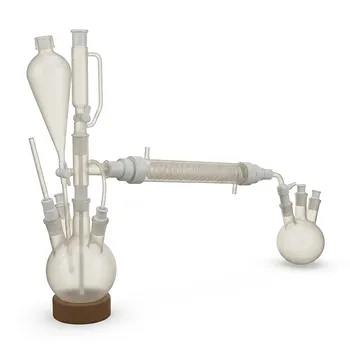
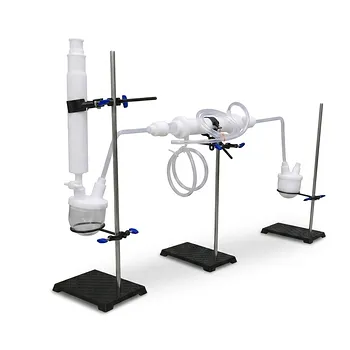
- PTFE Distillation Condensation Apparatus High Temperature Hydrofluoric Acid Resistant Fluorination Reaction Flask
- High Purity 30ml PTFE Corrosion Resistant Fluoropolymer Crucible with Graphite Heating Block Compatibility
- High Purity PTFE Beaker Heat Resistant Laboratory Chemical Vessel Hot Plate Compatible Non Deforming Fluoropolymer Labware
People Also Ask
- Why is the material of the reaction vessel critical for tribocatalytic degradation? Boost Your Catalytic Yield!
- What are the limitations of pure PTFE in high temperature applications? Understanding the 200°C Ceiling
- How do the thermal and processing properties of FEP compare to PTFE, and how does this affect material selection for specialized fluoropolymer labware? Choose the right material for your lab's demands.
- What are the maximum operating temperatures and processing differences between PTFE and PFA, and how do they guide material selection for high-temperature laboratory apparatus?
- Are Teflon parts capable of withstanding high temperatures? Understanding the 260°C Limit for Performance