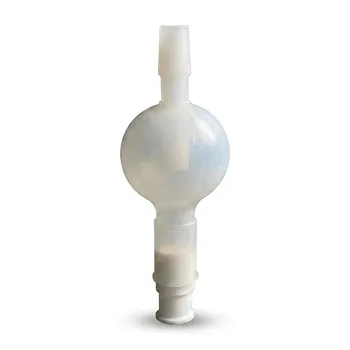
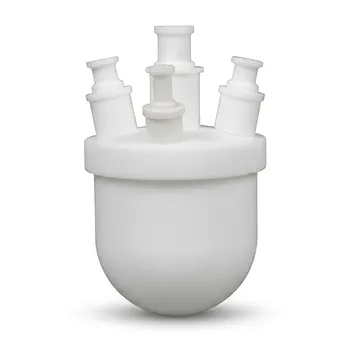
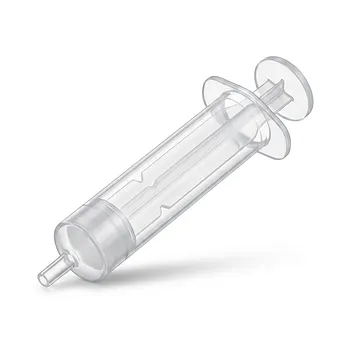
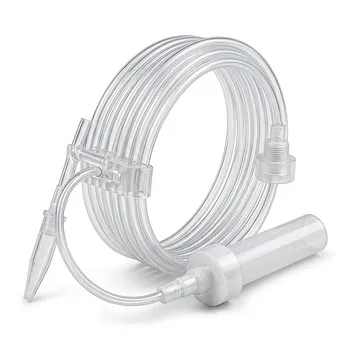
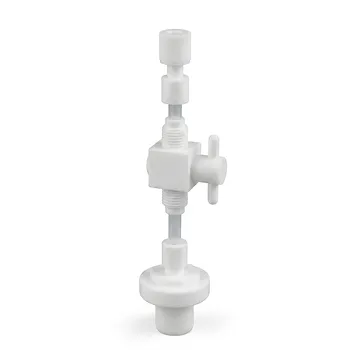
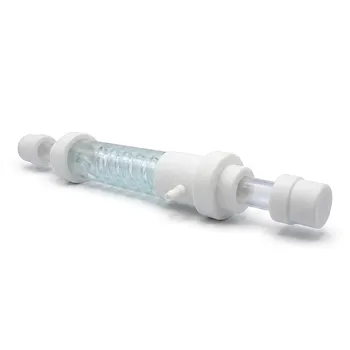
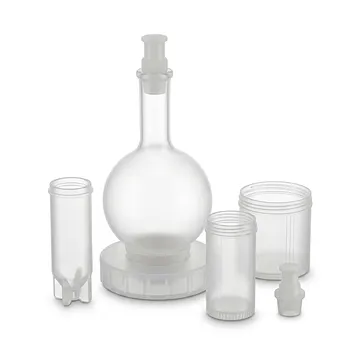
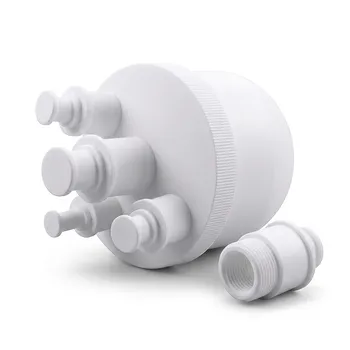
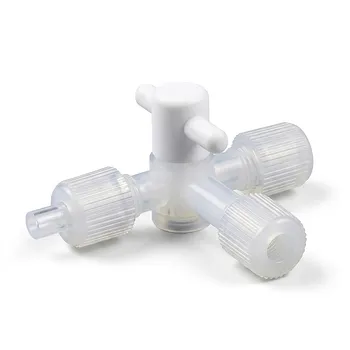
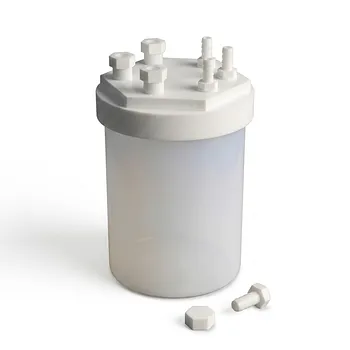
Higher fluorine content generally makes a fluoropolymer more chemically inert, thermally stable, flame resistant, and low-friction. This is why fully fluorinated materials such as PTFE and PFA are used for digestion vessels, trace-analysis containers, reagent bottles, tubing, valves, and other laboratory equipment exposed to aggressive chemicals and elevated temperatures.
Fluorine content is a major indicator of performance, but not the only selection factor. Higher fluorination improves chemical resistance, thermal endurance, solvent resistance, and non-stick behavior, while potentially reducing some mechanical properties. The correct material is therefore the one that balances inertness and temperature capability with strength, dimensional stability, and application-specific handling requirements.
Why Fluorine Changes Polymer Performance
The carbon–fluorine bond creates chemical inertness
Fluorine forms exceptionally strong bonds with carbon. When a polymer contains a high proportion of fluorinated groups, its molecular structure becomes less reactive and more difficult for chemicals to attack.
This increases resistance to aggressive mineral acids, organic solvents, oxidizing chemicals, and other reactive laboratory media. Fully fluorinated perfluoropolymers provide the highest level of chemical inertness among commonly used fluoropolymer materials.
Higher fluorination reduces solvent interaction
As fluorine content increases, solvents become less capable of dissolving, swelling, or penetrating the polymer. This is particularly important when equipment must retain its shape and surface integrity during prolonged chemical exposure.
Low solvent interaction also helps prevent sample absorption, contamination, and leaching, which are critical concerns in trace analysis and high-purity laboratory workflows.
How Fluorine Content Influences Key Properties
Chemical resistance increases
Higher fluorine content generally provides greater resistance to both inorganic and organic chemicals. This allows equipment made from PTFE or PFA to handle harsh reagents that would rapidly degrade many conventional plastics.
The practical benefit is not merely longer service life. Chemical inertness helps preserve the composition of the material being analyzed by reducing extractables and minimizing interactions between the equipment and the sample.
Thermal stability and melting behavior improve
Higher fluorination increases thermal stability and generally raises the melting point of the polymer. Fluoropolymers can therefore maintain their chemical and dimensional integrity under demanding temperature conditions.
This matters in acid digestion, thermal treatment, heated fluid transfer, and repeated laboratory processing. Perfluoropolymers are selected when both chemical exposure and elevated temperature are present.
Flame and weather resistance increase
Fluorine-rich structures offer improved flame resistance and photostability. They are also more resistant to weathering and degradation caused by environmental exposure.
These properties are especially valuable for equipment used near heat sources, in instrument environments, or in applications requiring long-term reliability with limited material degradation.
Friction and surface energy decrease
Higher fluorine content lowers the coefficient of friction and surface energy. The resulting surface is more non-stick, less adhesive, and easier to clean.
For laboratory equipment, this supports smoother fluid transfer, reduced residue retention, lower particle adhesion, and easier removal of reactive or viscous materials. It can also reduce flow resistance in tubing, valves, and other fluid-handling components.
Electrical insulation improves
As fluorine content rises, the dielectric constant and dissipation factor generally decrease, while surface and volume resistivity increase. These characteristics improve electrical insulation performance.
This is not the primary reason to choose PTFE or PFA for most chemical labware, but it becomes important when fluoropolymer components are integrated into analytical instruments, sensors, electrically active fluid systems, or high-voltage environments.
Why This Matters for Laboratory Equipment
Trace analysis requires low contamination risk
In trace analysis, even a small amount of contamination can distort results. A container that absorbs analytes, releases additives, or reacts with the sample can compromise the entire procedure.
High-fluorine materials help reduce these risks because they combine low solubility, low surface interaction, and exceptional chemical resistance. This makes PTFE and PFA suitable for high-purity sample vessels, digestion containers, and transfer components.
Digestion vessels must tolerate combined chemical and thermal stress
Digestion procedures often expose vessels to aggressive acids and high temperatures at the same time. A material that resists chemicals but softens or deforms under heat may still be unsuitable.
Perfluoropolymers provide the combination of chemical inertness and thermal endurance required for these conditions. Their performance helps protect both the vessel and the integrity of the digestion process.
Fluid-transfer components benefit from low friction
Tubing, valves, fittings, and pump components must move chemicals without introducing contamination or creating excessive resistance. Low friction and low surface energy help fluids pass through with less adhesion and fewer retained residues.
This is particularly useful when the system handles multiple reagents or high-purity fluids and must be cleaned thoroughly between operations.
Storage containers need long-term stability
Reagent bottles and chemical storage vessels may remain in contact with their contents for extended periods. Higher fluorination reduces the likelihood of chemical attack, swelling, extraction, or material degradation during storage.
The result is more reliable containment and a lower risk that the container will alter the chemical composition of the stored reagent.
Partially Fluorinated Versus Fully Fluorinated Materials
Fully fluorinated polymers maximize inertness
Materials such as PTFE and PFA are fully fluorinated perfluoropolymers. They are typically selected when maximum resistance to aggressive chemicals, high temperatures, solvents, and sample contamination is the priority.
PTFE is widely valued for extreme chemical and thermal resistance, while PFA also offers high purity and useful melt-processability for molded or complex laboratory components.
Partially fluorinated polymers can offer greater mechanical strength
Increasing fluorine content can slightly reduce certain mechanical properties, including resistance to cut-through or some forms of structural loading. Partially fluorinated materials may therefore be preferable when rigidity, strength, or mechanical durability is more important than maximum inertness.
Material selection should consider the complete operating environment rather than fluorine content alone.
Understanding the Trade-offs
Chemical performance can come at the expense of mechanical performance
The same molecular characteristics that provide low reactivity and low friction do not automatically provide maximum strength. Fluorine-rich polymers may be less suitable for applications involving high loads, sharp contact points, abrasion, or repeated mechanical deformation.
For load-bearing laboratory apparatus, the design may require thicker walls, reinforcement, mechanical supports, or a different fluoropolymer grade.
Thermal capability is not identical across all fluoropolymers
“Fluoropolymer” is a broad category. Different materials have different melting behavior, continuous-use limits, fabrication characteristics, and mechanical performance.
PTFE, PFA, and FEP should not be treated as interchangeable. The equipment must be evaluated against the actual temperature profile, including exposure duration, thermal cycling, pressure, and mechanical load.
Low friction does not eliminate every flow problem
A low coefficient of friction reduces adhesion and sliding resistance, but fluid performance also depends on tubing geometry, surface finish, viscosity, pressure, temperature, and system design.
Likewise, a non-stick surface can reduce residue retention without guaranteeing that every contaminant will be removed without an appropriate cleaning procedure.
Fluorine content is not the only measure of purity
High fluorine content supports chemical inertness, but laboratory purity also depends on resin quality, additives, processing history, surface condition, cleaning, and manufacturing controls.
For trace analysis, specify products intended for high-purity use and verify compatibility with the analytical method rather than relying only on the polymer name.
Making the Right Choice for Your Goal
The best material choice starts with the most demanding combination of chemical, thermal, mechanical, and purity requirements.
- If your primary focus is maximum chemical resistance: Choose a fully fluorinated perfluoropolymer such as PTFE or PFA for aggressive acids, solvents, and reactive laboratory media.
- If your primary focus is high-temperature processing: Select a grade with verified thermal capability for the actual exposure time, temperature, pressure, and thermal cycling conditions.
- If your primary focus is trace analysis and sample integrity: Prioritize high-purity PTFE or PFA components with low extractables, low absorption, and minimal risk of leaching.
- If your primary focus is smooth fluid transfer: Use a fluoropolymer with low friction and low surface energy, while also checking tubing dimensions, pressure rating, and chemical compatibility.
- If your primary focus is mechanical strength or rigidity: Consider a partially fluorinated material or a reinforced design, provided its chemical and thermal resistance remains adequate.
- If your primary focus is long-term equipment reliability: Evaluate fluorine content together with dimensional stability, fabrication method, wear conditions, and the complete operating environment.
For high-performance laboratory equipment, higher fluorine content is valuable because it protects both the material and the integrity of the chemical process—but the final choice must balance inertness, temperature capability, purity, and mechanical demands.
Summary Table:
| Property | Effect of Higher Fluorine Content |
|---|---|
| Chemical Resistance | Increases resistance to acids, solvents, and reactive media. |
| Thermal Stability | Improves heat tolerance and raises melting point. |
| Friction | Lowers coefficient of friction, reducing adhesion. |
| Flame Resistance | Enhances flame and weather resistance. |
| Electrical Insulation | Improves insulation performance. |
Select the optimal fluoropolymer for your lab's demanding applications. Contact KINTEK today for expert guidance and high-purity PTFE/PFA labware designed to enhance performance and reliability. Get in touch to discuss your requirements!
Related Products
- High Purity PFA Chromatography Column with Collection Bottle Corrosion Resistant Fluoropolymer Filtration System for Trace Analysis
- Custom PTFE Flask 250ml High Purity Fluoropolymer Laboratory Vessel for Chemical Research
- Custom PTFE Reaction Tank Corrosion Resistant Fluoropolymer Chemical Processing Barrel 10L 20L 30L
- Corrosion Resistant PFA Syringe Translucent Visual Fluoropolymer Labware 10ml Chemical Handling Tool
- Custom PFA Tubing 1/4 Inch High Purity Corrosion Resistant Fluoropolymer Tube with Welding and Machining Services
People Also Ask
- What are the primary functional and temperature differences between PFA and FEP when selecting melt-processible fluoropolymers for custom laboratory apparatus?
- How does PPVE modify PTFE to make melt-processable PFA? Discover key benefits and applications.
- Why is the chemical stability of polymer endgroups critical when selecting melt-processible fluoropolymers like PFA for high-purity laboratory apparatus? Choose Stable Endgroups for Reliable Performance
- What are the characteristics of PFA material? A Guide to Its High-Performance Balance
- Why is Perfluoroalkoxy alkane (PFA) preferred over glass or stainless steel in pharmaceutical process development? Pure Yield