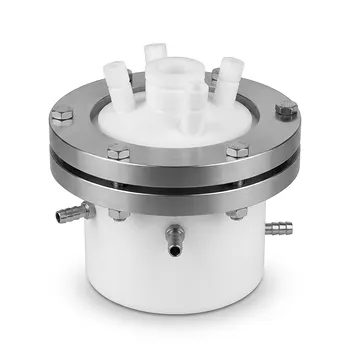
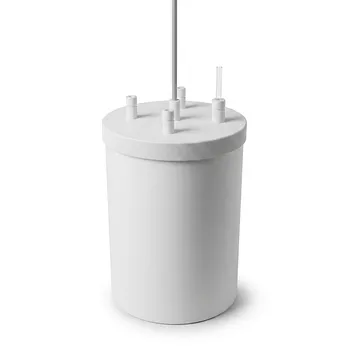
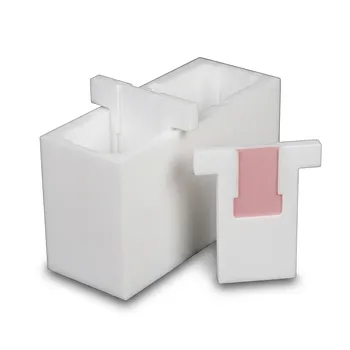
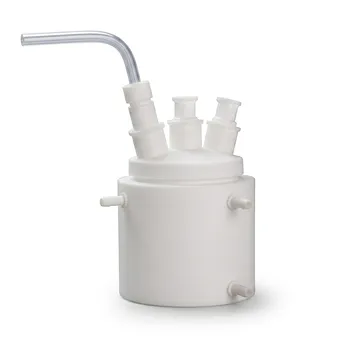
Precision CNC machining is the primary driver behind the rapid prototyping capabilities of PTFE microchannel reactors. By milling technical-grade PTFE blocks directly, engineers can bypass the lengthy and expensive tooling phases associated with traditional glass or silicon fabrication. This method allows for the immediate creation of hermetic, reconfigurable chips that can be tested, cleaned, and modified within a single work cycle.
The core advantage of PTFE fabrication lies in its mechanical versatility; the ability to use CNC milling for custom geometries combined with modular sealing techniques allows for a "fail-fast" approach to chemical reactor design and optimization.
The Role of CNC Machining in Design Speed
Eliminating Specialized Tooling
Unlike glass-based microfluidics that often require cleanrooms and photolithography masks, PTFE reactors are produced via direct CNC milling. This allows a designer to move from a CAD model to a physical prototype in hours rather than weeks, significantly lowering the barrier to entry for custom experiments.
Precision Geometry for Custom Reactions
CNC machining enables the creation of complex, three-dimensional channel geometries that are difficult to achieve with planar etching. Because PTFE is a highly machinable polymer, researchers can iterate on channel width, depth, and mixing structures to optimize residence time and mass transfer for specific chemical signatures.
Cost-Effective Material Usage
Using technical-grade PTFE blocks is significantly cheaper than sourcing high-purity quartz or specialized silicon wafers. The lower cost of raw materials encourages iterative testing, as the financial risk of a "failed" prototype is minimal compared to other fabrication mediums.
Modular Assembly and Reconfigurability
Mechanical Sealing Systems
PTFE chips are often sealed using mechanical 'click' systems, such as tenon-and-mortise interlocking under compression. This eliminates the need for permanent thermal bonding or adhesives, allowing the reactor to be opened, inspected, and resealed without destroying the device.
Ease of Maintenance and Cleaning
The low surface energy of PTFE prevents solids from adhering to the channel walls, but when fouling does occur, the ability to disassemble the reactor is a major advantage. Prototyping is accelerated when a single device can be thoroughly cleaned and reused for different reaction screenings.
Flexibility via FEP Interlayers
When permanent sealing is required, FEP (Fluorinated Ethylene Propylene) interlayers can act as a bonding agent during thermal bonding. This provides a fallback for higher-pressure applications while maintaining the chemical integrity of the fluoropolymer environment.
Direct Scalability via Numbering-Up
Preserving Lab-Scale Fluid Dynamics
A major hurdle in prototyping is the transition from lab to production; PTFE reactors solve this through "numbering-up." Instead of redesigning a larger vessel, the fabrication process simply involves creating multiple parallel channels or modularly stacking identical units.
Seamless Translation to Production
Because the fluid dynamics and heat transfer remain constant within each microchannel, the data gathered during the rapid prototyping phase is directly applicable to industrial scales. This eliminates the "scale-up gap" where reactions behave differently in larger batch reactors.
Understanding the Trade-offs and Limitations
Thermal Constraints and Softening
While PTFE is thermally stable, its continuous use temperature is typically capped at approximately 260°C. During the fabrication process, such as thermo-molding, temperatures can reach 350°C, but operating near these limits can lead to material softening and potential deformation of precision channels.
Challenges in Surface Roughness
CNC milling, while fast, can introduce surface roughness compared to the atomic-level smoothness of etched glass. In some microscale flows, this roughness can influence pressure drop or promote unintended turbulence, which must be accounted for during the design phase.
Mechanical Compression Requirements
Mechanical sealing relies on even pressure distribution across the chip interface. If the "click" system or external housing is poorly designed, leaks can occur, especially when the reactor is subjected to thermal cycling which causes the PTFE to expand and contract.
How to Apply This to Your Project
Depending on your specific research or production goals, the fabrication of PTFE reactors should be approached with different priorities:
- If your primary focus is rapid chemical screening: Utilize CNC milling for technical-grade blocks to create modular chips that can be disassembled and cleaned between different reaction trials.
- If your primary focus is high-pressure stability: Implement thermal bonding with FEP interlayers to ensure a more robust, permanent seal that resists leakage under stress.
- If your primary focus is industrial scale-up: Design your prototype with a "numbering-up" strategy in mind, ensuring the single-channel geometry is optimized before parallelizing the units.
The transition from a conceptual design to a functional, scalable chemical reactor is made significantly more efficient by leveraging the inherent machinability and modularity of PTFE.
Summary Table:
| Feature | Key Benefit | Prototyping Advantage |
|---|---|---|
| Direct CNC Machining | Eliminates expensive tooling/masks | Moves from CAD to physical part in hours |
| Mechanical Sealing | Reconfigurable 'click' systems | Allows non-destructive inspection and reuse |
| Technical-Grade PTFE | Low-cost raw material | Reduces financial risk of iterative failures |
| Numbering-Up Design | Consistent fluid dynamics | Eliminates the traditional lab-to-plant scale-up gap |
| FEP Interlayers | Optional thermal bonding | Provides high-pressure stability when required |
Accelerate Your Research with KINTEK’s Precision Fluoropolymer Fabrication
From everyday essentials like beakers, crucibles, and reagent bottles to advanced PTFE microchannel reactors and custom electrochemical cells, KINTEK is your single source for high-performance labware. We specialize in turning complex designs into functional prototypes through our expert end-to-end custom CNC fabrication.
Whether you need high-purity trace analysis tools, fluid transfer components (tubing, valves, fittings), or bespoke reaction apparatus like microwave digestion vessels and battery testing fixtures, our exclusive focus on PTFE and PFA ensures unmatched chemical resistance and precision.
Ready to bring your custom lab setup to life? Contact us today to leverage our expertise in high-performance materials and rapid prototyping for your next project.
Related Products
- Customizable Polytetrafluoroethylene PTFE Reactor and Corrosion Resistant Teflon Flask
- PTFE 10L Reaction Vessel with Stirring Paddle Customizable Corrosion Resistant High Temperature Reactor for Biopharmaceutical and Chemical Processing
- Custom PTFE Multilayer Reaction Apparatus High Temperature Corrosion Resistant Threaded Modular Sieve System
- Custom PTFE Volatile Matter Condensation Reflux Reaction Device Corrosion Resistant Pressure Resistant
- High Performance Customizable PTFE Reaction Vessel and Corrosion Resistant Polytetrafluoroethylene Flask for Chemical Laboratory Use
People Also Ask
- What functional advantages do PTFE reactors provide over glass? Achieve Superior Purity and Safety in Synthesis
- What are the primary fabrication methods for capillary-based and monolithic PTFE reactors? Expert Production Insights
- Why are PTFE or PFA reaction vessels required for the selective etching process of MXene using hydrofluoric acid (HF)?
- Why is a Teflon-lined (PTFE) reactor vessel required for the hydrothermal synthesis of V2O5 and SnO2 nanomaterials?
- What is the role of high chemical inertness reaction vessels in the organic synthesis of acylhydrazone ligands? | Guide