Expansion transforms PTFE from a dense polymer into a strong, porous node-and-fibril membrane. During high-temperature, high-strain-rate stretching, PTFE molecules orient and form solid nodes connected by highly oriented crystalline fibrils. This structure can increase bulk tensile strength to approximately 69 MPa at about 90% porosity, compared with roughly 21–35 MPa for conventional dense PTFE, while creating interconnected pores for gas and vapor transport.
The expansion process increases both porosity and mechanical performance by replacing a dense PTFE structure with an oriented fibril network. Stretch ratio, temperature, strain rate, and expansion direction determine the final balance between tensile strength, pore size, porosity, permeability, and particle retention.
How Expansion Creates the ePTFE Structure
PTFE develops a node-and-fibril network
Unsintered, high-molecular-weight PTFE is stretched under controlled elevated-temperature conditions. Rather than remaining as a continuous dense mass, the material fibrillates into solid PTFE nodes linked by fine fibrils.
These fibrils provide the membrane’s structural framework, while the spaces between them become the interconnected pore network.
Molecular orientation improves load transfer
Rapid stretching aligns polymer chains and crystalline regions along the direction of expansion. This orientation allows tensile loads to be distributed through the fibrils more effectively than in conventional molded or extruded PTFE.
As a result, expansion can improve tensile strength even while the membrane becomes substantially more porous.
Effect on Tensile Strength
Oriented fibrils increase mechanical strength
The key mechanical benefit is fibril orientation. Highly aligned fibrils act as reinforcing elements between nodes, helping the membrane resist tensile deformation and tearing.
The primary reference reports approximately 69 MPa bulk tensile strength for ePTFE with around 90% porosity, compared with about 21 MPa for standard molded PTFE.
Matrix strength is different from bulk strength
A reported matrix strength of up to approximately 690 MPa refers to the strength normalized to the solid PTFE fraction of the membrane. It should not be interpreted as the force-bearing strength of the entire porous membrane.
For practical laboratory filtration, the more relevant value is usually the bulk tensile strength, because it reflects the behavior of the complete membrane, including its void volume.
Biaxial expansion improves directional balance
Uniaxial expansion tends to align nodes and fibrils preferentially in one direction. This can produce directional differences in tensile strength and tear resistance.
Biaxial expansion stretches the film in both the machine and transverse directions, producing a more isotropic structure with more uniform mechanical behavior and better resistance to tearing from pressure differentials.
Effect on Porosity and Pore Size
Greater stretch generally increases porosity
Increasing the stretch ratio separates the PTFE nodes and creates more void volume. Reported porosity can increase from approximately 56% to 89%, depending on the expansion conditions.
Higher porosity generally improves gas flow, vapor permeability, and liquid-throughput potential, provided the membrane remains compatible with the fluid and the filtration mechanism.
Pore size depends on more than stretch ratio
A higher overall stretch ratio often increases the mean pore diameter. However, expansion speed and temperature can alter the structure in the opposite direction.
Higher transverse stretching speeds at elevated temperature can produce smaller, more closely spaced nodes and a denser fibril network. In some conditions, total porosity increases while mean pore diameter decreases to sub-micron values such as approximately 0.09 micrometers.
Fibril density controls filtration behavior
A membrane with many fine fibrils can retain particles efficiently while still maintaining significant void volume. Conversely, larger or more widely spaced pores can provide higher flow but may reduce retention of smaller particles.
Therefore, porosity alone does not define filtration performance. Pore size distribution, pore interconnectivity, thickness, and fibril structure are equally important.
Why Strength and Porosity Can Increase Together
The membrane is not simply “stretched thinner”
A simplistic model would predict that stretching PTFE creates more pores and therefore weakens it. ePTFE behaves differently because the process also reorganizes and orients the polymer.
The resulting fibril network provides efficient load paths through a low-density structure, allowing high porosity and useful tensile strength to coexist.
Nodes anchor the fibrils
The nodes act as junctions that transfer stress between multiple fibrils. A fine, homogeneous network distributes stress more evenly than a coarse or irregular structure.
This reduces the likelihood that one large defect or oversized pore will become the starting point for mechanical failure.
Processing conditions determine the balance
Expansion temperature and strain rate influence how PTFE fibrillates. Conditions that generate smaller nodes and numerous connecting fibrils can improve structural uniformity and mechanical resilience while also modifying permeability and pore size.
The strongest membrane is therefore not automatically the membrane with the highest porosity. Performance depends on the entire node-and-fibril architecture.
What This Means for Laboratory Filtration
High porosity supports gas and vapor flow
The interconnected pore network gives ePTFE high gas and vapor permeability. This makes it useful for hydrophobic vent filters, pressure equalization, and phase-separation barriers.
The membrane can allow gases to pass while resisting liquid water because of PTFE’s low surface energy and hydrophobicity.
Tensile strength supports pressure handling
The oriented fibril structure helps the membrane withstand handling, clamping, pressure differentials, and filtration-induced stresses. This is especially important in thin membranes and filtration laminates.
Biaxially oriented membranes provide more consistent resistance to tearing across the membrane surface.
Surface filtration improves recovery
In microporous surface filtration, particles larger than the effective pore openings are retained primarily at the membrane surface. The retained solids form a filter cake rather than penetrating deeply into the matrix.
This structure can improve particle recovery and simplify cake removal, which is valuable in laboratory sample preparation and analytical workflows.
Understanding the Trade-offs
Higher porosity does not guarantee higher flow
Increasing porosity generally increases available void volume, but flow also depends on pore diameter, tortuosity, membrane thickness, and wetting behavior.
A highly porous membrane with very fine pores may have excellent particle retention but lower liquid throughput than a membrane with larger pores.
Strength may be direction-dependent
Uniaxial expansion can produce different tensile properties in the machine and transverse directions. If the membrane will experience multidirectional pressure or handling loads, a biaxially expanded construction is usually more mechanically balanced.
Pore size and retention must be matched
Larger pores can improve permeability but may allow unwanted particles or droplets to pass. Smaller pores improve retention but can increase pressure drop and reduce throughput.
The correct design target is not maximum porosity; it is the required combination of pore size, retention, flow, and mechanical durability.
Hydrophobicity limits direct aqueous filtration
Unmodified ePTFE naturally resists wetting by water and many aqueous liquids. This is beneficial for venting and liquid-blocking applications but can prevent spontaneous liquid flow through the membrane.
For direct filtration of aqueous or polar solutions, a hydrophilic surface treatment or a compatible pre-wetting approach may be required.
How to Apply This to Your Project
The expansion process should be selected according to the required balance between mechanical strength, permeability, pore size, and particle retention.
- If your primary focus is tensile durability: Use a highly oriented, preferably biaxially expanded structure with a uniform node-and-fibril network to improve resistance to tearing and pressure-induced damage.
- If your primary focus is maximum gas or vapor permeability: Favor a higher-porosity structure while confirming that the resulting pore size still meets liquid-blocking and contaminant-retention requirements.
- If your primary focus is fine-particle retention: Select processing conditions that create smaller, closely spaced pores and a dense fibril network, accepting the potential for higher pressure drop.
- If your primary focus is aqueous liquid filtration: Specify a hydrophilic-modified ePTFE membrane or an appropriate wetting procedure, because untreated ePTFE is inherently hydrophobic.
- If your primary focus is uniform performance across the membrane: Prefer biaxial expansion to reduce directional differences in flow, strength, and tear resistance.
Properly controlled expansion allows ePTFE membranes to combine unusually high porosity with strong, application-specific mechanical performance.
Summary Table:
| Aspect | Effect | Key Values |
|---|---|---|
| Tensile Strength | Increases due to oriented fibrils | ~69 MPa (bulk), ~690 MPa (matrix) |
| Porosity | Increases with stretch ratio | 56% – 89% |
| Pore Size | Depends on stretch, temperature, speed | Can decrease to ~0.09 µm |
| Structure | Nodes connected by fibrils | Fibril network |
| Directionality | Uniaxial vs biaxial | Biaxial improves isotropy |
Optimize your filtration with KINTEK's precision ePTFE membranes. Our expert team helps you balance tensile strength, porosity, and pore size for your lab applications. Contact us today to discuss your requirements and discover how our PTFE/PFA expertise can enhance your research. Get in touch!
Related Products
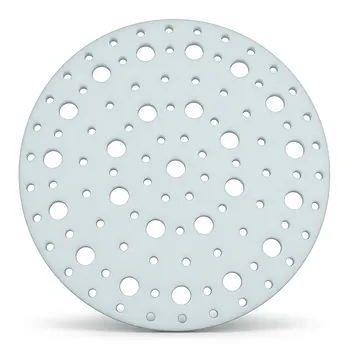
- High Temperature Resistant Insulating TFM Separator and Ultra Clean Laboratory PTFE Baffle Plate with Customizable Pore Size and Hole Configuration
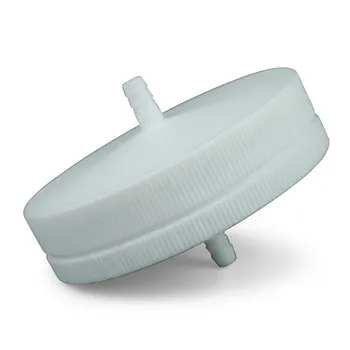
- PTFE Membrane Filter Holder for Aerosol Environmental Monitoring and Low Concentration Particulate Matter Sampling Chemical Resistant Air Quality Analysis Component
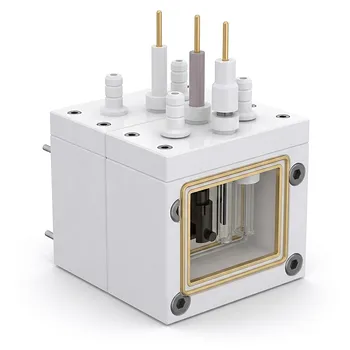
- All PTFE Exchangeable Membrane Electrochemical Cell Dual Chamber Three Electrode Photoelectrochemical Cell for Laboratory Trace Analysis
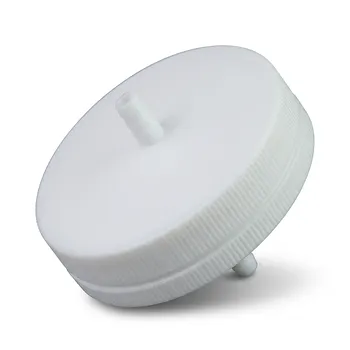
- PTFE Filter Membrane Holder 47mm Leak Proof Corrosion Resistant Environmental Sampling Unit Customizable
- High Purity PTFE Square Membrane Cutter Equipartition Device for Trace Analysis and Disease Control Centers Clean Non Stick No Leaching
People Also Ask
- What are the limitations of pure PTFE in high temperature applications? Understanding the 200°C Ceiling
- Are Teflon parts capable of withstanding high temperatures? Understanding the 260°C Limit for Performance
- What future advancements are expected in temperature-resistant PTFE seals? Discover Smarter, Tougher Sealing Solutions
- What is porous PTFE used for? Advanced Filtration for Harsh Chemical & High-Temp Environments
- What are the benefits of porous PTFE? Unlock Superior Filtration and Chemical Resistance