Adding vinyl alcohol (VA) comonomers changes PVDF copolymers in two distinct stages: VA hydroxyl groups make ferroelectric beta-phase formation easier during melt processing, while subsequent chemical crosslinking can suppress ferroelectric losses and improve high-field dielectric performance. Custom PTFE and PFA fixtures then provide the insulation, chemical resistance, and mechanical reliability needed to measure these changes safely.
VA improves processability and enables direct melt crystallization into the ferroelectric beta-phase, but crosslinking changes the electrical response by reducing crystalline domain size. The resulting material can shift from strongly ferroelectric behavior toward double-hysteresis or linear dielectric behavior, with higher breakdown strength, energy density, and charge-discharge efficiency.
How VA Changes PVDF Crystallization
Hydroxyl groups reduce processing barriers
Introducing VA into the PVDF backbone adds hydroxyl functional groups. These groups alter the polymer’s crystallization behavior and reduce the need for conventional mechanical orientation methods.
For a copolymer containing approximately 15 mol% VA, the material can crystallize directly into the ferroelectric beta-phase from the melt. This is significant because standard PVDF processing often relies on stretching or other post-processing steps to promote the electroactive phase.
Direct beta-phase formation simplifies fabrication
The ability to obtain the beta-phase during melt processing can make the material easier to fabricate into useful dielectric forms. It also reduces dependence on mechanical stretching, which can complicate dimensional control and limit component geometry.
The main benefit is therefore not simply a change in composition. VA provides a route to producing an electroactive structure through a more direct and potentially scalable processing sequence.
Ferroelectric behavior remains structure-dependent
VA incorporation enables beta-phase formation, but the final electrical behavior still depends on the polymer’s crystalline morphology. In particular, the size and connectivity of crystalline regions determine how readily dipoles switch under an applied electric field.
This distinction matters because forming the ferroelectric phase and optimizing it for energy storage are not necessarily the same objective.
How Crosslinking Alters Ferroelectric Performance
Crosslinking reduces crystalline domain size
Chemical crosslinking of P(VDF-co-VA) restricts chain mobility and reduces the size of crystalline domains. Smaller domains can limit large-scale cooperative dipole switching within the polymer.
As a result, the material’s response may move away from a conventional ferroelectric hysteresis loop toward double-hysteresis or more nearly linear dielectric behavior.
Reduced hysteresis lowers energy loss
A strongly ferroelectric material can retain substantial remanent polarization after the electric field is removed. That behavior produces hysteresis loss during repeated charge and discharge cycles.
Crosslinking reduces this ferroelectric loss by making polarization switching less extensive or less irreversible. The material can therefore dissipate less energy during operation.
Breakdown strength increases
The crosslinked structure can also improve electrical breakdown strength. A more constrained polymer network and smaller crystalline domains can reduce the formation or growth of electrically vulnerable regions under high fields.
The practical result is a dielectric that can tolerate higher applied electric fields before failure. Because capacitive energy storage scales strongly with electric field, this improvement directly supports higher stored energy density.
Energy density and efficiency improve together
Crosslinked P(VDF-co-VA) can provide higher stored energy density while also improving charge-discharge efficiency. These gains come from the combination of increased breakdown strength and reduced hysteresis loss.
This is an important trade in dielectric design: maximizing polarization alone is not sufficient if much of the input energy is lost during cycling.
How to Evaluate the Modified Dielectric
Hysteresis testing reveals switching behavior
Electric-field versus polarization measurements show whether the material behaves as a conventional ferroelectric, a double-hysteresis dielectric, or a more linear capacitor-like material.
The shape of the hysteresis loop is particularly useful for comparing uncrosslinked and crosslinked P(VDF-co-VA). A narrower loop generally indicates lower energy dissipation during polarization cycling.
Breakdown testing measures usable field range
Breakdown-strength testing determines the maximum electric field the specimen can withstand before electrical failure. This measurement must account for specimen thickness, electrode geometry, field concentration, temperature, and test environment.
Reliable fixtures are essential because a poorly controlled setup can cause premature failure at an edge, contact, void, or mechanically damaged area rather than in the dielectric itself.
Charge-discharge measurements connect structure to application
Charge-discharge testing measures the energy that can be stored and the fraction recovered during discharge. It links the material’s hysteresis behavior and breakdown strength to practical energy-storage performance.
Testing should therefore evaluate more than a single dielectric constant. The meaningful performance profile includes polarization response, loss, breakdown strength, recoverable energy density, and efficiency.
How Custom PTFE and PFA Components Aid Testing
PTFE provides electrical isolation
Custom-machined PTFE test fixtures can isolate electrodes and surrounding hardware from the high electric fields used during dielectric measurements. This reduces the likelihood that the fixture itself becomes an unintended current path.
PTFE’s high dielectric strength makes it suitable for insulating supports, spacers, electrode holders, and protective components in high-voltage test assemblies.
PFA adds chemical and dimensional robustness
PFA components provide similar high-performance electrical insulation while offering strong chemical resistance and useful fabrication flexibility. This is valuable when the test apparatus includes solvents, reactive chemicals, electrochemical media, or cleaning procedures.
PFA can be used for custom chambers, holders, tubing, insulating barriers, and other components that must remain stable in demanding environments.
Custom machining controls the test geometry
Commercially available hardware may not provide the electrode spacing, specimen access, sealing arrangement, or insulation distances required for a specific experiment. Custom machining allows the apparatus to be matched to the sample and measurement method.
Controlled geometry helps reduce field enhancement and improves repeatability between specimens. It also makes it easier to protect operators and instrumentation from unintended electrical discharge.
Electrochemical apparatus supports broader characterization
Custom PTFE and PFA electrochemical components can support measurements involving electrodes, electrolytes, or chemically sensitive environments. Their resistance to chemical attack helps preserve fixture performance across repeated tests.
The fixtures do not change the polymer’s dielectric properties. Their role is to create a stable, isolated, and reproducible environment in which those properties can be measured accurately.
Understanding the Trade-offs
VA improves processing but does not guarantee optimum storage behavior
VA can enable direct beta-phase crystallization from the melt, but beta-phase content alone does not determine usable energy-storage performance. Excessive ferroelectric switching can still produce high hysteresis and low charge-discharge efficiency.
Material formulation and crosslink density must therefore be selected together with the intended electrical operating regime.
Crosslinking improves field performance but changes polarization response
Crosslinking can increase breakdown strength and efficiency, but it also reduces crystalline domain size and weakens conventional ferroelectric switching. A designer seeking maximum remanent polarization may view this as a disadvantage.
For recoverable energy storage, however, the shift toward double-hysteresis or linear behavior can be beneficial because it reduces energy loss.
Testing hardware can become a source of error
High-field measurements are sensitive to electrode alignment, surface defects, thickness variation, edge effects, and fixture leakage. If the apparatus is not properly insulated or dimensioned, the measured breakdown strength may reflect the test setup rather than the polymer.
Custom fluoropolymer components reduce these risks, but they do not eliminate the need for careful specimen preparation, field calibration, and repeated measurements.
Supplementary fluoropolymer modifications serve a different purpose
Perfluoroalkyl vinyl ether comonomers such as PEVE can improve flex fatigue resistance and melt processability in tetrafluoroethylene-based fluoropolymers. Those effects are relevant to tubing, diaphragms, and fittings, but they should not be treated as direct evidence for the VA-induced ferroelectric and dielectric behavior of P(VDF-co-VA).
The two modification strategies address different performance targets: VA and crosslinking primarily affect electroactive morphology and dielectric response, while PEVE is associated with mechanical durability and processing behavior.
How to Apply This to Your Project
The appropriate material and test strategy depends on whether the priority is processing, ferroelectric switching, or high-field energy storage.
- If your primary focus is melt-processable ferroelectric PVDF: Use VA incorporation near the demonstrated 15 mol% composition to promote direct beta-phase crystallization without relying on mechanical stretching.
- If your primary focus is recoverable energy density: Evaluate chemical crosslinking because its reduction of crystalline domain size can lower hysteresis and increase breakdown strength, efficiency, and stored energy.
- If your primary focus is ferroelectric actuator or sensor response: Compare uncrosslinked and crosslinked materials carefully, since crosslinking may reduce the conventional polarization switching that these applications use.
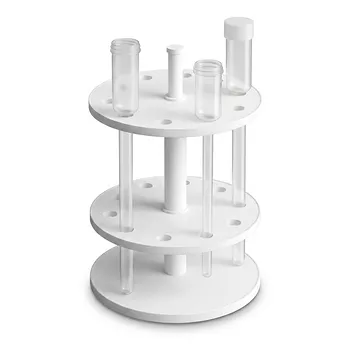
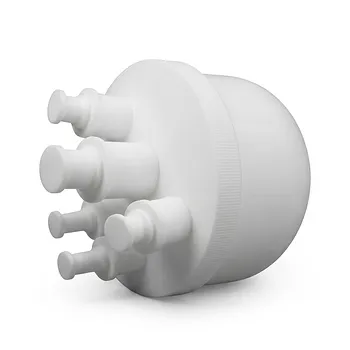
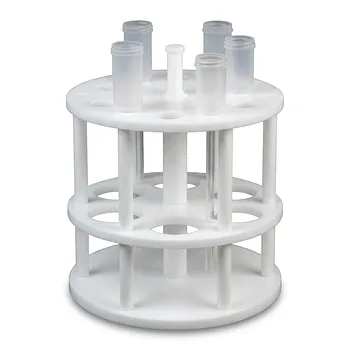
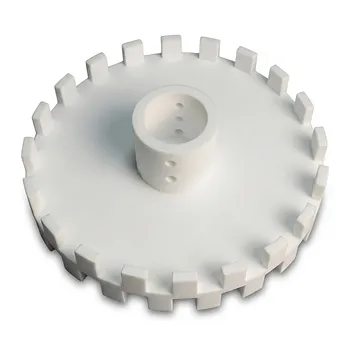
- If your primary focus is reliable high-field characterization: Use custom-machined PTFE and PFA fixtures to provide electrical isolation, chemical resistance, controlled geometry, and safer operation.
- If your primary focus is flexible fluoropolymer hardware: Consider PEVE-modified tetrafluoroethylene systems separately, because their principal advantages are flex-fatigue life, melt processability, and elevated-temperature mechanical performance.
The most reliable design approach is to treat polymer chemistry, crystalline morphology, crosslinking, and test-fixture geometry as one connected dielectric-engineering system.
Summary Table:
| Aspect | Effect of VA Comonomers | Effect of Crosslinking |
|---|---|---|
| Crystallization | Enables direct beta-phase from melt | Reduces crystalline domain size |
| Ferroelectric behavior | Supports conventional ferroelectric switching | Shifts to double-hysteresis or linear dielectric |
| Hysteresis loss | Higher loss (if uncrosslinked) | Reduced loss, higher efficiency |
| Breakdown strength | Moderate | Increased |
| Energy density | Moderate | Higher |
| Charge-discharge efficiency | Lower | Higher |
Optimize your PVDF-based dielectrics with custom PTFE/PFA test fixtures from KINTEK. Our precision-machined components ensure reliable high-field measurements, chemical resistance, and safety for your energy storage research. Contact us today to discuss your custom requirements and elevate your material testing. Get in touch!
Related Products
- High Purity PFA Chromatography Columns and Collection Bottles Corrosion Resistant Fluoropolymer Filtration Systems for Trace Analysis
- High Purity PFA Chromatography Column with Collection Bottle Corrosion Resistant Fluoropolymer Filtration System for Trace Analysis
- High Purity PFA Coiled Tubing Custom PTFE Machining PFA Welding and Precision Bending Solutions
- PVDF Sample Support Body for Corrosion Testing and Electrochemical Analysis
- Corrosion Resistant High Purity PFA Valve and Weldable Transparent Tubing for Semiconductor Fluid Transfer
People Also Ask
- Why use high-purity PFA bottles for Carbon Quantum Dots? Ensure Ink Stability and Prevent Fluorescence Quenching
- Why is PFA often selected over traditional PTFE for manufacturing complex fluoropolymer fluid components, custom fittings, and sealed laboratory digestion vessels? Discover the key advantages for your lab.
- Why is the chemical stability of polymer endgroups critical when selecting melt-processible fluoropolymers like PFA for high-purity laboratory apparatus? Choose Stable Endgroups for Reliable Performance
- What are the characteristics of PFA material? A Guide to Its High-Performance Balance
- Why is Perfluoroalkoxy alkane (PFA) preferred over glass or stainless steel in pharmaceutical process development? Pure Yield