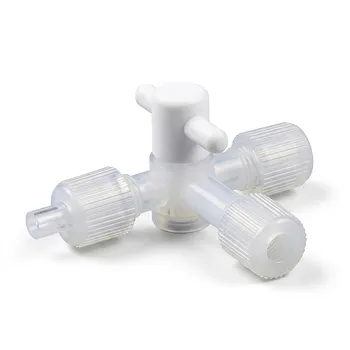
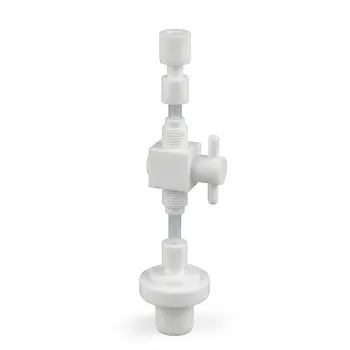
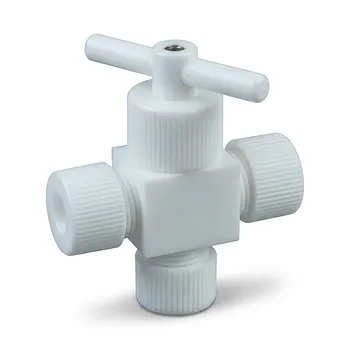
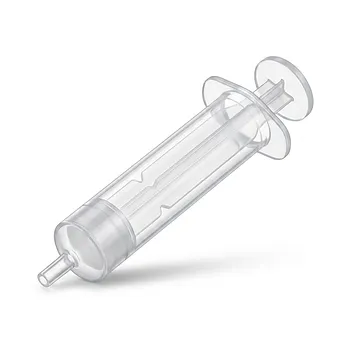
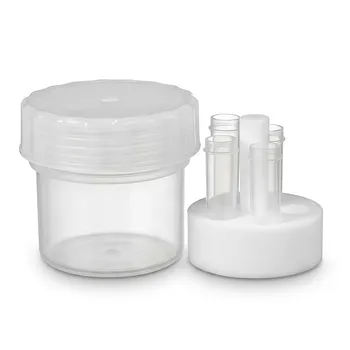
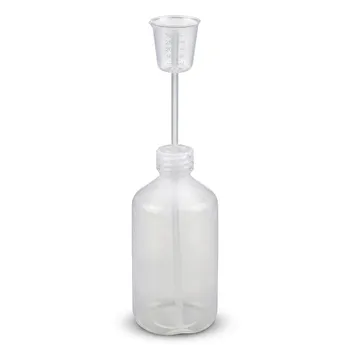
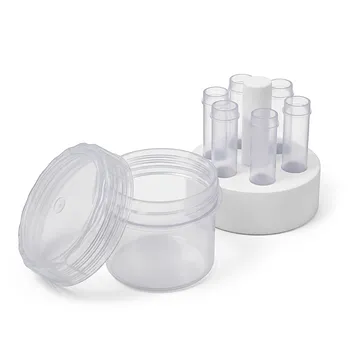
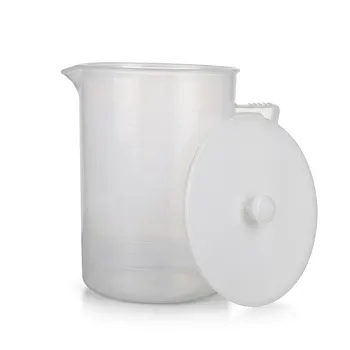
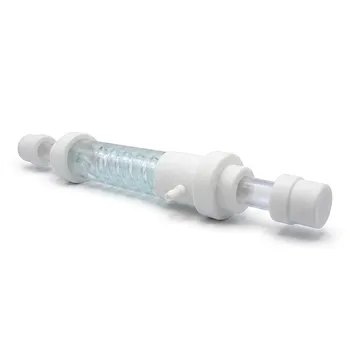
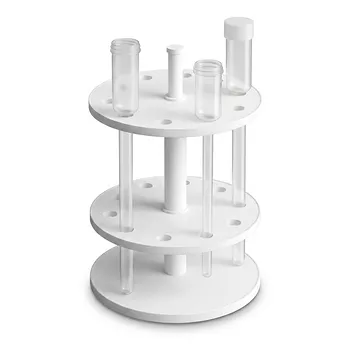
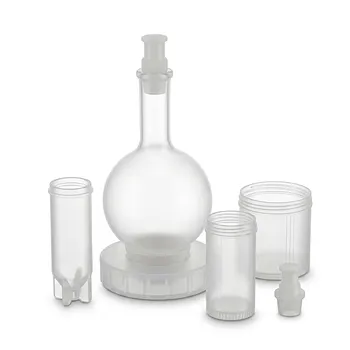
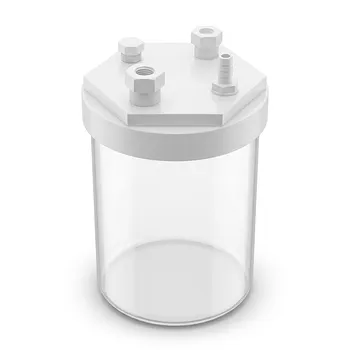
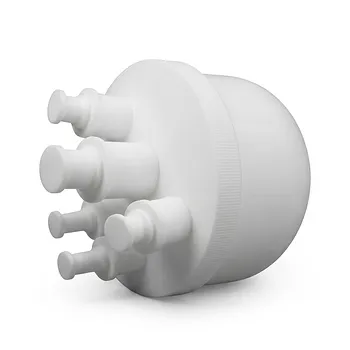
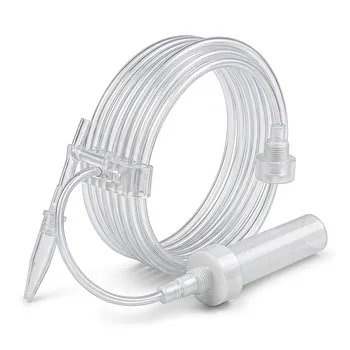
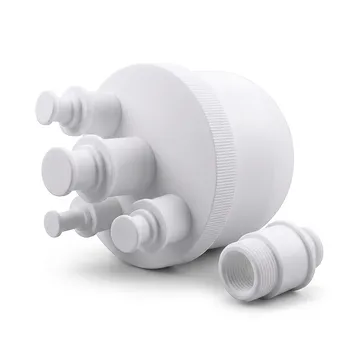
High iodide chain-end functionality above 95% makes fluoropolymer block copolymerization substantially more predictable and efficient. It means that most polymer chains retain an iodine-bearing, reactivatable end group for incorporation of a second block, while minimizing dead homopolymer that cannot participate in further growth. Chemically inert PTFE and PFA tubing, valves, fittings, and containers help preserve this performance by containing reactive initiators, transfer agents, monomers, and fluorinated solvents without introducing contamination, leaks, or stoichiometric loss.
The central advantage is architectural control: high iodide functionality gives nearly every polymer chain a usable starting point for block extension, while compatible fluoropolymer fluid-handling hardware protects the reaction conditions required to achieve and maintain that functionality.
Why Iodide Functionality Controls Block Formation
Active chain ends enable sequential growth
In iodine transfer polymerization, perfluoroalkyl iodides such as C6F13I can act as chain transfer agents because their carbon-iodine bonds are relatively easy to cleave thermally or through radical reactions.
The resulting iodine-terminated fluoropolymer chains can be reactivated during a later polymerization stage. This allows a secondary fluorinated or compatible polymer block to grow from the original chain rather than forming independently.
High functionality improves block copolymer yield
A total iodide chain-end functionality above 95% indicates that more than 95% of the synthesized chains retain the intended iodine end group.
Consequently, most chains have the potential to become block copolymers. The process is less dominated by unreactive chains that remain as homopolymer impurities.
End-group identity matters
The presence of iodine alone does not guarantee equivalent reactivity. In the cited chemistry, -CF2-I termini are reactivatable, whereas less reactive -CH2-I termini may remain inactive during block extension.
Therefore, functionality should be evaluated together with end-group structure. A high total iodine measurement can overstate practical block-forming capability if a significant fraction of the iodine is attached in a nonreactive configuration.
How High Functionality Changes the Final Material
It reduces dead homopolymer
Irreversible termination creates polymer chains without a usable reactive end. Those chains cannot efficiently accept a second block and remain as dead homopolymer in the final product.
At greater than 95% functionality, this impurity pathway is reduced, although the remaining inactive fraction can still matter in demanding applications or when high block purity is required.
It improves molecular architecture
A high proportion of active ends supports more consistent synthesis of defined architectures, including linear block copolymers, graft structures, star polymers, and hyperbranched materials.
The architecture is controlled more effectively because a larger fraction of the starting chains follows the intended sequence of activation and growth.
It supports more uniform properties
Block composition, molecular-weight distribution, crystallinity, melting behavior, and processability are influenced by chain architecture and polymerization history.
Improved end-group fidelity helps ensure that measured properties reflect the designed block structure rather than an uncontrolled mixture of block copolymer and nonfunctional homopolymer.
What the Fluid-Handling System Must Protect
Reactive chemistry requires compatible containment
Controlled radical polymerization of fluorinated monomers may involve photo-initiators, organometallic reagents, iodine-containing transfer agents, and fluorinated solvents.
The fluid path must resist chemical attack and avoid releasing extractables into the reaction. PTFE and PFA are useful materials for tubing, valves, fittings, transfer lines, and high-purity containers because of their broad chemical resistance and low-contamination behavior.
Leak prevention protects stoichiometry
Small leaks or permeation losses can change the relative amounts of monomer, transfer agent, initiator, solvent, or catalyst.
That matters directly to chain-end functionality. If the intended transfer-agent or initiator ratio changes, the process may generate more incorrectly terminated or inactive chains and produce less predictable block growth.
Low contamination supports reproducibility
Trace contamination can interfere with radical reactions, deactivate reactive species, or introduce foreign nucleation and termination pathways.
Clean, chemically resistant fluid-handling components reduce the risk that the equipment becomes a source of impurities. This is especially important when preparing high-purity polymers for analytical, energy, or specialized laboratory applications.
Precision components support controlled processing
Thermoplastic fluoropolymers such as PFA can be molded or machined into precision tubing, fittings, valves, vessels, and reaction equipment.
This combines chemical resistance with practical manufacturability, allowing fluid paths to be configured for controlled transfer, sampling, solvent exchange, and purification without sacrificing high-purity performance.
Understanding the Trade-offs
High functionality is not complete functionality
A value above 95% is strong, but it still implies that a minority of chains may be inactive or improperly terminated.
For sensitive block architectures, that minority can affect composition, molecular-weight distribution, phase behavior, and purification requirements. The acceptable level depends on the performance specification of the final material.
Total iodine can hide reactive-end differences
Analytical results that report only total iodide functionality may not distinguish highly reactivatable -CF2-I ends from less useful -CH2-I ends.
End-group characterization should therefore address both the amount and chemical identity of the terminal groups when block-extension performance is critical.
Fluoropolymer compatibility is process-specific
PTFE and PFA are broadly resistant materials, but no equipment material should be selected from a generic compatibility label alone.
The actual monomer, solvent, organometallic reagent, temperature, pressure, exposure time, mechanical stress, and connection design must be evaluated. Seals, gaskets, valve internals, and fittings may have different compatibility limits from the primary tubing material.
Hardware does not replace process control
Inert fluid handling prevents avoidable contamination and loss, but it cannot correct poor reaction design or incomplete purification.
The polymerization still requires control of transfer-agent concentration, initiation, temperature, exposure conditions, mixing, and removal of unreacted low-molecular-weight species. Selective solvent extraction, such as acetone washing where chemically appropriate, can help remove nonfunctional or unreacted fractions.
Making the Right Choice for Your Goal
Select the emphasis based on what the process must achieve:
- If your primary focus is block-copolymer yield: Maintain iodide functionality above 95% and verify that the retained end groups are the reactivatable type needed for secondary block growth.
- If your primary focus is architectural precision: Control end-group identity, molecular-weight distribution, and reaction stoichiometry together rather than relying on total iodine content alone.
- If your primary focus is reaction purity: Use qualified PTFE or PFA fluid paths, high-purity containers, and compatible seals to limit contamination, leakage, and reagent loss.
- If your primary focus is high-purity applications: Combine controlled polymerization with appropriate solvent extraction and analytical verification to remove dead homopolymer and low-molecular-weight species.
High iodide functionality defines what the polymer chains can become, while disciplined fluoropolymer fluid handling helps ensure that the process actually delivers that intended structure.
Summary Table:
| Aspect | Impact of High Iodide Functionality (>95%) | Role of Fluoropolymer Fluid Handling |
|---|---|---|
| Chain-end reactivity | Most chains retain reactivatable -CF2-I ends | Prevents contamination that could deactivate ends |
| Block copolymer yield | Higher conversion to block copolymers, less dead homopolymer | Maintains stoichiometry of transfer agents and monomers |
| Architecture control | Enables precise linear, graft, or star structures | Provides clean, inert surfaces to avoid side reactions |
| Material properties | Uniform composition and molecular weight distribution | Ensures reproducibility across batches |
| Purity | Reduced inactive chains, but minority may remain | Low-extractable materials avoid introducing impurities |
| Process reliability | Requires control of end-group identity and stoichiometry | Leak-tight components preserve reaction conditions |
Unlock the full potential of your fluoropolymer synthesis with KINTEK's high-purity PTFE/PFA fluid handling components. Our extensive range of tubing, valves, fittings, and custom-machined parts ensures chemical inertness, leak-proof performance, and minimal contamination—critical for achieving >95% iodide functionality and precise block copolymers. Whether you need standard labware or bespoke reaction systems, our end-to-end CNC machining capabilities deliver exactly what you need. Contact us today to discuss your requirements and elevate your polymerization processes.
Related Products
- Corrosion Resistant High Purity PFA Valve and Weldable Transparent Tubing for Semiconductor Fluid Transfer
- High Purity PFA PTFE Flare Stop Valves Customizable 2-Way 3-Way Reducing Fluoropolymer Fluid Control Solutions
- Custom PTFE Valve 2-Way 3-Way Corrosion Resistant Low Background Virgin Fluoropolymer Industrial Fluid Control
- Corrosion Resistant PFA Syringe Translucent Visual Fluoropolymer Labware 10ml Chemical Handling Tool
- Corrosion Resistant PTFE Support with PFA Transparent Reaction Tank and High Purity PFA Sampling Tube for Trace Analysis
People Also Ask
- Why are high-purity PFA fluid transfer components preferred for battery electrolytes? Ensure Purity & Data Accuracy
- How do high-precision PFA fluid transfer components, such as tubing and fittings, affect the results of continuous-flow synthesis?
- How do PFA fluid transfer components contribute to chemical research precision? Achieve high-purity results today.
- What role do PFA tubing and valves play in high-precision laboratory fluid transfer systems? Ensure Ultra-Pure Results
- What advantages do PTFE and PFA tubing offer for organic solvents? Superior chemical resistance, purity, and high-temperature stability.