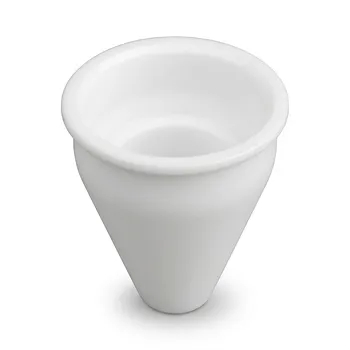
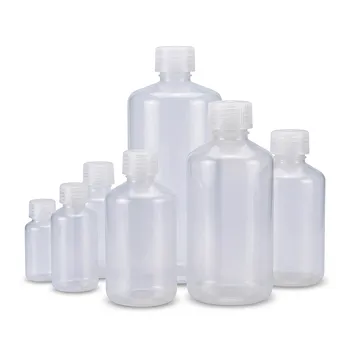
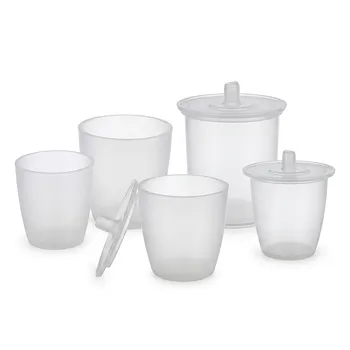
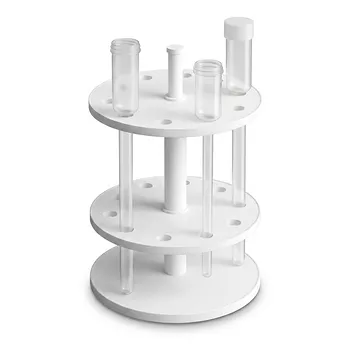
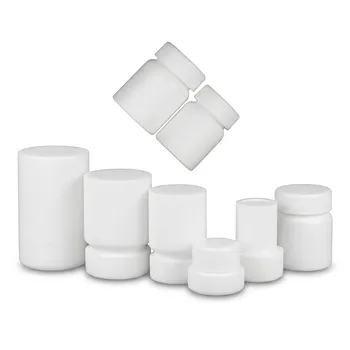
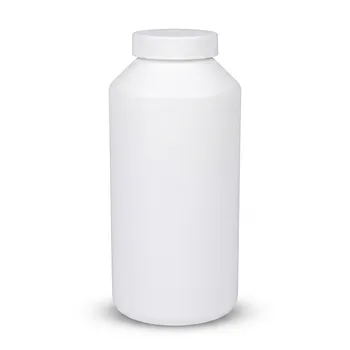
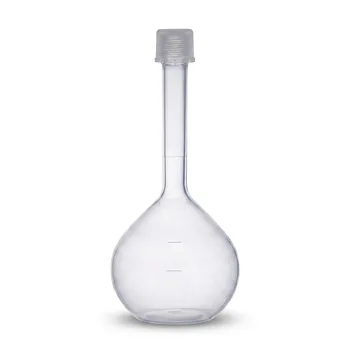
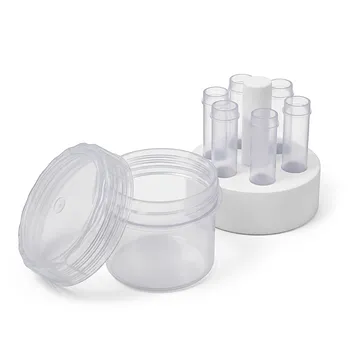
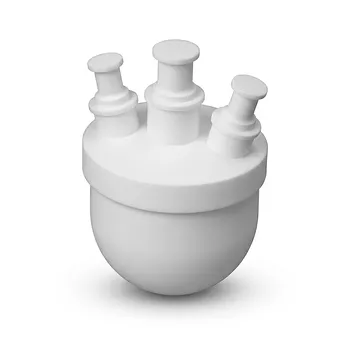
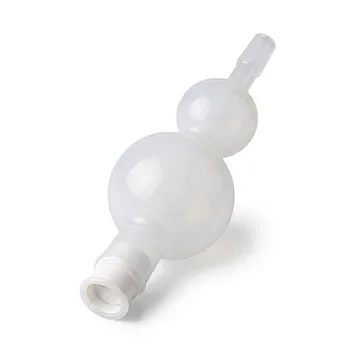
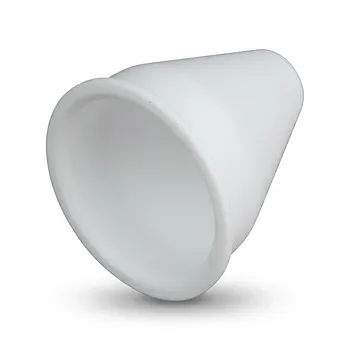
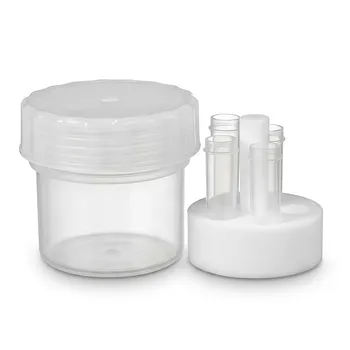
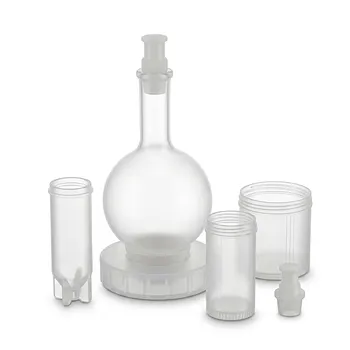
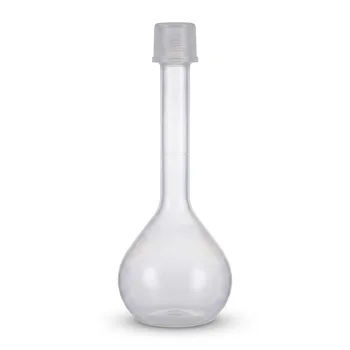
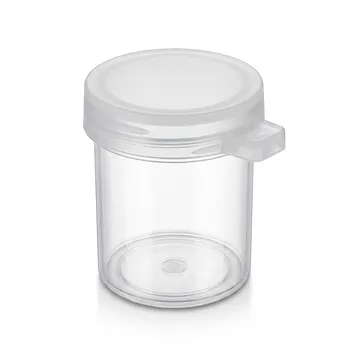
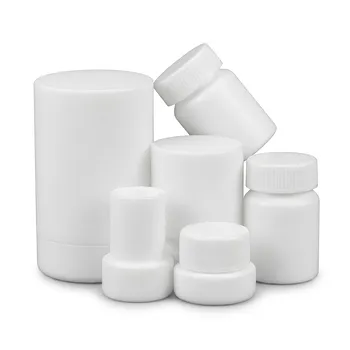
The non-contaminating behavior of fluoropolymer trace-analysis containers comes from the combined effects of bulky, tightly packed -CF3 groups, very low surface energy, and unusual electronic stability. Their large van der Waals dimensions create a fluorine-rich outer surface that is difficult for water, ions, and many analytes to wet or penetrate. At the same time, the groups' high fluorophilicity, low polarizability, and strong electron-withdrawing character reduce surface interactions, helping minimize adsorption, droplet retention, cross-contamination, and background contribution.
The key principle is surface control: when densely packed -CF3 groups dominate the outermost molecular layer, the container becomes highly non-wetting and chemically unreactive, so trace samples are less likely to bind to the wall or acquire contamination from it.
Why -CF3 Groups Create a Clean Surface
Large van der Waals Dimensions Reduce Accessible Contact
A trifluoromethyl group has a substantial van der Waals radius, approximately 2.7, and a volume of about 42.6. The fluorine atoms therefore form a bulky molecular sheath around the polymer backbone.
This sheath limits the ability of ions, polar molecules, and larger analyte species to approach the underlying carbon framework. The surface presents a sterically crowded, fluorine-rich interface rather than exposed reactive sites.
Tight Fluorine Packing Shields the Polymer
Fluorine atoms pack closely around the polymer structure and shield it from direct contact with the sample. This reduces opportunities for hydrogen bonding, ionic association, and other short-range interactions that can cause analytes to adhere.
The effect is similar to placing a dense protective covering over a surface: the chemically less accessible layer controls how the liquid interacts with the material beneath it.
The Outermost Groups Determine Wetting
Surface behavior is governed primarily by the chemical groups exposed at the outermost molecular layer. Fluorinated terminal groups lower surface energy much more effectively than hydrocarbon groups.
The relative trend is:
-CH3 > -CH2- > -CF2- > -CF3
Densely ordered -CF3 groups can produce surface free-energy values as low as 6-10 mN/m, compared with approximately 30-35 mN/m for conventional unfluorinated polymers.
How Lipophilicity and Low Surface Energy Limit Contamination
Hydrophobicity Reduces Aqueous Retention
The low surface energy of fluoropolymer surfaces produces high water repellency and contact angles commonly reported in the range of 92° to 97.3° for materials with high pendant -CF3 density.
Water-based samples therefore spread less readily across the container wall. Fewer droplets remain behind after pouring, pipetting, or draining, which improves liquid recovery and reduces carryover between samples.
Lipophobicity Matters Alongside Lipophilicity
The term lipophilicity requires careful interpretation for fluorinated materials. A -CF3 group is strongly hydrophobic and has a strong affinity for fluorinated environments, but fluoropolymer surfaces are generally also lipophobic, meaning they resist wetting and adhesion by many oils and hydrocarbons.
This combination is important in trace analysis because the surface does not readily absorb either aqueous samples or many organic contaminants. The practical result is low analyte retention across a broad range of sample matrices.
Low Adhesion Supports More Complete Cleaning
Fluoropolymer surfaces exhibit anti-adhesive behavior, low friction, and low solubility in many organic solvents and hydrocarbons. Contaminants are therefore less likely to become strongly attached or absorbed into the surface.
Cleaning can remove residual material more effectively when the sample does not form a persistent interfacial film. However, cleaning performance still depends on the contaminant, cleaning chemistry, temperature, contact time, and the condition of the container.
How Electronic Properties Suppress Surface Interactions
Strong Electronegativity Lowers Chemical Reactivity
Fluorine is highly electronegative, and the C-F bonds in fluorinated groups are strongly stabilized. This contributes to the chemical non-reactivity and oxidative resistance associated with fluoropolymers.
A chemically inert surface provides fewer reactive sites for analyte transformation, surface attack, or formation of strongly bound residues.
The Inductive Effect Reduces Local Reactivity
The -CF3 group exerts a strong electron-withdrawing inductive, or -I, effect. By drawing electron density away through the molecular framework, it reduces the tendency of nearby sites to participate in ionic or polar interactions.
This helps explain why many ionic species and trace contaminants show limited affinity for a well-formed fluoropolymer surface. The effect is not that every ion is categorically unable to bind, but that the surface offers few favorable binding environments.
Low Polarizability Weakens Dispersion Interactions
Despite its high fluorine content, a fluoropolymer surface has relatively low polarizability compared with many hydrocarbon-rich or aromatic surfaces. Its electron cloud is difficult to distort.
That reduces attractive dispersion and induced-dipole interactions with many organic molecules. Lower interaction strength generally means less adsorption and easier removal during rinsing.
Why This Matters in Trace Analysis
Lower Adsorption Preserves Analyte Recovery
At ultra-trace concentrations, even a small amount of analyte retained on a vessel wall can produce a significant recovery error. The non-wetting and anti-adhesive character of -CF3-rich surfaces helps keep analytes in the liquid phase.
This is particularly valuable for reagent bottles, digestion vessels, sample tubes, and fluid-transfer components used before instrumental analysis.
Lower Background Supports Better Detection
A suitable fluoropolymer container can contribute very little background through analyte adsorption, moisture uptake, or chemical degradation. This helps preserve low detection limits and improves confidence that a measured signal originates from the sample rather than the vessel.
Claims of “near-zero” background should still be treated as application-specific. Manufacturing residues, fillers, pigments, machining debris, handling, and extractable species can affect actual blank performance.
Reduced Droplet Retention Limits Cross-Contamination
When droplets do not cling to the wall, less material remains available to contaminate the next sample. This improves transfer efficiency and reduces memory effects in repeated workflows.
The benefit is strongest when the container is properly cleaned, dried, and matched to the sample chemistry.
Understanding the Trade-offs
Surface Cleanliness Is Not Only a Molecular Property
The presence of -CF3 groups does not guarantee a contaminant-free container. Surface roughness, scratches, additives, welds, molding conditions, and manufacturing cleanliness can create physical locations where particles or residues remain.
Trace-analysis performance must therefore be verified through procedural blanks, extractables testing, and recovery studies rather than inferred from polymer composition alone.
Low Adsorption Does Not Mean Zero Interaction
Fluoropolymer surfaces strongly reduce many adsorption mechanisms, but specific analytes can still interact through physical entrapment, unusual solubility behavior, particulate attachment, or contamination introduced during handling.
Highly concentrated samples, surfactants, aggressive solvents, and long contact times may also change the observed recovery behavior.
Bulky -CF3 Groups Can Alter Bulk Transport
The steric volume of -CF3 groups can increase fractional free volume in some polymer architectures. This may increase gas diffusion and permeability, potentially by several-fold depending on the polymer and gas.
For sealed reagent storage or volatile-sensitive applications, the complete material design must therefore be considered. The same molecular features that improve hydrophobicity and chemical resistance can influence gas and vapor transport.
Material Selection Must Match the Workflow
Different fluoropolymers have different crystallinity, morphology, processing histories, additives, and extractable profiles. A container selected for acid digestion may not be the best choice for long-term storage of a volatile organic standard.
Compatibility, temperature, sterilization or cleaning procedures, blank levels, and mechanical requirements should all be evaluated together.
Making the Right Choice for Your Goal
The molecular behavior of -CF3 groups is most useful when translated into application-specific validation criteria.
- If your primary focus is maximum analyte recovery: Choose a smooth, clean fluoropolymer surface with high exposed fluorinated-group density, then verify performance using matrix-matched recovery tests.
- If your primary focus is low contamination and blank levels: Prioritize low-extractable, trace-qualified labware and confirm it with procedural blanks rather than relying only on the polymer label.
- If your primary focus is rapid cleaning and low carryover: Use the material's low-energy, non-wetting surface to reduce retention, while validating the full cleaning protocol against the actual analytes.
- If your primary focus is long-term reagent or standard storage: Evaluate chemical compatibility together with gas permeability, temperature exposure, closure design, and potential extractables.
Understanding the exposed fluorinated surface, not merely the presence of fluorine in the polymer, is the basis for selecting containers that preserve trace-level sample integrity.
Summary Table:
| Property | Description | Impact on Surface Cleanliness |
|---|---|---|
| van der Waals dimensions | Large volume (~42.6 ų) and radius (~2.7 Å) | Forms a bulky fluorine-rich layer that limits contact with analytes |
| Lipophilicity | Hydrophobic and lipophobic | Reduces wetting and adhesion of both aqueous and organic substances |
| Electronic properties | Strong electronegativity, -I effect, low polarizability | Reduces reactivity and dispersion interactions with contaminants |
| Surface energy | As low as 6-10 mN/m with dense -CF3 groups | Improves non-wetting and droplet repellency |
Enhance your trace analysis with ultra-clean PTFE and PFA labware from KINTEK. Our high-performance fluoropolymer products minimize contamination and maximize recovery. Contact us today to find the perfect solution for your lab — Get in touch!
Related Products
- Custom Machined PTFE Conical Sample Cell Corrosion Resistant Triangular Fluoropolymer Container for Trace Analysis
- Semiconductor Electronic Grade PFA Sampling Bottle for Ultrapure Reagent Storage and Trace Analysis
- High Purity PFA Crucible and Corrosion Resistant PTFE Beaker for Trace Analysis and Custom Laboratory Applications
- Custom PFA Micro Column Rack and PTFE Machined Storage Solutions for Trace Analysis
- PTFE Small Reaction Bottle Corrosion Resistant Teflon Sample Dissolution Tank One Piece Molded Fluoropolymer Storage Container
People Also Ask
- What customization options are available for PTFE materials? Tailor Performance for Your Application
- How do Polytetrafluoroethylene (PTFE) containers perform regarding gas permeation? Expert Insights on Solvent Absorption
- What are some common applications of machined PTFE? Leverage its Unique Properties for Demanding Applications
- How are PTFE laboratory containers and apparatus typically manufactured? Inside the Precision Machining Process
- What inherent material characteristics of non-melt-processable PTFE make it suitable for manufacturing high-purity laboratory containers and custom-machined apparatus?