PFCA aryl ether networks combine unusually high thermal stability with low dielectric response, but their performance should be compared with PTFE and PFA using consistent temperature definitions. PFCA networks such as OFCP-derived materials can reach 5% decomposition temperatures of up to 445 °C in nitrogen, with glass-transition temperatures above 260 °C. PTFE and PFA generally offer lower practical continuous-use limits—about 260 °C—although PTFE can remain remarkably stable at higher temperatures before rapid decomposition.
Core takeaway: PFCA networks provide a higher measured decomposition threshold and higher structural-use temperature than conventional melt-processable fluoropolymers, while PTFE and PFA generally have lower dielectric constants—approximately 2.0–2.1, compared with 2.5–5.7 for PFCA networks. Their chemical inertness, low contamination potential, and low dielectric background make PTFE and PFA particularly suitable for high-purity synthesis, sample preparation, and electrical characterization.
How the Thermal Stability Compares
PFCA networks have a high decomposition threshold
Crosslinked PFCA aryl ether networks derived from monomers such as OFCP show Td5% values up to approximately 445 °C under nitrogen.
Their Tg values above 260 °C are also significant. The material can remain glassy and dimensionally stable well beyond the operating range of many conventional polymers.
Because these networks are crosslinked, they do not simply soften and flow like a typical melt-processable fluoropolymer. This can improve dimensional stability during high-temperature electrical or chemical testing.
PTFE and PFA are normally limited by continuous-use temperature
PTFE and PFA are commonly specified for continuous operation near 260 °C, or approximately 500 °F.
This rating is not the same as a Td5% value. Continuous-use temperature describes long-term service capability, whereas Td5% identifies the temperature at which a specified mass loss—typically 5%—occurs under a particular thermogravimetric test atmosphere.
PTFE generally has the greater extreme-temperature margin
PTFE has a melting range of approximately 320–340 °C, while PFA melts at roughly 302–310 °C.
PTFE also tends to retain greater stability at very high temperatures. The reference data indicate minimal PTFE weight loss up to approximately 500 °C, followed by rapid decomposition above about 525 °C under relevant test conditions.
PFA maintains excellent thermal performance but can degrade faster than PTFE at approximately 400–425 °C, partly because its perfluoroalkyl ether side chains are more susceptible to high-temperature degradation.
The comparison depends strongly on the test atmosphere
The PFCA 445 °C Td5% value is reported in nitrogen, an inert atmosphere. Fluoropolymer decomposition behavior can differ substantially in air, nitrogen, vacuum, or other environments.
For design decisions, compare materials using the same:
- Atmosphere
- Heating rate
- Sample form
- Decomposition criterion
- Exposure duration
- Mechanical-load condition
A single Td5% number should not be treated as a universal maximum operating temperature.
How the Dielectric Constants Compare
PFCA networks have low but variable dielectric constants
PFCA aryl ether networks show dielectric constants from approximately 2.5 to 5.7 across radio frequencies.
That range is still low compared with many engineering polymers, ceramics, and polar organic materials. However, it is broader and generally higher than the dielectric response of fully fluorinated PTFE and PFA.
The variation can reflect network structure, frequency, crosslink density, residual impurities, moisture, porosity, and measurement configuration.
PTFE and PFA generally provide the lower dielectric baseline
PTFE and PFA are known for very low dielectric constants and low dielectric loss. Typical values are near 2.0–2.1, depending on frequency, crystallinity, density, temperature, and measurement method.
This gives PTFE and PFA an advantage when the laboratory component itself must contribute as little electrical signal as possible.
A low dielectric constant is not the same as zero electrical influence
PTFE and PFA can minimize dielectric background, but no physical fixture is completely invisible to an electrical measurement.
The measured result can still be affected by:
- Component geometry
- Distance from the active field
- Surface contamination
- Air gaps
- Fringing fields
- Fixture alignment
- Temperature-dependent dimensional changes
High-purity fluoropolymer components are therefore best understood as low-background materials, not perfectly background-free materials.
Why Chemical Inertness Matters in Laboratory Components
Fully fluorinated backbones resist aggressive chemistry
PTFE and PFA contain highly fluorinated carbon backbones. The surrounding fluorine atoms shield the carbon framework and provide strong resistance to acids, solvents, and corrosive reagents.
The strength of the carbon–fluorine bond is a major contributor to this behavior. As a result, these materials are less likely than many alternatives to swell, dissolve, corrode, or release extractable contaminants.
Chemical inertness protects sample integrity
During synthesis or purification of PFCA networks, aggressive reaction solvents can attack ordinary polymer vessels, seals, or fixtures.
PTFE and PFA labware reduces the likelihood that the container will introduce:
- Dissolved organic contaminants
- Metallic ions
- Corrosion products
- Plasticizers
- Particulates
- Reaction by-products from the vessel itself
This is especially important for trace analysis, high-purity synthesis, and dielectric measurements where small impurities can alter the result.
PFA is useful for complex molded components
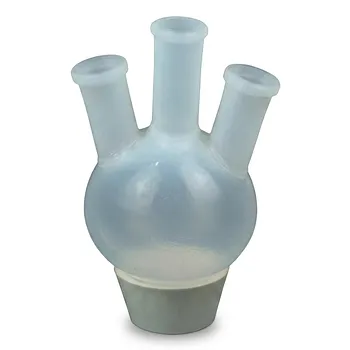
PFA is melt-processable and can be formed into intricate, transparent, high-purity shapes.
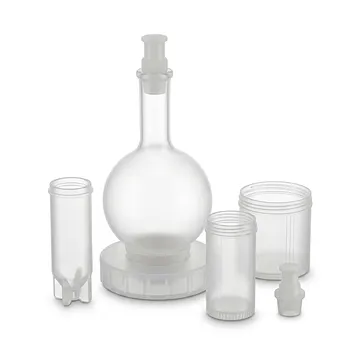
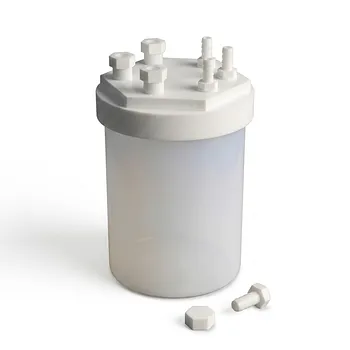
That makes it well suited for items such as chemical dishes, storage vessels, cleaning tanks, tubing, fittings, and custom laboratory containers where complex geometry is required.
PTFE is useful for machining and extreme chemical exposure
PTFE is commonly selected for chemically demanding components and custom-machined fixtures.
It provides excellent chemical resistance and a higher ultimate thermal margin than PFA, although its lower hardness and relatively soft surface can make it more vulnerable to deformation, scratching, or dimensional creep under load.
Why These Materials Suit Electrical Characterization
They reduce dielectric background
When measuring the dielectric properties of a PFCA network, the test fixture must not dominate the signal.
PTFE and PFA contribute a relatively small dielectric response because their dielectric constants and dielectric losses are low. This helps isolate the response of the test specimen.
They resist the solvents used during preparation
Electrical test samples may require cleaning, swelling, solvent exchange, or chemical conditioning before measurement.
PTFE and PFA can tolerate many aggressive chemical environments without significant attack, helping maintain consistent sample preparation and fixture cleanliness.
They support repeatable handling
High-purity labware made from PTFE or PFA is unlikely to react with the sample or absorb substantial quantities of many laboratory chemicals.
This supports repeatable preparation, especially when the goal is to compare dielectric constants across frequency or between different polymer-network formulations.
Understanding the Trade-offs
PFCA networks are not automatically superior in every category
PFCA networks can provide a higher Td5% and higher Tg than PTFE or PFA, but their dielectric constants may be higher and more variable.
They may also require more complex synthesis, curing, purification, and process control than conventional fluoropolymer labware.
PTFE and PFA have practical temperature limits
Although PTFE and PFA can withstand short-term exposure to temperatures above their continuous-use ratings, prolonged exposure near or above those limits can cause creep, embrittlement, dimensional change, or decomposition.
Components should not be rated solely from melting point or a high-temperature TGA result.
Decomposition products require control
Overheating fluoropolymers can generate hazardous decomposition products and may contaminate samples or laboratory equipment.
Use ventilation, temperature controls, and material-specific operating limits. Do not treat a fluoropolymer's high melting or decomposition temperature as permission for uncontrolled heating.
Mechanical performance can limit the design first
PTFE and PFA are chemically robust but not especially hard or mechanically rigid compared with many partially fluorinated engineering polymers.
Under pressure, clamping force, or elevated temperature, creep and deformation may become more important than chemical resistance or dielectric performance.
Making the Right Choice for Your Goal
The best material depends on whether the priority is maximum thermal stability, minimum dielectric background, chemical compatibility, or manufacturability.
- If your primary focus is maximum thermal stability: Consider a crosslinked PFCA aryl ether network, which can provide Td5% values up to approximately 445 °C in nitrogen and Tg values above 260 °C.
- If your primary focus is minimum dielectric background: Prefer PTFE or PFA, whose dielectric constants are typically around 2.0–2.1 and whose dielectric loss is very low.
- If your primary focus is aggressive chemical handling: Use high-purity PTFE or PFA labware because their fully fluorinated structures resist acids, solvents, and contamination.
- If your primary focus is intricate molded laboratory hardware: Choose PFA, which combines near-PTFE chemical resistance with melt-processability.
- If your primary focus is custom-machined electrical fixtures: Choose PTFE when chemical resistance and low dielectric interference outweigh its lower hardness and tendency to creep.
- If your primary focus is reliable high-temperature operation: Design around the approximately 260 °C continuous-use limit for PTFE and PFA, rather than their much higher short-term melting or decomposition thresholds.
The practical choice is straightforward: use PFCA networks for high-temperature, crosslinked dielectric structures, and PTFE or PFA for chemically inert, low-background laboratory hardware and fixtures.
Summary Table:
| Property | PFCA Networks | PTFE | PFA |
|---|---|---|---|
| Td5% (N2) | ~445°C | ~525°C (rapid decomposition) | ~400-425°C (faster degradation) |
| Tg | >260°C | ~130°C (non-crosslinked) | ~-7°C (non-crosslinked) |
| Continuous Use Temp | ~260°C (structural) | ~260°C | ~260°C |
| Dielectric Constant | 2.5-5.7 | 2.0-2.1 | 2.0-2.1 |
| Chemical Inertness | Moderate (depends on structure) | Excellent | Excellent |
| Processability | Crosslinked, not melt-processable | Not melt-processable; machined | Melt-processable |
Looking for high-performance fluoropolymer labware? At KINTEK, we specialize in PTFE and PFA products exclusively dedicated to high-performance applications. From basic labware to complex custom-machined parts, our components offer superior chemical resistance, low dielectric constant, and high purity for your most demanding tasks. Whether you are a researcher or a distributor, we provide OEM/ODM support, certifications, and reliable supply. Contact us today to discuss your needs and discover how our solutions can enhance your lab's performance. Contact us now!
Related Products
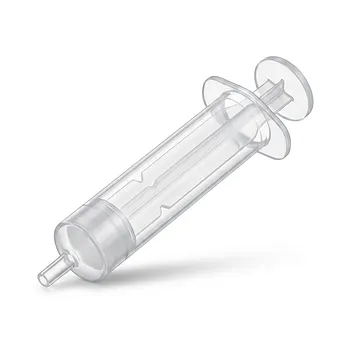
- Corrosion Resistant PFA Syringe Translucent Visual Fluoropolymer Labware 10ml Chemical Handling Tool
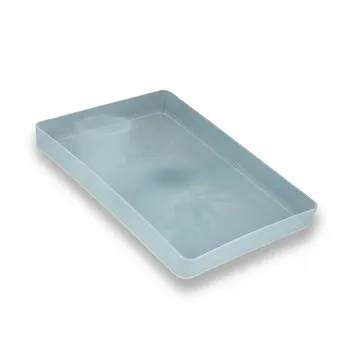
- Customizable PFA Square Tray Corrosion Resistant High Temperature Large Petri Dish Electrolytic Cell
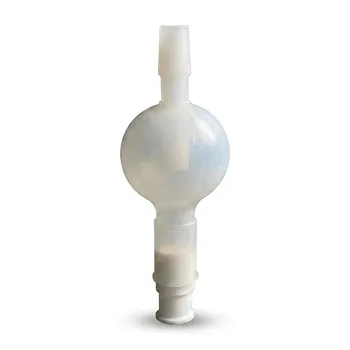
- High Purity PFA Chromatography Column with Collection Bottle Corrosion Resistant Fluoropolymer Filtration System for Trace Analysis
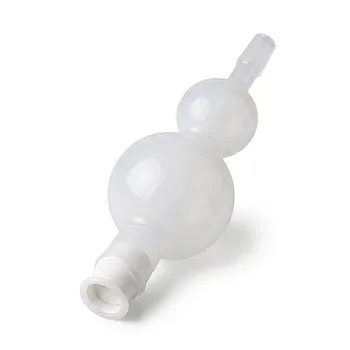
- High Purity PFA Chromatography Columns and Collection Bottles Corrosion Resistant Fluoropolymer Filtration Systems for Trace Analysis
- Custom PFA Tubing 1/4 Inch High Purity Corrosion Resistant Fluoropolymer Tube with Welding and Machining Services
People Also Ask
- How does the incorporation of comonomers such as perfluoropropyl vinyl ether (PPVE) alter the molecular structure and processing characteristics of TFE-based fluoropolymers like PFA compared to standard PTFE?
- Why do PFA fluoropolymer laboratory products offer different melt-processability and structural toughness compared to standard PTFE labware?
- PFA vs FEP: Which is Better for High-Temperature Lab Equipment?
- How does the removal of C8 (APFO) processing aids impact the chemical purity of solid fluoropolymer laboratory tools and fluid handling products? Discover the key benefits of C8-free PTFE, PFA, and FEP for trace analysis and high-purity applications.
- How does increasing fluorine content affect the physical and chemical performance of fluoropolymer laboratory supplies and components?