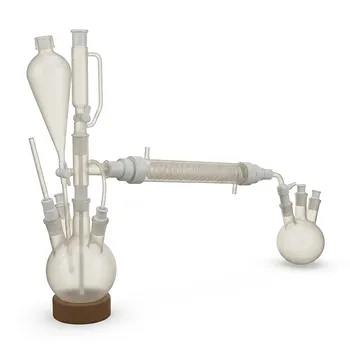
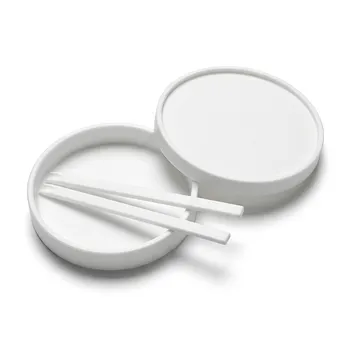
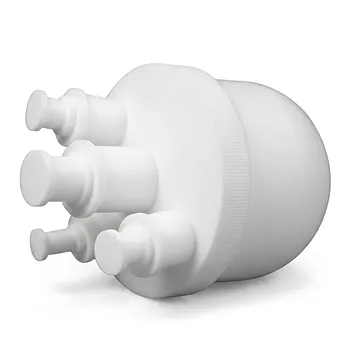
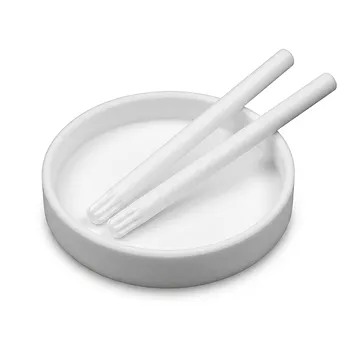
At elevated temperatures, labware must be selected for both chemical inertness and thermal durability. Perfluorinated compounds resist acids, bases, oxidizing agents, and thermal attack because of their strong carbon-fluorine bonds, but the fluoropolymer labware used to contain them has its own temperature limits. PTFE and PFA can minimize wall-catalyzed reactions and contamination, yet neither should be treated as automatically suitable for continuous exposure above 300°C.
Chemical inertness makes fluoropolymers attractive for demanding experiments, while their temperature-dependent mechanical stability determines whether they are appropriate. Select labware based on the actual temperature profile, exposure duration, pressure, and risk of decomposition products, not on chemical resistance alone.
Why Perfluorinated Compounds Require Careful Labware Selection
Strong bonds do not eliminate surface effects
Perfluorinated compounds contain highly stable carbon-fluorine bonds and are generally resistant to aggressive chemical environments. However, a hot silica or borosilicate surface can still influence reaction pathways through adsorption, surface acidity, catalytic activity, or localized heat transfer.
At temperatures above approximately 300°C, these effects can become significant in thermal-degradation and thermolysis studies. A vessel that is chemically compatible under ordinary conditions may therefore produce misleading results when its surface participates in the reaction.
Conventional glass can compromise experimental fidelity
Glass is often useful because it is transparent, readily available, and chemically resistant to many reagents. It is not universally inert, however, particularly when a study is intended to measure the intrinsic thermal behavior of a fluorinated compound.
Glass surfaces may promote unintended wall reactions or alter decomposition products. If the objective is mechanistic or trace-level analysis, even a small surface contribution can be mistaken for a property of the compound itself.
How Fluoropolymer Properties Guide the Choice
PTFE prioritizes extreme chemical resistance
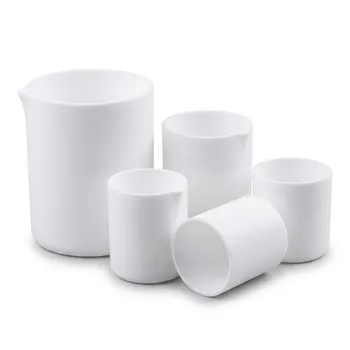
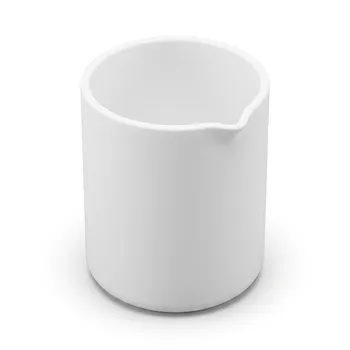
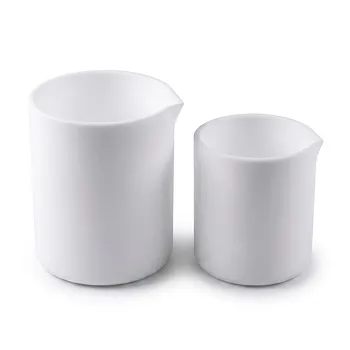
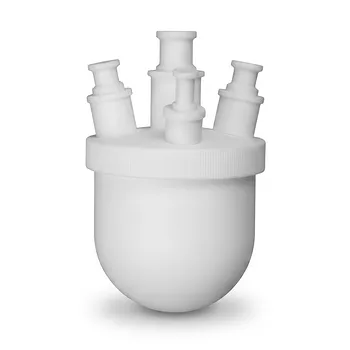
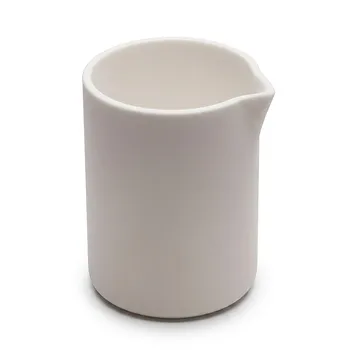
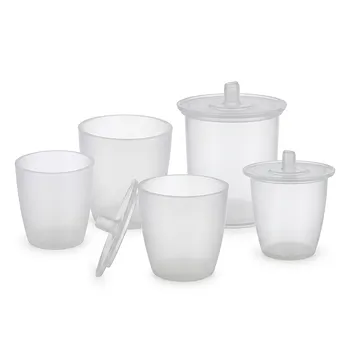
PTFE provides very high chemical inertness, low volatility, low friction, and strong resistance to oxidative and reagent attack. It is therefore useful for digestion vessels, crucibles, tubing, storage components, and custom-machined parts where chemical contamination is the primary concern.
PTFE is generally the stronger candidate for prolonged exposure near the upper end of the fluoropolymer temperature range. Supplementary data indicate substantially lower weight loss for PTFE than PFA after thermal equilibration between 400°C and 425°C.
PFA adds purity and transparency
PFA offers comparable chemical inertness with advantages in high purity, optical transparency, and melt-processability. These properties make it useful where visual monitoring, low contamination, or complex molded geometries are important.
PFA can tolerate short-term high-temperature exposure during processing, with reported processing capability extending to approximately 425-445°C. That processing limit should not be confused with a safe continuous-use temperature for finished laboratory equipment.
Thermal endurance is time-dependent
A material can survive a brief temperature excursion while failing during a long isothermal hold. PFA may experience faster weight loss than PTFE during prolonged exposure near 400-425°C, even though it can tolerate short processing periods at similar temperatures.
The relevant question is therefore not simply, “What is the maximum temperature?” It is, “How long will the material remain at that temperature, under what load, and in contact with which chemicals?”
Matching Labware to the Testing Regime
For moderate elevated-temperature testing
PTFE or PFA labware can be appropriate when temperatures remain within the manufacturer’s validated service range and the vessel is not exposed to excessive mechanical stress. Their chemical inertness helps suppress leaching, corrosion, and wall-mediated reactions.
PFA is particularly useful when sample visibility or high-purity handling matters. PTFE is often preferable when prolonged chemical exposure and dimensional stability are more important than transparency.
For prolonged exposure near 400°C
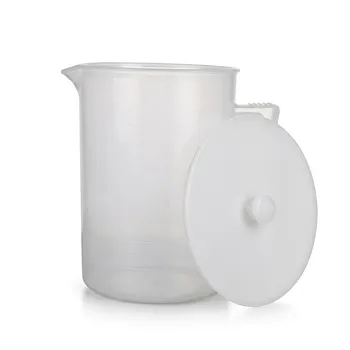
PTFE is the more defensible fluoropolymer option when continuous exposure approaches 400°C, based on the lower reported thermal weight-loss rate. Even then, the design must be validated for creep, softening, pressure, dimensional change, and decomposition-product control.
A PTFE vessel should not be selected solely because the compound being tested is perfluorinated. The labware itself may degrade or lose mechanical integrity before the experiment is complete.
For temperatures above fluoropolymer limits
At temperatures substantially above the validated service limits of PTFE and PFA, alternative materials or containment strategies are required. Depending on the chemistry and measurement objective, these may include specially selected ceramics, metals, glassy carbon, or other high-temperature materials.
The replacement must be assessed for catalytic activity and contamination just as carefully as a fluoropolymer. “Higher temperature capability” does not automatically mean “chemically inert.”
What Must Be Verified Before Testing
Check the complete temperature profile
Record the ramp rate, maximum temperature, hold time, cooling conditions, and number of thermal cycles. Short excursions, continuous operation, and repeated cycling can produce very different material behavior.
Thermal decomposition in granular PTFE is reported to begin extremely slowly at lower temperatures and increase as temperature rises. That trend reinforces the need to evaluate exposure history rather than relying on a single nominal limit.
Evaluate mechanical stability
Chemical compatibility does not guarantee structural integrity. At elevated temperature, fluoropolymers may soften, creep, deform, lose dimensional accuracy, or become unsuitable for pressure-bearing service.
This is especially important for sealed digestion vessels, fittings, tubing connections, and custom-machined parts. A chemically inert liner is not sufficient if the surrounding assembly cannot safely contain the pressure and thermal load.
Control contamination and off-gassing
Exceeding a polymer’s safe operating range can release volatile decomposition products, fluorosurfactants, or other contaminants. These products can alter analytical results and may create personnel or equipment hazards.
For trace analysis, precondition the labware where appropriate, use blank runs, and verify that the observed signal is not originating from the vessel. The cleanliness and thermal history of the apparatus are part of the measurement method.
Understanding the Trade-offs
Chemical inertness versus temperature capability
Fluoropolymers are among the strongest choices for chemical resistance, but their high-temperature performance has practical boundaries. A material that is nearly impervious to concentrated acids and strong bases may still deform or decompose when held at an extreme temperature.
The correct choice balances chemical compatibility with thermal, mechanical, and analytical requirements.
Transparency versus long-term stability
PFA provides optical transparency that can simplify visual observation and process control. PTFE generally offers better performance for prolonged exposure at extreme temperatures, but it is opaque and may be less convenient for visual inspection.
This is a practical trade-off rather than a simple ranking. Visibility is valuable only if the material remains stable throughout the full test.
Inertness versus surface catalysis
Fluoropolymer surfaces are attractive because they are less likely than many glass surfaces to participate in aggressive chemical reactions. However, no material should be assumed to be perfectly inert under every combination of temperature, reagent, pressure, and time.
Validation with blanks, replicate vessels, and post-test inspection is necessary when surface effects could influence the conclusion.
Maximum processing temperature versus service temperature
Processing data describe what a resin can withstand during manufacturing under controlled conditions. They do not necessarily establish the safe operating limit of a finished crucible, dish, tubing assembly, or reaction vessel.
Confusing these two values is a common source of inappropriate labware selection.
How to Apply This to Your Project
The decision should be based on the full thermal and chemical duty cycle, supported by manufacturer data and blank testing.
- If your primary focus is chemical inertness below the validated high-temperature service range: Use high-purity PTFE or PFA to reduce wall reactions, leaching, and sample contamination.
- If your primary focus is prolonged exposure near 400°C: Prefer PTFE over PFA only after confirming the specific grade, geometry, mechanical loading, and continuous-use rating.
- If your primary focus is optical observation or high-purity processing: Consider PFA, but distinguish its short-term processing capability from its long-term thermal stability.
- If your primary focus is testing above the fluoropolymer operating range: Select a validated high-temperature material and independently assess its catalytic activity, contamination risk, and pressure capability.
- If your primary focus is reliable trace analysis: Run thermal blanks and contamination controls to detect off-gassing, vessel-derived signals, and temperature-induced surface effects.
The reliable approach is to choose labware for the complete chemical, thermal, mechanical, and analytical profile of the experiment rather than for chemical resistance alone.
Summary Table:
| Material | Chemical Inertness | Thermal Stability | Key Advantages | Best For |
|---|---|---|---|---|
| PTFE | Excellent, resistant to acids, bases, oxidizing agents | Superior long-term stability near 400°C; lower weight loss | Extreme chemical resistance, low friction, dimensional stability | Prolonged exposure near 400°C, harsh chemical environments |
| PFA | Excellent, comparable to PTFE | Can withstand short-term excursions up to ~425°C, but faster weight loss during prolonged exposure | High purity, optical transparency, melt-processability | Visual monitoring, high-purity handling, complex shapes |
Choose the right fluoropolymer labware for your high-temperature testing. At KINTEK, we specialize in PTFE and PFA products, from basic labware to custom-machined parts. Our experts can help you select the ideal material for your application, ensuring accuracy and safety. Contact us today to discuss your needs and benefit from our end-to-end custom CNC machining and high-quality manufacturing. Get in touch with our team.
Related Products
- Large Scale PTFE Beakers and Flasks for High Temperature Corrosion Resistant Laboratory Applications with Custom CNC Fabrication
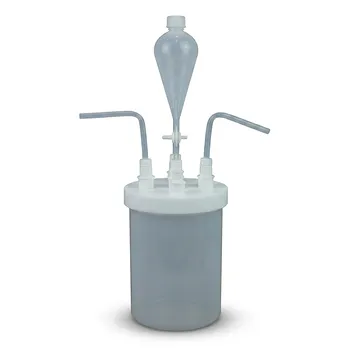
- Corrosion Resistant PFA Translucent Reaction Bottle with PTFE Screw Cap and Standard 19 24 Ground Joint Neck for High Temperature Lab Applications
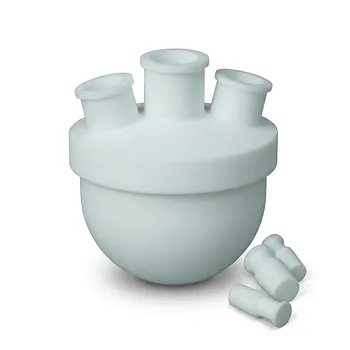
- High Temperature PTFE Reaction Flask 1000ml Single Neck Round and Flat Bottom Laboratory Bottle
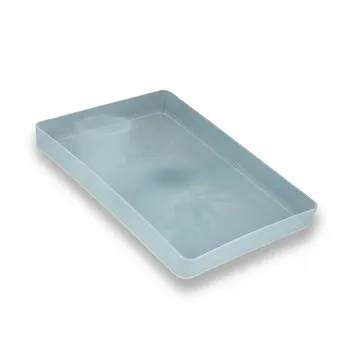
- Customizable PFA Square Tray Corrosion Resistant High Temperature Large Petri Dish Electrolytic Cell
- Custom Thickened PTFE Beaker 3000ml Hotplate Heating High Temperature Deformation Resistant Fluoropolymer Labware
People Also Ask
- Why is the material of the reaction vessel critical for tribocatalytic degradation? Boost Your Catalytic Yield!
- What is the operational temperature range for PTFE laboratoryware? Mastering Thermal Limits from -200°C to +260°C
- What are the main advantages of PTFE as a material for laboratory bottles? Superior Chemical & Thermal Resistance
- Why is PTFE used in laboratory applications? Ensure Chemical Purity and Reliability
- What are the limitations of pure PTFE in high temperature applications? Understanding the 200°C Ceiling