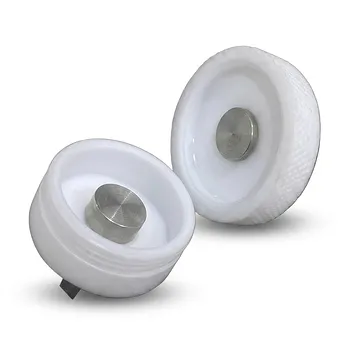
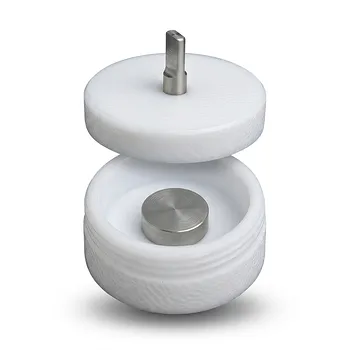
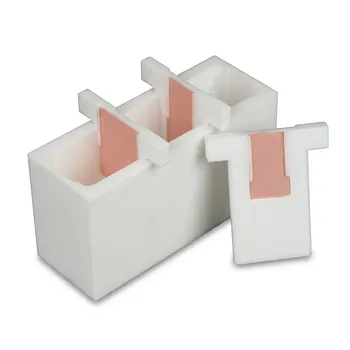
PTFE battery clamps improve operational efficiency by leveraging an ultra-low coefficient of friction and low surface energy to create a "non-stick" environment. This allows for the rapid, residue-free exchange of delicate electrode samples—ranging from 0.1 mm to 5 mm—while preventing active material adhesion and chemical carry-over between test batches.
Core Takeaway: The unique surface chemistry of PTFE minimizes mechanical resistance and material adhesion, directly reducing experimental downtime and eliminating cross-contamination risks in high-precision electrochemical testing.
Streamlining Sample Handling and Throughput
Low Friction for Rapid Sample Exchange
PTFE possesses an ultra-low coefficient of friction, typically measured between 0.05 and 0.10. This slickness allows researchers to slide delicate wires, rods, or foils into the clamp without snagging or damaging the sample.
Minimizing Experimental Downtime
Because the surface is inherently non-adhesive, electrodes can be swapped instantly without the need for aggressive prying or mechanical adjustments. This speed is critical in high-throughput lab settings where multiple battery configurations must be tested in a single shift.
Versatility Across Material Geometries
The surface properties remain effective across a wide range of sample thicknesses, specifically from 0.1 mm to 5 mm. This flexibility ensures that a single set of PTFE clamps can handle diverse electrode types without requiring specialized coatings or frequent tool changes.
Ensuring Data Integrity and Purity
Preventing Active Material Adhesion
The hydrophobic nature and low surface energy of PTFE prevent active material powders and viscous residues from sticking to the clamp. By rejecting these materials, the clamp ensures that the mass of the electrode remains accurate and the electrolyte remains uncontaminated.
Elimination of Parasitic Reactions
PTFE is near-universally chemically inert, resisting aggressive electrolytes like lithium hexafluorophosphate. This ensures the clamp does not leach contaminants or dissolve during the experiment, which would otherwise cause "parasitic reactions" that skew electrochemical data.
Reducing Chemical Carry-over
The hydrophobic surface prevents droplet retention after rinsing, which significantly improves drying efficiency. This prevents "carry-over," where chemicals from one processing bath or test batch are accidentally introduced into the next.
Understanding the Trade-offs
Mechanical Limitations vs. Chemical Purity
While PTFE is superior for surface rejection, it has lower mechanical strength compared to stainless steel or other high-performance plastics. Under high stress, pure PTFE may exhibit "creep" or deformation, potentially affecting the grip tension over long-duration experiments.
The Role of Fillers for Durability
To combat wear, PTFE is often augmented with fillers like carbon, graphite, or glass. While these fillers improve wear resistance and stability, they can slightly alter the surface energy or chemical resistance, requiring a balance between physical durability and chemical purity.
Thermal Considerations
PTFE maintains its non-stick properties across a wide temperature range, but its soft nature means that extreme heat can exacerbate mechanical deformation. Users must ensure that the clamping pressure is calibrated to the specific temperature of the battery test.
How to Apply This to Your Lab
To maximize the efficiency of your battery testing workflow, select your PTFE clamp configuration based on your specific experimental priorities:
- If your primary focus is High-Throughput Screening: Prioritize pure PTFE clamps to take full advantage of the lowest possible friction for rapid, repetitive sample switching.
- If your primary focus is Ultra-Pure Electrochemistry: Use unfilled PTFE to ensure zero leaching and maximum resistance to aggressive carbonate-based electrolytes.
- If your primary focus is Long-Term Durability: Opt for carbon-filled or glass-filled PTFE to increase wear resistance if your experiments involve heavy samples or high mechanical clamping forces.
By matching the surface advantages of PTFE to your specific testing requirements, you ensure both the speed of your operations and the accuracy of your results.
Summary Table:
| Feature | Physical Property | Impact on Lab Efficiency |
|---|---|---|
| Sample Exchange | Ultra-low friction (0.05-0.10) | Rapid, snag-free insertion of delicate electrodes |
| Material Adhesion | Low surface energy | Prevents active material buildup and residue |
| Cleaning Cycle | Hydrophobic surface | Minimizes drying time and chemical carry-over |
| Chemical Stability | Universal inertness | Eliminates parasitic reactions and leaching |
| Throughput | Non-stick interface | Enables instant, residue-free batch transitions |
Upgrade your experimental precision with KINTEK’s high-performance fluoropolymer solutions. From everyday basic labware (beakers, measuring cylinders, crucibles, dishes, reagent/wash bottles, centrifuge and digestion tubes), high-purity trace analysis instruments, and cleaning/storage tanks, to comprehensive fluid transfer components (tubing, fittings, valves), sample prep and filtration tools (separatory funnels, burettes, filters, pipettes, tweezers, spatulas), and general consumables (stirring bars, O-rings, gaskets, seal tapes, caps, septa), extending all the way to advanced derivative and reaction apparatus like standard or custom electrochemical cells, battery testing fixtures, electrode accessories, hydrothermal synthesis liners, microwave digestion vessels, microchannel reactors, and condensation/reflux devices, KINTEK manufactures virtually all imaginable laboratory supplies crafted from PTFE and PFA. Backed by end-to-end custom CNC fabrication, we are equipped to deliver absolutely everything from complex non-standard machined parts and bespoke laboratory setups to high-volume orders, maintaining an exclusive and absolute focus on high-performance materials. Contact us today to optimize your lab’s workflow with our bespoke engineering services!
Related Products
- Corrosion Resistant PTFE Coin Cell Battery Testing Clamps and Acid Proof Custom Fluoropolymer Battery Fixtures
- Acid Resistant PTFE Button Cell Battery Test Fixture Customizable Machining High Purity Electrochemical Testing Clamp
- PTFE Filter Membrane Holder for Hydrogen Chloride and Water Filtration 90mm Environmental Sampling Clamp Customizable
- Custom PTFE Reaction Lid with Integrated Valve and Fitting Corrosion Resistant No Leaching PFA FEP Bottle Cap System
- White PTFE Electrolytic Cell with Movable Slider and Insulated Lid for Fluorine Corrosion Resistance
People Also Ask
- What is the thermal operating range for PTFE battery clamps in electrochemical research? Stability from -200°C to +260°C
- What are the primary functions and material compositions of PTFE battery clamps? Ensure Precision & Chemical Resistance
- How do coin cell testing fixtures evaluate ZIF-derived LCO cycling stability? Ensure Battery Research Precision
- What are the electrical insulation and signal integrity advantages of using PTFE battery clamps? Ensure Data Accuracy
- How does the chemical inertness of PTFE benefit laboratory-scale battery testing? Ensure high-purity research results.