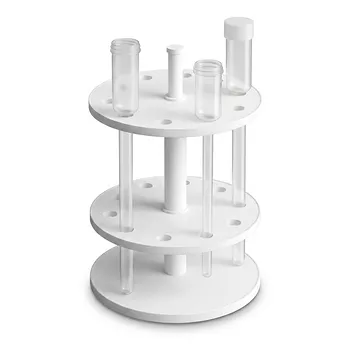
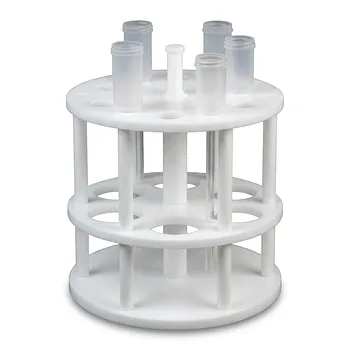
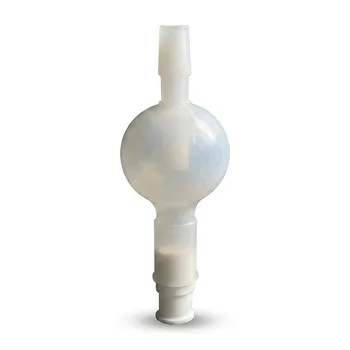
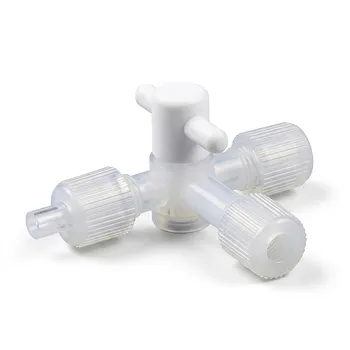
PTFE and PFA protect trace-analysis accuracy by absorbing virtually no moisture. PTFE shows approximately 0% water absorption over 24 hours, while PFA absorbs less than 0.03%, compared with as much as 1.9% for some nylon laboratory polymers. This minimizes fluid retention, sample carryover, polymer swelling, and contamination, helping high-purity instruments and sample-preparation components deliver more reliable measurements.
In trace analysis, even small amounts of retained liquid or leached material can affect results. PTFE and PFA reduce this risk because water and aqueous samples largely remain on the surface rather than penetrating the material.
Why Moisture Absorption Matters in Trace Analysis
Trace measurements have little tolerance for contamination
Trace analysis measures substances at very low concentrations, sometimes near the instrument’s detection limit. A small contaminant contribution from a container, fitting, tube, or sample-preparation tool can therefore distort the result.
Materials that absorb moisture can also retain dissolved chemicals from previous samples. That retained residue may later be released into a new sample, creating cross-contamination between testing batches.
Absorption and adsorption create different risks
Water absorption refers to moisture entering the polymer matrix. Surface adsorption refers to liquid, ions, or analytes adhering to the material’s surface.
PTFE and PFA address both risks effectively: their moisture absorption is near zero, and their hydrophobic, non-wetting surfaces reduce the tendency of aqueous solutions to remain attached to the material.
Moisture can change component dimensions
When a polymer absorbs water, it may swell or change its mechanical properties. In precision laboratory components, even small dimensional changes can affect seals, fittings, valves, tubing connections, or fluid paths.
The extremely low absorption of PTFE and PFA helps maintain dimensional stability during repeated exposure to aqueous reagents, cleaning cycles, and humid laboratory conditions.
How PTFE and PFA Preserve Sample Integrity
They reduce fluid retention
A porous or moisture-absorbing material can hold liquid after draining or rinsing. That retained liquid may dilute the next reagent or sample, or introduce residues from an earlier procedure.
Because PTFE and PFA absorb almost no water, less liquid becomes trapped within the material itself. This is particularly valuable for reagent bottles, digestion vessels, cleaning tanks, sample containers, and fluid-transfer components.
They limit cross-contamination
In high-purity workflows, cleaning must remove both visible residue and chemically retained material. A polymer that absorbs moisture can also retain dissolved contaminants within its matrix, making complete cleaning more difficult.
PTFE and PFA provide a low-retention surface that supports more predictable rinsing. This does not eliminate the need for validated cleaning procedures, but it reduces one important source of carryover.
They minimize sample loss
Analytes can be lost when they adhere to container walls or become retained in a material. This is especially important for trace metals, biological analytes, and low-level impurities.
The hydrophobic surfaces of PTFE and PFA reduce the interaction between aqueous samples and the labware surface. Lower surface adsorption helps more of the intended sample reach the analytical instrument.
Why These Properties Benefit Instrument Components
Reagent bottles and storage containers remain cleaner
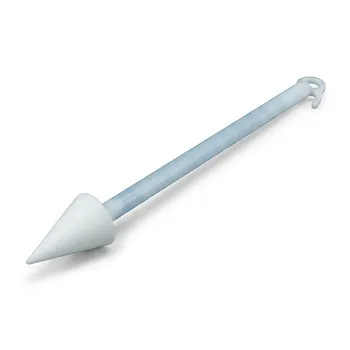
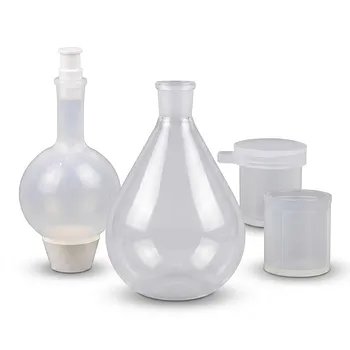
PTFE and PFA are suitable for storing high-purity reagents because they combine low moisture absorption with low extractables and leachables. They are also highly resistant to aggressive acids, bases, organic solvents, and other laboratory chemicals.
This combination reduces the chance that a storage container will contribute background contamination or chemically alter the reagent before use.
Digestion vessels resist aggressive preparation chemistry
Trace-element workflows often use strong oxidative acids and elevated temperatures to break down samples. PTFE and PFA resist chemical attack under many of these conditions.
Their low absorption reduces the possibility that moisture, dissolved ions, or reaction products will penetrate the vessel and later contaminate another digestion. Their chemical inertness also helps prevent the container from reacting with the digestion mixture.
Tubing, valves, and fittings preserve fluid composition
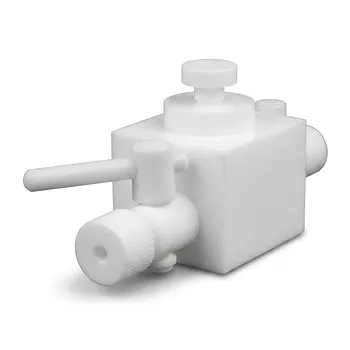
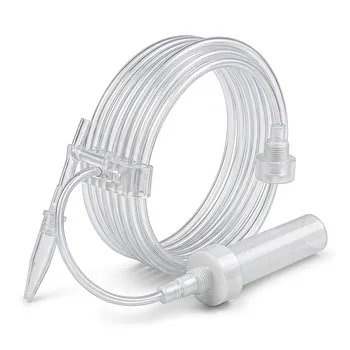
Fluid-transfer paths can affect results when they retain liquid, release contaminants, or allow analytes to adsorb onto internal surfaces. PTFE and PFA tubing, valves, and fittings provide chemically resistant, low-absorption pathways.
This helps maintain the intended concentration and composition of reagents as they move through automated or semi-automated sample-preparation systems.
High-purity instruments experience less background interference
In techniques such as trace metal analysis and LC-MS/MS, background ions or leached compounds can interfere with detection. PTFE and PFA contribute very low levels of extractable material when the correct high-purity grades and manufacturing controls are used.
The result is a cleaner analytical background, which supports more dependable detection of substances such as nickel, zinc, copper, and low-level impurities.
The Role of Hydrophobicity
Water is less likely to wet the surface
PTFE and PFA have high water contact angles, approximately 114 degrees for PTFE and 115 degrees for PFA in the cited data. A high contact angle indicates that water tends to bead rather than spread across the surface.
This non-wetting behavior helps reduce the amount of aqueous sample that remains on vessel walls, fittings, and other components after draining.
Surface behavior complements low bulk absorption
Hydrophobicity alone does not determine laboratory suitability. A material could resist wetting yet still absorb chemicals or release contaminants into a sample.
PTFE and PFA are effective because their surface properties work together with extremely low water absorption, broad chemical resistance, and low levels of extractables and leachables.
Understanding the Trade-offs
Low absorption does not replace cleaning validation
PTFE and PFA reduce retention and contamination risk, but they are not self-cleaning. Surface residue, particulates, manufacturing residues, or strongly adsorbed compounds can still affect results.
Laboratories must use cleaning methods, blank controls, and material qualification appropriate to the analytical method.
Material grade and manufacturing quality matter
“PTFE” or “PFA” describes a polymer family, not a complete purity specification. Fillers, pigments, processing aids, machining residues, packaging, and handling can introduce contaminants even when the base polymer has excellent properties.
For trace analysis, specify high-purity grades and verify extractables, leachables, elemental background, cleanliness, and lot-to-lot consistency.
PTFE and PFA are not interchangeable in every design
PTFE offers exceptional chemical resistance and very low moisture absorption, but it is generally more difficult to process because it does not behave like a conventional melt-processable thermoplastic. PFA can be melt-processed and is often preferred for transparent or more complex molded components.
The correct choice also depends on temperature, pressure, flexibility, transparency, dimensional requirements, and the particular reagents involved.
Moisture measurements depend on test conditions
Reported absorption values vary with exposure time, temperature, specimen preparation, and test method. The cited values of 0% for PTFE and less than 0.03% for PFA over 24 hours should therefore be treated as reference conditions rather than universal guarantees.
For a regulated or highly sensitive workflow, qualification should use the actual chemicals, temperatures, cleaning cycles, and exposure times expected in service.
Making the Right Choice for Your Goal
PTFE and PFA are most valuable when moisture retention, chemical interaction, and background contamination could compromise a low-level measurement.
- If your primary focus is minimizing cross-contamination: Use high-purity PTFE or PFA for vessels, reagent containers, tubing, valves, and fittings, supported by validated rinsing and blank-control procedures.
- If your primary focus is trace-metal accuracy: Select qualified fluoropolymer labware with verified low elemental background and resistance to the acids and digestion conditions used in the method.
- If your primary focus is reducing sample loss: Favor the low-adsorption surfaces of PTFE and PFA for containers and fluid paths that contact dilute or surface-sensitive analytes.
- If your primary focus is dimensional and fluid-handling stability: Use their near-zero moisture absorption to reduce swelling and fluid retention, while confirming suitability for the system’s temperature and pressure conditions.
- If your primary focus is LC-MS/MS or impurity profiling: Choose high-purity materials with documented extractables and leachables performance so that the fluoropolymer does not add background ions or obscure low-level signals.
For high-purity trace analysis, PTFE and PFA provide a stable, low-retention foundation that helps preserve sample composition from preparation through measurement.
Summary Table:
| Property | PTFE | PFA |
|---|---|---|
| Water Absorption (24 hrs) | ~0% | <0.03% |
| Contact Angle (water) | ~114° | ~115° |
| Hydrophobicity | High | High |
| Dimensional Stability | Excellent | Excellent |
| Chemical Resistance | Outstanding | Outstanding |
| Cleanability | Excellent | Excellent |
Ensure the reliability of your high-purity trace analyses with KINTEK's PTFE and PFA labware. Our products are engineered for minimal moisture absorption, low extractables, and superior chemical resistance. From digestion vessels and reagent bottles to tubing and custom CNC-machined parts, we provide the purity and performance your lab demands. Contact us today to discuss your specific requirements and elevate your analytical accuracy.
Related Products
- PTFE PFA Vacuum Filtration System Corrosion Resistant Customizable Shatterproof Laboratory Device
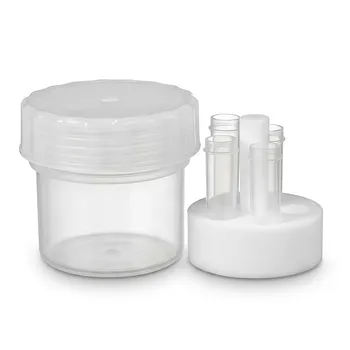
- Corrosion Resistant PTFE Support with PFA Transparent Reaction Tank and High Purity PFA Sampling Tube for Trace Analysis
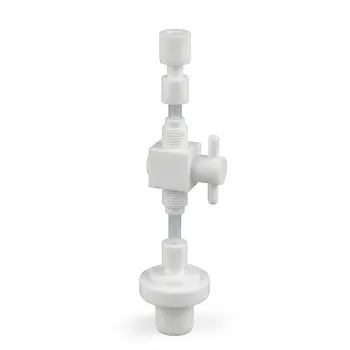
- High Purity PFA PTFE Flare Stop Valves Customizable 2-Way 3-Way Reducing Fluoropolymer Fluid Control Solutions
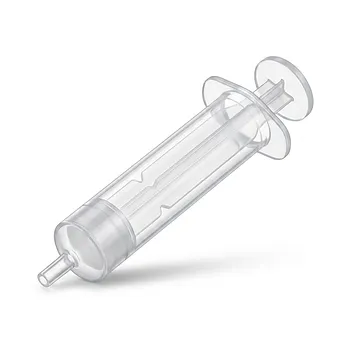
- Corrosion Resistant PFA Syringe Translucent Visual Fluoropolymer Labware 10ml Chemical Handling Tool
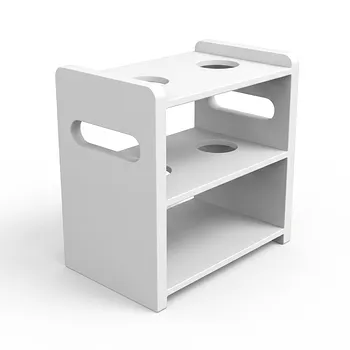
- Custom PTFE Acid Resistant Support Rack for PFA Hydrogen Absorption Systems Multi Hole Configurations
People Also Ask
- What makes PTFE filtration systems advantageous for industrial and scientific use? Unmatched Chemical & Thermal Stability
- What temperature resistance do PTFE filters offer? Unmatched Thermal Stability from -200°C to +260°C
- How does the hydrophobicity of PTFE filters benefit their use? Ensure Uninterrupted Gas Flow and Solvent Filtration
- Which chemicals are fully compatible with PTFE filters? Discover Unmatched Chemical Resistance
- What sizes and pore options are available for PTFE filters? Choose the Right Filter for Your Application