PFA is the high-performance benchmark among fluoropolymers, providing a superior balance of mechanical toughness and thermal stability. It offers ten times the repeated-bending endurance of FEP and significantly better creep resistance than both FEP and PTFE when subjected to high-stress environments. While it maintains the extreme chemical and heat resistance of PTFE, PFA adds the critical advantage of melt-processability, allowing for the creation of complex, high-durability components.
PFA serves as the optimal choice when a project requires the chemical inertness of PTFE but demands greater mechanical robustness and the ability to be injection-molded. Its superior flex life and resistance to deformation under heat make it the definitive material for pressurized or dynamic systems.
Superior Durability and Flex Life
Exceptional Repeated-Bending Endurance
PFA is engineered for high-flex applications, offering tenfold better repeated-bending endurance than FEP. This makes it the ideal material for components that undergo frequent movement or mechanical stress.
High Elongation and Toughness
With an elongation of approximately 300 percent, PFA demonstrates remarkable elasticity and toughness. This flexibility allows the material to absorb energy and resist fracturing under mechanical loads that might compromise other plastics.
Structural Integrity Under Stress
Enhanced Creep Resistance
Compared to FEP and PTFE, PFA possesses higher melt strength and better creep resistance when exposed to combined chemical and thermal stress. This structural stability reduces the risk of part deformation or leakage in pressurized industrial systems.
Stability Across Temperature Extremes
While PTFE maintains useful mechanical properties from -73°C to 204°C, PFA extends this capability. PFA can withstand continuous service temperatures up to +260°C, significantly outperforming FEP’s limit of +205°C.
Processing and Manufacturing Advantages
Melt-Processability for Complex Geometries
Unlike PTFE, which cannot be melt-processed and requires specialized sintering, PFA is melt-processable. This allows engineers to use injection molding or extrusion to create complex shapes with smooth, non-porous surfaces.
High-Purity Surface Finish
The ability to extrude or mold PFA results in a smooth surface finish that is often superior to the granular structure of sintered PTFE. This is critical in applications where minimizing contamination or ensuring fluid flow is a primary concern.
Understanding the Trade-offs
Lower Scratch Resistance
One significant limitation is that PFA’s scratch resistance is lower than that of PTFE. Because the surface is more susceptible to physical marring, users must avoid abrasive cleaning tools or environments with high particulate friction.
Impact of Complex Processing
While melt-processability is a benefit for design, the thermal requirements for processing PFA are higher than those for FEP. This requires more robust manufacturing equipment and careful thermal management during production to maintain material integrity.
Choosing the Right Fluoropolymer for Your Goal
When selecting a material for your specific application, consider how these mechanical differences align with your operational requirements.
- If your primary focus is repeated mechanical movement: PFA is the clear choice due to its ten-to-one advantage in flex life over FEP.
- If your primary focus is pressurized high-temperature systems: PFA should be used to leverage its superior creep resistance and +260°C thermal threshold.
- If your primary focus is complex part geometry: PFA is required because it can be injection molded, whereas PTFE is limited by its non-melt-processable nature.
- If your primary focus is surface hardness and abrasion: PTFE may be preferable, as it offers better resistance to scratching than PFA.
By understanding these mechanical nuances, you can ensure your material choice provides the necessary longevity and safety for your high-performance environment.
Summary Table:
| Property | Perfluoroalkoxy (PFA) | Polytetrafluoroethylene (PTFE) | Fluorinated Ethylene Propylene (FEP) |
|---|---|---|---|
| Max Service Temp | 260°C | 260°C | 205°C |
| Flex Life | Exceptional (10x FEP) | Low | Moderate |
| Processability | Melt-Processable (Molding) | Non-Melt (Sintering) | Melt-Processable (Molding) |
| Creep Resistance | Superior | Moderate | Lower |
| Elongation | ~300% | ~200-400% | ~300% |
| Scratch Resistance | Lower | Higher | Moderate |
Upgrade Your Lab with Precision-Engineered Fluoropolymers
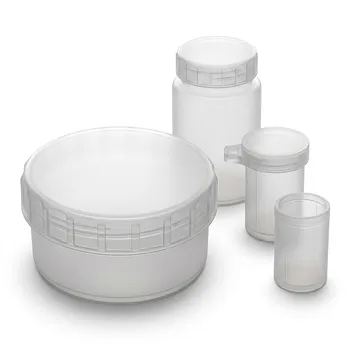
Maximize your research performance with KINTEK’s high-performance lab solutions. Whether you require everyday basics like PFA beakers, centrifuge tubes, and reagent bottles, or advanced custom CNC-fabricated components, we provide the absolute focus on quality your work demands.
From high-purity trace analysis instruments and comprehensive fluid transfer components (tubing, valves) to bespoke electrochemical cells and microwave digestion vessels, KINTEK manufactures virtually every imaginable laboratory supply from premium PFA and PTFE.
Ready to enhance your lab's durability and chemical resistance? Contact us today to discuss your standard or custom requirements and leverage our end-to-end fabrication expertise.
Related Products
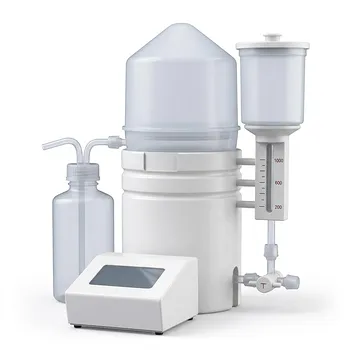
- High Purity PFA Chromatography Column with Collection Bottle Corrosion Resistant Fluoropolymer Filtration System for Trace Analysis
- High Purity PFA Chromatography Columns and Collection Bottles Corrosion Resistant Fluoropolymer Filtration Systems for Trace Analysis
- PFA Sub Boiling Acid Purifier Electronic Grade Distillation System Laboratory Trace Analysis Equipment
- High Purity PFA Chromatography Column Double Layer Constant Pressure Filtration System with Sieve Plate for Strong Acid Resistance
- High Purity PFA Chromatography Column and Collection Bottle System Corrosion Resistant Filter Column with Sieve Plate Glass Alternative
People Also Ask
- Why is the chemical stability of polymer endgroups critical when selecting melt-processible fluoropolymers like PFA for high-purity laboratory apparatus? Choose Stable Endgroups for Reliable Performance
- What are the characteristics of PFA material? A Guide to Its High-Performance Balance
- Why is Perfluoroalkoxy alkane (PFA) preferred over glass or stainless steel in pharmaceutical process development? Pure Yield
- Why is PFA superior for cleaning and preventing cross-contamination? The Gold Standard for Ultra-Trace Lab Hygiene
- What are the key properties of PFA (PerFluoroAlkoxy)? A Guide to Extreme Chemical and Thermal Resistance