Fluorinated functional groups influence redox-active fluoropolymer monomers through two coupled design variables: electronic structure and molecular shape. Fluorine directly attached to an aromatic sp² carbon has a relatively weak net electronic effect because its σ-electron withdrawal is partly offset by π donation. Fluorinated groups attached through sp³ carbons, especially −CF₃ and −CF₂CF₃, exert much stronger inductive electron withdrawal, while longer perfluoroalkyl groups additionally change steric volume and solid-state packing. High-purity PTFE and PFA labware is essential because aggressive fluorinated reagents, elevated temperatures, trace leaching, and residual metals can all compromise monomer purity and the resulting polymer’s redox and physical performance.
The most effective monomer design balances fluorine’s electronic control of frontier orbitals with its steric control of molecular packing. That design can only be translated into reliable polymer performance when synthesis and processing avoid impurities, chain-terminating species, metallic residues, and labware-derived contamination.
How Fluorinated Groups Change Monomer Electronics
Direct Aromatic Fluorination Has a Limited Net Effect
Fluorine bonded directly to an sp²-hybridized aromatic carbon has a reported Hammett constant of approximately σp = 0.06, indicating a weak overall substituent effect.
This behavior results from two opposing interactions: fluorine withdraws electron density through the σ framework but can donate electron density into the aromatic π system. The net effect is therefore much smaller than its electronegativity alone would suggest.
For a redox-active monomer, direct aryl fluorination can provide modest electronic adjustment without dramatically changing the character of the redox-active core. It may be useful when the goal is fine control rather than a major shift in electron affinity or oxidation behavior.
sp³-Bound Fluoroalkyl Groups Are Strong Inductive Acceptors
Groups such as −CF₃ and −CF₂CF₃, when attached through sp³-hybridized carbon, cannot compensate for σ withdrawal through effective π donation.
Their stronger inductive effects are reflected in Hammett constants of approximately σp = 0.54 for −CF₃ and σp = 0.52 for −CF₂CF₃. These groups can substantially lower the electron density of nearby redox-active units.
This provides a direct way to tune monomer frontier orbital levels. Depending on the redox-active structure and attachment position, the resulting electronic shift can influence the ease of oxidation or reduction and the electrochemical stability of the polymer.
Perfluoroalkyl Chains Add Electronic and Steric Control
Longer perfluoroalkyl substituents retain strong inductive electron withdrawal while introducing substantially greater van der Waals volume. For example, a −CF₂CF₂CF₂CF₃ group has a reported volume of approximately 131.07 ų.
Their geometry also changes with chain length. Instead of behaving like compact, approximately spherical substituents, perfluoroalkyl groups can produce chain-like or columnar spatial profiles.
That combination allows monomer designers to adjust both frontier orbital energies and solid-state packing. The substituent may therefore affect not only intrinsic redox properties but also intermolecular interactions, accessibility of redox sites, and the morphology of the polymer.
Why Steric Design Matters in the Polymer
Substituent Size Controls Redox-Site Environment
A bulky fluorinated group can separate neighboring redox-active units or shield them from surrounding molecules and ions. This may alter how efficiently charge carriers, counterions, or electrolyte species approach the redox centers.
The same steric protection can also affect the conformations available to the monomer before polymerization. Consequently, substituent selection should account for both the isolated monomer and the chain environment created after polymerization.
Shape Influences Solid-State Packing
Fluorinated groups can change whether polymer segments pack closely, form ordered domains, or adopt more open arrangements. These changes influence the physical environment in which electron transfer occurs.
A monomer with suitable orbital energies may still perform poorly if its fluorinated substituents produce unfavorable packing, excessive isolation of redox sites, or limited transport pathways. Electronic tuning and morphological design therefore need to be considered together.
Fluorine Content Changes Bulk Polymer Behavior
Changing the fluorinated monomer ratio can alter solubility, flexibility, thermal endurance, surface energy, and chemical resistance. These effects are not determined by fluorine content alone; they also depend on chain architecture, molecular weight, stereochemical sequences, and end-group structures.
This is why monomer design cannot be reduced to selecting the most electron-withdrawing substituent. The useful choice is the one that delivers the required electrochemical response while preserving processability and the target mechanical and thermal properties.
How Polymer Architecture Extends the Design Space
Functionality Controls Network Formation
Bifunctional trifluorovinyl ether monomers can produce linear or thermoplastic perfluorocyclobutane-based materials. Tri- and tetrafunctional analogues instead promote dense, thermally cross-linked networks.
This change is structural rather than merely compositional. Cross-linking can raise thermal performance, with reported 5% weight-loss decomposition temperatures above 500 °C and glass-transition temperatures above 200 °C, but it also makes the material insoluble in common solvents such as THF, DMF, and chloroform.
Side Chains Can Add Ion-Transport Function
Fluorinated backbones combined with poly(ethylene oxide) side chains illustrate another design strategy. The fluorinated segment contributes thermal, chemical, and electrochemical stability, while the PEO chains can complex lithium salts and support Li⁺ transport.
For these materials, the purity of the synthesis environment is especially important. Residual transition-metal ions from polymerization or processing can impair lithium-ion transport and reduce battery performance.
Molecular Weight and End Groups Are Functional Variables
High-molecular-weight fluoropolymers require highly pure monomers and controlled polymerization conditions. Trace hydrogen- or chlorine-bearing compounds can act as telogens or chain terminators, limiting molecular-weight growth and changing polymer end groups.
Those end groups can influence thermal stability, chemical resistance, and electrochemical behavior. Techniques such as multidimensional ¹⁹F NMR can help identify fluorinated structural features and chain ends when these parameters must be verified.
Why High-Purity PTFE and PFA Labware Is Essential
Fluorinated Chemistry Can Attack Ordinary Equipment
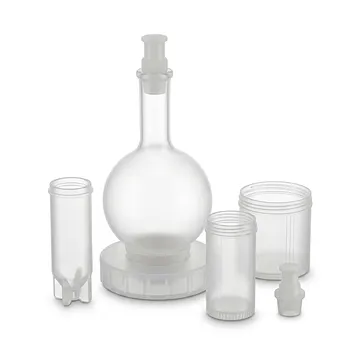
Fluorinated solvents and reagents may be chemically aggressive, particularly under elevated temperature or digestion conditions. PTFE and PFA provide the chemical inertness needed for reaction vessels, reagent bottles, digestion tubes, filtration components, and storage containers.
They also tolerate demanding thermal treatments without introducing the corrosion products associated with less-resistant materials. This protects both the experiment and the material being synthesized or analyzed.
Labware Can Become a Source of Trace Contamination
Even when the intended reaction is well controlled, contact surfaces can contribute trace metals, organic residues, or other leachable species. Such contamination is especially damaging in redox-active systems, where small quantities of electroactive or catalytic impurities can alter measured potentials, reaction pathways, or charge-transfer behavior.
For high-purity work, the vessel is part of the chemical system. Inert fluoropolymer labware reduces the risk that the container changes the composition of the monomer, polymer, solvent, or electrolyte.
Clean Equipment Protects Polymer Molecular Weight
Impurities can interrupt polymerization, alter chain ends, and create structural defects. This is particularly consequential for fluoropolymers whose performance depends on molecular weight, chain architecture, and precise end-group composition.
Maintaining purity from monomer preparation through polymerization, washing, drying, and storage therefore supports consistent thermal, mechanical, chemical, and electrochemical properties.
Labware Must Survive Post-Synthesis Treatment
Highly cross-linked fluoropolymer networks may resist ordinary organic solvents and require aggressive washing or elevated-temperature treatment. PTFE and PFA components can support these operations without swelling, degrading, or contributing significant contamination.
This matters for both synthesis and downstream processing, including solvent exchange, filtration, digestion, and trace analysis of the final material.
Understanding the Trade-offs
Stronger Electron Withdrawal Is Not Always Better
A highly inductive group can shift frontier orbitals in a useful direction, but excessive withdrawal may make the redox process difficult to access or change the balance between redox activity and stability.
The correct substituent depends on the desired operating potential, redox reversibility, polymer environment, and compatibility with the electrolyte or reaction conditions.
Greater Steric Bulk Can Reduce Processability
Long perfluoroalkyl chains can improve packing control or isolate functional groups, but they also increase molecular volume and may hinder close contact between redox-active sites. They can further affect solubility, flexibility, and the ability to form uniform films or coatings.
Steric tuning should therefore be evaluated alongside polymerization behavior and the intended material form.
Cross-Linking Improves Stability but Removes Solubility
Tri- and tetrafunctional monomers can provide exceptional thermal and chemical stability through network formation. The trade-off is reduced solubility, more difficult purification, and limited options for solution processing.
A network architecture is appropriate when durability is the priority, but a linear or lightly functionalized system may be better when remoldability, dissolution, or film processing is required.
High-Purity Labware Does Not Correct Poor Monomer Synthesis
PTFE and PFA equipment prevents many contamination pathways, but it cannot remove side-products created during synthesis. Direct fluorination, for example, can generate unwanted species such as tetrafluoroethylphenyl ethers.
Refined multi-step routes, including fluoroalkylation followed by metal-mediated dehalogenation, may be required to obtain the monomer purity needed for reliable polymer properties.
Making the Right Choice for Your Goal
Choose the functional group, polymer architecture, and processing environment as one connected design problem.
- If your primary focus is redox-potential tuning: Use the strong inductive effects of sp³-bound groups such as −CF₃ or −CF₂CF₃ when a substantial frontier-orbital shift is required, while treating direct aromatic fluorination as a finer electronic adjustment.
- If your primary focus is solid-state morphology: Evaluate the volume and chain-like geometry of longer perfluoroalkyl groups because they can alter packing as well as electronic levels.
- If your primary focus is thermal and chemical durability: Consider higher-functionality monomers that form cross-linked networks, accepting the resulting loss of common-solvent solubility.
- If your primary focus is ion transport or electrochemical purity: Control residual metal ions and other trace contaminants throughout polymerization and purification, particularly in fluorinated polymers containing ion-coordinating side chains.
- If your primary focus is reproducible high-purity synthesis: Use clean PTFE or PFA vessels and components that resist aggressive chemistry, high temperatures, and chemical leaching.
- If your primary focus is final-material qualification: Verify molecular weight, chain ends, fluorinated sequences, and structural defects with appropriate analytical methods, including advanced ¹⁹F NMR where necessary.
Effective redox-active fluoropolymer design comes from matching fluorine’s electronic and steric effects to the required polymer architecture while protecting purity at every stage of synthesis and processing.
Summary Table:
| Fluorinated Group | Electronic Effect | Steric Effect | Design Implication |
|---|---|---|---|
| Direct Ar-F | Weak (σp = 0.06) | Small | Fine-tuning redox potentials |
| -CF₃, -CF₂CF₃ | Strong inductive (σp ≈ 0.54) | Moderate | Substantial frontier orbital shifts |
| -CF₂CF₂CF₂CF₃ | Strong inductive | Large (vol ≈ 131 ų) | Alters packing and morphology |
Need High-Purity PTFE/PFA Labware for Your Fluoropolymer Synthesis?
At KINTEK, we specialize in manufacturing laboratory supplies exclusively from high-performance PTFE and PFA. Our products are designed to meet the rigorous demands of redox-active fluoropolymer synthesis, ensuring minimal contamination and maximum chemical resistance. From reaction vessels and digestion tubes to custom CNC-machined parts and electrochemical cells, we provide the tools you need to achieve reliable, high-purity results. Contact us today to discuss your requirements and elevate your research with KINTEK's precision labware. Get in touch now!
Related Products
- Custom PFA Pear Shaped Flask High Purity Corrosion Resistant Labware Custom Molded Fluoropolymer Flask Glass Replacement Solution
- High Purity PFA Beaker with Handle and Large Capacity Washable Soak Basket Multi Spec Teflon Laboratory Labware
- Custom PTFE Flask 250ml High Purity Fluoropolymer Laboratory Vessel for Chemical Research
- Custom PTFE Petri Dish 200mm High Purity Corrosion Resistant Low Background Laboratory Ware
- High Purity PTFE Single Neck Reaction Flask Acid Resistant Customizable Fluoropolymer Laboratory Reactor
People Also Ask
- What are the chemical compatibility boundaries of PFA fluoropolymer labware, and how can PFA surfaces be treated for adhesive bonding? Learn safe usage and bonding methods.
- How does end-group stabilization during PFA polymer synthesis influence purity? Achieve Ultra-High Purity & Reliability in Lab Components.
- Why Use PFA Labware for MnFe2O4/rGO Precursors? Ensure Stoichiometric Precision and Purity
- How does PFA labware enhance the accuracy of ultra-trace element analysis? Achieving PPT Precision with Zero Leaching
- Why is PFA labware recommended for CuBi2O4? Protect high-purity precursors and ensure semiconductor bandgap accuracy.