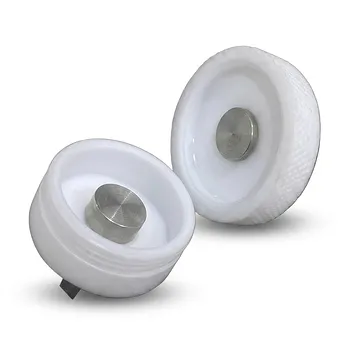
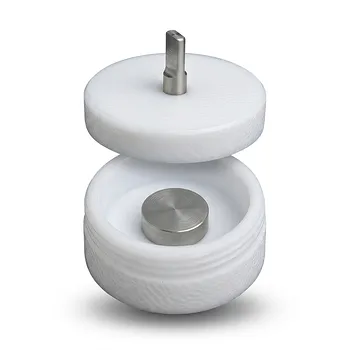
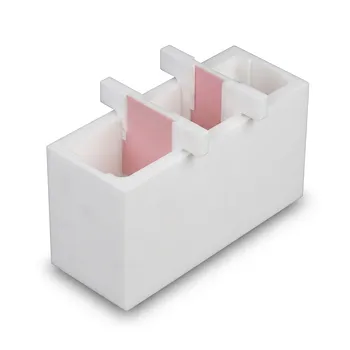
PTFE battery clamps utilize two primary gripping mechanisms—screw-based compression and spring-loaded clips—to establish secure electrical contact. The screw mechanism uses a PTFE-threaded cap to press the electrode against a conductive backing plate, while the spring-loaded variant employs gold-plated copper clips for consistent pressure on thinner materials.
These mechanisms are designed to provide a contamination-free, chemically inert interface that ensures stable electrical signals during sensitive electrochemical testing like cyclic voltammetry or impedance spectroscopy.
The Screw and Compression Mechanism
This mechanism is the "heavy-duty" option for battery research, designed for versatility and mechanical robustness.
Mechanical Force through Threaded Design
The system functions by rotating a PTFE-threaded cap or set screw through the clamp housing. As the screw tightens, it applies direct linear pressure to the electrode sample, ensuring it remains stationary even in agitated electrolytes.
The Conductive Interface
To facilitate electrical flow, the electrode is compressed against a conductive backing plate, typically made of platinum or gold. This setup ensures that the electrical path is highly conductive while remaining resistant to the corrosive environments common in battery testing.
Dimensional Versatility
The screw-based design is valued for its wide operating range. It can securely accommodate electrode thicknesses ranging from 0.1 mm to 5 mm, making it the standard choice for bulk materials or thick composite electrodes.
The Clip and Spring-Loaded Mechanism
This mechanism is engineered for precision and the handling of delicate, thin-film materials.
Consistent Contact Pressure
Unlike the manual tightening of a screw, the clip variant uses a pre-tensioned spring to provide gentle, repeatable pressure. This is critical for research where the consistency of the contact resistance is a primary variable in the experiment.
Embedded Conductive Elements
The gripping jaws are made of high-purity PTFE, but they house an internal gold-plated copper clip. This configuration protects the metal from the electrolyte while ensuring that the electrical connection to the electrode sheet is direct and low-resistance.
Suitability for Flexible Sheets
This mechanism is the preferred choice for thin or flexible electrode sheets. Because the pressure is distributed and controlled, it minimizes the risk of piercing or deforming fragile samples that might be crushed by a screw-based system.
Understanding the Trade-offs
While PTFE is the ideal material for chemical inertness, it presents specific mechanical challenges that researchers must navigate.
Mechanical Stability vs. Chemical Inertness
PTFE is soft and can "creep" under high pressure, which is why many clamps integrate PEEK or metal cores. These cores provide the structural rigidity needed for secure mounting without compromising the chemical passivity of the outer PTFE shell.
Dielectric Properties and Signal Integrity
The excellent dielectric properties of PTFE ensure that the clamp itself does not interfere with the electrical signals. However, if the internal metal conductors are exposed due to wear or improper assembly, oxidative attack can occur, leading to signal noise or sample contamination.
Maintenance and Cleaning
Screw mechanisms can trap small amounts of electrolyte within the threads, requiring meticulous cleaning between tests. Clip mechanisms are often easier to rinse but have more intricate internal parts that may be harder to replace if the spring tension fails over time.
Selecting the Mechanism for Your Application
Choosing the right gripping mechanism depends entirely on the physical characteristics of your electrode and the sensitivity of your measurements.
- If your primary focus is bulk material or thick electrodes (up to 5mm): Utilize the screw/compression mechanism to ensure maximum mechanical stability and a firm hold.
- If your primary focus is thin films or flexible sheets: Select the spring-loaded clip variant to achieve repeatable contact pressure without damaging the sample.
- If your primary focus is high-sensitivity impedance (EIS) measurements: Prioritize a clamp with gold-plated interfaces and a rigid PTFE/PEEK body to ensure the signal remains clean and the connection remains stable.
The effectiveness of a PTFE battery clamp relies on matching the mechanical gripping force to the fragility of the electrode while maintaining a chemically isolated electrical path.
Summary Table:
| Mechanism Type | Key Components | Optimal Electrode Thickness | Primary Advantage |
|---|---|---|---|
| Screw / Compression | PTFE-threaded cap, gold/platinum plate | 0.1 mm – 5.0 mm | Mechanical stability for bulk materials |
| Spring-Loaded Clip | Gold-plated copper clips, PTFE jaws | Thin films & flexible sheets | Consistent contact pressure & precision |
Elevate Your Electrochemical Accuracy with KINTEK
Achieve uncompromising results in your battery research with high-performance fluoropolymer solutions from KINTEK. Whether you require the mechanical robustness of screw-based clamps or the delicate precision of spring-loaded clips, our expertise in PTFE and PFA manufacturing ensures your lab is equipped for excellence.
At KINTEK, we manufacture virtually all imaginable laboratory supplies. Our range spans from everyday basic labware (beakers, crucibles, reagent bottles) and fluid transfer components (tubing, valves) to advanced reaction apparatus like custom electrochemical cells, battery testing fixtures, and microwave digestion vessels. Backed by end-to-end custom CNC fabrication, we deliver everything from complex non-standard machined parts to high-volume orders with an absolute focus on high-performance materials.
Ready to enhance your lab's efficiency and signal integrity? Contact us today to discuss your custom requirements and experience the KINTEK advantage!
Related Products
- Corrosion Resistant PTFE Coin Cell Battery Testing Clamps and Acid Proof Custom Fluoropolymer Battery Fixtures
- Acid Resistant PTFE Button Cell Battery Test Fixture Customizable Machining High Purity Electrochemical Testing Clamp
- PTFE Filter Membrane Holder for Hydrogen Chloride and Water Filtration 90mm Environmental Sampling Clamp Customizable
- Custom PTFE Reaction Lid with Integrated Valve and Fitting Corrosion Resistant No Leaching PFA FEP Bottle Cap System
- White PTFE Electrolytic Cell with Movable Slider and Insulated Lid for Fluorine Corrosion Resistance
People Also Ask
- What is the thermal operating range for PTFE battery clamps in electrochemical research? Stability from -200°C to +260°C
- What are the primary functions and material compositions of PTFE battery clamps? Ensure Precision & Chemical Resistance
- How do coin cell testing fixtures evaluate ZIF-derived LCO cycling stability? Ensure Battery Research Precision
- What are the electrical insulation and signal integrity advantages of using PTFE battery clamps? Ensure Data Accuracy
- How does the chemical inertness of PTFE benefit laboratory-scale battery testing? Ensure high-purity research results.