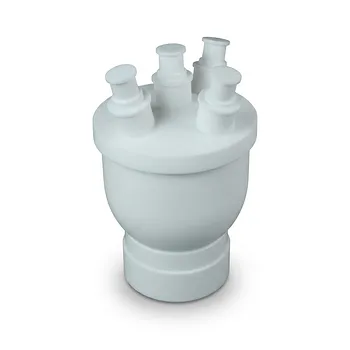
Hydrothermal reactor linings are the silent enablers of advanced materials discovery. They provide a chemically inert environment that allows for the precise manipulation of solubility and deposition in multicomponent aqueous systems. This isolation ensures that reactions occur without interference from the reactor vessel itself, facilitating the stabilization of metastable phases and the mapping of complex phase diagrams.
By providing a non-reactive barrier and broad chemical compatibility, hydrothermal linings allow researchers to explore extreme reaction conditions—such as high pH and high vapor pressures—that would otherwise lead to material decomposition or reactor corrosion. This capability is essential for identifying novel inorganic compounds that cannot be synthesized via traditional high-temperature methods.
The Mechanics of a Controlled Synthesis Environment
Chemical Compatibility Across the pH Scale
Hydrothermal linings are designed to withstand extreme pH levels and a variety of corrosive solvents. This broad compatibility allows researchers to explore the edges of chemical stability, enabling the discovery of materials that only form under highly acidic or basic conditions.
Precise Control Over Solubility
By providing a stable environment, linings allow for the fine-tuning of deposition rates in multicomponent systems. This level of control is critical when attempting to grow high-quality crystals or precipitate specific inorganic structures from complex solutions.
Stabilization of Multicomponent Systems
In systems involving multiple elements, the lining prevents unwanted side reactions with the reactor walls. This ensures that the chemical potential of the reactants remains predictable, which is necessary for the accurate mapping of phase diagrams.
Unlocking Metastable Phases and Novel Compounds
Preventing Decomposition at Melting Points
Many novel inorganic compounds are metastable, meaning they might decompose if they reach their traditional melting points. Hydrothermal synthesis under a lined environment allows these phases to form at lower temperatures through aqueous pathways, bypassing thermal instability.
Managing High Vapor Pressures
Unlined systems may fail or contaminate the product when reagents exhibit high vapor pressures. The lining acts as a containment layer that maintains the integrity of the chemical environment, allowing volatile components to stay in solution and participate in the formation of new phases.
Identifying Hidden Inorganic Structures
Because the lining provides a "clean slate," researchers can observe how different variables—like pressure and temperature—affect the resulting structure. This leads to the identification of novel inorganic compounds that would be obscured by impurities or wall reactions in unlined vessels.
Broadening Applications: Green Chemistry and Biomass
Minimizing Hazardous Organic Solvents
Linings facilitate green chemistry by enabling reactions where water serves as the sole solvent. This reduces the environmental footprint of materials discovery and aligns with sustainable manufacturing principles.
Synthesis Without Metal Contamination
In biomass processing, an inert lining is essential for the hydrolysis of feedstocks like lignocellulosic waste. It prevents the introduction of metal catalysts or contaminants from the reactor body, resulting in a significantly cleaner end product.
Enhancing Efficiency Over Pyrolysis
Compared to high-temperature pyrolysis, lined hydrothermal reactors require lower energy inputs. The chemical environment provided by the lining allows for efficient conversion of waste into valuable chemicals without the need for extreme heat.
Understanding the Trade-offs
Thermal Conductivity and Lag
While linings provide chemical protection, they often act as insulators. This can create a temperature gradient or a "thermal lag" between the reactor’s heating element and the internal solution, requiring careful calibration of reaction times.
Pressure and Temperature Limitations
Different lining materials (such as Teflon, PEEK, or Silver) have specific mechanical limits. Exceeding the rated temperature or pressure of a lining can lead to deformation, leakage, or "ballooning," which can ruin an experiment and damage the reactor.
Permeability and Cross-Contamination
Some polymer linings can be slightly permeable to gases or small ions over long durations or at high temperatures. Over time, this can lead to trace contamination or even corrosion of the underlying stainless steel shell if the lining is not properly maintained or replaced.
Applying These Insights to Material Research
Making the Right Choice for Your Goal
- If your primary focus is Discovering New Phases: Utilize the lining's stability to map phase diagrams at extreme pH levels where traditional vessels would corrode.
- If your primary focus is Synthesizing Metastable Materials: Leverage the lower-temperature aqueous pathway provided by the lining to prevent the decomposition of delicate structures.
- If your primary focus is Green Chemistry or Biomass: Ensure the lining is completely inert to prevent metal leaching, which maintains the purity of your bio-derived chemicals.
- If your primary focus is High-Pressure Safety: Regularly inspect the lining for signs of deformation or wear to prevent catastrophic failure of the pressure vessel.
By mastering the chemical and thermal environment provided by reactor linings, researchers can move beyond traditional synthesis limits to uncover the next generation of inorganic materials.
Summary Table:
| Feature | Impact on Material Discovery | Advantage |
|---|---|---|
| Chemical Inertness | Eliminates reactor wall side-reactions | Ensures high-purity phase mapping |
| Extreme pH Stability | Enables synthesis in highly acidic/basic media | Accesses previously unreachable chemical spaces |
| Low-Temp Pathways | Stabilizes metastable phases below melting points | Prevents thermal decomposition of new structures |
| Thermal Insulation | Creates controlled temperature gradients | Allows for fine-tuned crystal growth rates |
| Contaminant Barrier | Prevents metal leaching from stainless steel | Essential for clean biomass & green chemistry |
Elevate Your Research with KINTEK’s High-Performance Fluoropolymers
Unlock the full potential of hydrothermal synthesis with KINTEK. We specialize in high-performance PTFE and PFA laboratory supplies, providing the inert environments critical for discovering the next generation of inorganic materials.
Our extensive range covers everything from everyday basic labware (beakers, crucibles, reagent bottles) and fluid transfer components (tubing, valves) to advanced reaction apparatus like custom hydrothermal synthesis liners, electrochemical cells, and microwave digestion vessels.
Why choose KINTEK?
- Precision Engineering: End-to-end custom CNC fabrication for non-standard machined parts and bespoke setups.
- Material Expertise: An absolute focus on fluoropolymer performance to prevent contamination and withstand extreme pH levels.
- Scalability: Whether you need high-volume consumables or a single complex prototype, we deliver with uncompromising quality.
Ready to optimize your laboratory environment? Contact KINTEK today to discuss your custom project and explore our full product catalog!
Related Products
- High Temperature Corrosion Resistant Hydrothermal Synthesis Reactor with TFM Inner Liner and Straight Cylinder Design
- PTFE Lined High Pressure Digestion Vessel 50ml High Temperature Hydrothermal Synthesis Tank
- High Pressure Custom TFM Reactor Stainless Steel Outer Vessel PTFE Inner Cup for Corrosive Synthesis
- Custom TFM Reaction Vessel with Stainless Steel Jacket and PTFE Inner Cup for High Corrosion Resistance
- Custom PTFE Reaction System with Hose Barb Fittings Corrosion Resistant High Sealing 2L 4L Lab Reactor with Separatory Funnel
People Also Ask
- What is the role of a corrosion-resistant reactor in the synthesis of lignin-based carbon dots? Ensure Maximum Purity
- What are the technical advantages of using hydrothermal synthesis reactors for advanced electronic & optical nanomaterials?
- How does a hydrothermal synthesis reactor facilitate the production of crystalline materials with tailored morphologies? Precision Crystal Growth
- Why is the sealing reliability of a hydrothermal synthesis reactor critical for 24-hour cycles? Ensure Nano-Precision
- What role do hydrothermal synthesis reactors play in CQD preparation? Achieve High-Purity Nanomaterial Synthesis