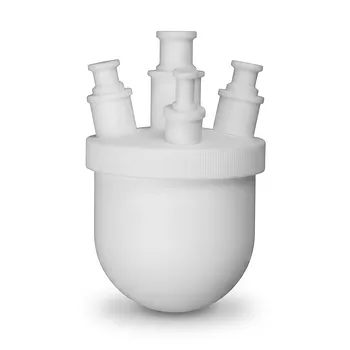
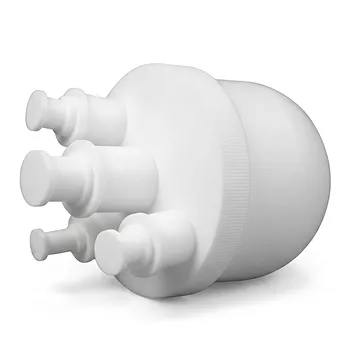
Hydrothermal reaction vessels facilitate the synthesis of 3D NiCo LDH nanoflowers by providing a high-pressure, high-temperature environment that drives mass transfer and oriented crystal growth. These vessels allow for heterogeneous nucleation directly onto 2D templates, ensuring that the resulting nanoflower structures are stable, highly crystalline, and structurally optimized for applications like photocatalysis.
The core function of a hydrothermal vessel is to create a controlled, high-energy environment that forces reactants to overcome kinetic barriers. By maintaining temperatures (such as 180 °C) and pressures that exceed atmospheric conditions, the vessel transforms simple precursors into complex, 3D architectures through guided ion diffusion and specific crystal orientation.
The Role of the Sealed High-Pressure Environment
Accelerating Ion Diffusion and Mass Transfer
The high-pressure environment within the vessel significantly accelerates ion diffusion rates compared to open-system reactions. This increased mobility ensures that reactants reach the template surface efficiently, overcoming the natural resistance of the liquid medium.
Establishing Uniform Thermal Fields
Hydrothermal vessels provide a uniform thermal field, which is critical for consistent crystal growth across the entire template. Stable temperature control prevents localized variations that could lead to irregular morphology or incomplete reactions.
Maintaining Chemical Saturation
Because the environment is sealed, the concentration of precursors remains stable throughout the reaction. This stability is essential for achieving high crystallinity and ensuring that atoms are effectively incorporated into the crystal lattice.
Mechanisms of Structural Formation
Promoting Heterogeneous Nucleation
The vessel's conditions favor heterogeneous nucleation, where crystals begin forming directly on the surface of 2D templates like Ti3C2@TiO2. This surface-guided process prevents the random precipitation of particles in the solution and anchors the growth to the desired substrate.
Guiding Oriented Crystal Growth
Under hydrothermal conditions, NiCo LDH crystals are guided to grow along specific crystallographic directions. Instead of forming flat layers, these crystals assemble into "open" 3D nanoflower structures that extend outward from the 2D template.
Enhancing Surface Area and Interaction
The resulting 3D structures are highly beneficial for chemical processes because they shorten reactant diffusion distances. Furthermore, the complex flower-like geometry increases the efficiency of light reflection and scattering, which is vital for photocatalytic performance.
Understanding the Trade-offs and Constraints
Kinetic Control vs. Structural Integrity
While higher temperatures and pressures accelerate growth, exceeding optimal limits can lead to the overgrowth or collapse of the delicate nanoflower petals. Precise control is required to balance the speed of synthesis with the definition of the 3D morphology.
Material Compatibility and Safety
Operating at temperatures like 180 °C requires vessels made of specialized materials, such as Teflon-lined stainless steel, to prevent corrosion and withstand internal pressure. Failure to maintain the vessel’s seals can result in pressure drops that halt the oriented growth process entirely.
Scalability and Monitoring Challenges
Because the reaction occurs in a sealed "black box," it is impossible to observe the growth in real-time. This necessitates extensive pre-experimental calibration to ensure the timing of the transition from 2D templates to 3D structures is accurate.
How to Apply This to Your Synthesis Goals
Optimizing Your Hydrothermal Strategy
To achieve the best results when growing 3D nanostructures on templates, consider the following technical priorities:
- If your primary focus is maximizing specific surface area: Optimize the pressure to favor the growth of thinner, more numerous "petals" in the 3D nanoflower structure.
- If your primary focus is high crystallinity and purity: Ensure the vessel maintains a strictly uniform thermal field at 180 °C to allow for complete incorporation of precursors into the lattice.
- If your primary focus is photocatalytic efficiency: Focus on the orientation of the crystals to ensure the 3D structure maximizes light scattering within the system.
By mastering the high-pressure environment of the hydrothermal vessel, you can transform simple 2D templates into high-performance 3D architectures.
Summary Table:
| Mechanism | Functional Role | Impact on Nanostructure |
|---|---|---|
| High Pressure | Accelerates ion diffusion | Overcomes kinetic barriers for complex 3D architecture |
| Uniform Heat | Establishes stable thermal field | Ensures consistent morphology and high crystallinity |
| Sealed System | Maintains chemical saturation | Promotes stable atom incorporation into the lattice |
| Surface Growth | Favors heterogeneous nucleation | Anchors 3D nanoflowers directly onto 2D templates |
| Crystal Guidance | Drives oriented growth | Creates open 3D structures with high light scattering |
Elevate Your Material Synthesis with KINTEK’s High-Performance Solutions
Achieving precise 3D nanostructures like NiCo LDH nanoflowers demands laboratory equipment that can withstand extreme high-pressure and high-temperature environments without compromising purity. At KINTEK, we specialize in manufacturing an exhaustive range of laboratory supplies crafted from premium PTFE and PFA, specifically designed for advanced chemical synthesis.
From essential basic labware (beakers, crucibles, and reagent bottles) and sample prep tools (filters, pipettes, and tweezers) to specialized reaction apparatus like Teflon-lined hydrothermal synthesis liners, microwave digestion vessels, and custom electrochemical cells, we provide the tools necessary for superior material performance. Our expertise extends to comprehensive fluid transfer components (tubing, valves, fittings) and general consumables (O-rings, gaskets, and septa), all backed by end-to-end custom CNC fabrication.
Whether you require high-volume standard orders or bespoke, non-standard machined parts for unique laboratory setups, KINTEK’s absolute focus on high-performance fluoropolymers ensures your research achieves maximum structural integrity and efficiency.
Ready to optimize your synthesis process? Contact our technical team today to discuss your custom laboratory requirements!
References
- Lijarani Biswal, Kulamani Parida. MXene Derived Ti<sub>3</sub>C<sub>2</sub>–TiO<sub>2</sub> Coupled NiCo LDH: A 2D/3D Interfacial Engineered S-Scheme Heterojunction for Enhanced Photocatalytic H<sub>2</sub>O<sub>2</sub> and H<sub>2</sub> Production. DOI: 10.1021/acs.langmuir.5c03086
This article is also based on technical information from Kintek Knowledge Base .
Related Products
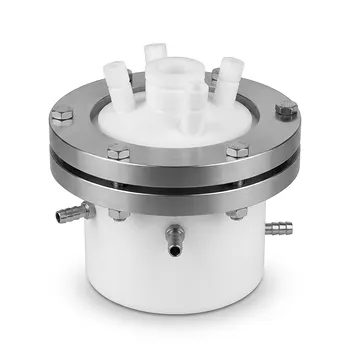
- High Temperature Corrosion Resistant Hydrothermal Synthesis Reactor with TFM Inner Liner and Straight Cylinder Design
- PTFE Lined High Pressure Digestion Vessel 50ml High Temperature Hydrothermal Synthesis Tank
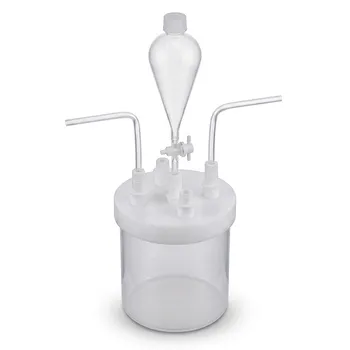
- Custom PTFE Reaction System with Hose Barb Fittings Corrosion Resistant High Sealing 2L 4L Lab Reactor with Separatory Funnel
- High Pressure Custom TFM Reactor Stainless Steel Outer Vessel PTFE Inner Cup for Corrosive Synthesis
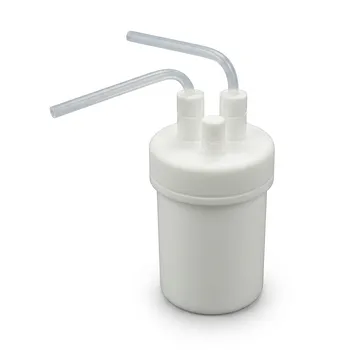
- High Purity PFA Reaction Vessel for Biopharmaceutical Synthesis and Corrosive Chemical Fluid Handling with Customizable Tube Fittings
People Also Ask
- What is the role of a corrosion-resistant reactor in the synthesis of lignin-based carbon dots? Ensure Maximum Purity
- What are the technical advantages of using hydrothermal synthesis reactors for advanced electronic & optical nanomaterials?
- How does a hydrothermal synthesis reactor facilitate the production of crystalline materials with tailored morphologies? Precision Crystal Growth
- Why is the sealing reliability of a hydrothermal synthesis reactor critical for 24-hour cycles? Ensure Nano-Precision
- What role do hydrothermal synthesis reactors play in CQD preparation? Achieve High-Purity Nanomaterial Synthesis