Fluorinated polyphosphazenes offer a major processing advantage over conventional PTFE: selected materials bearing fluoroalkoxy side groups, such as trifluoroethoxy groups, can dissolve in common organic solvents including acetone and methyl ethyl ketone. PTFE is essentially insoluble and has extremely high melt viscosity, so it cannot be processed through ordinary solution coating or conventional melt molding. This makes fluorinated polyphosphazenes attractive when a high-performance fluorinated surface must be applied, cast, or chemically modified from solution.
The key distinction is not simply performance, but processability. PTFE provides exceptional chemical inertia, hydrophobicity, low surface energy, and thermal stability, but its insolubility restricts fabrication. Fluorinated polyphosphazenes can provide comparable fluorinated surface behavior while enabling solution-based processing.
Why PTFE Is Difficult to Process
PTFE is effectively insoluble
PTFE’s highly fluorinated, crystalline structure gives it exceptional chemical resistance and hydrophobicity. The same structural stability makes it resistant to dissolution in ordinary organic solvents.
As a result, PTFE generally cannot be applied as a conventional solution, painted from a solvent, or readily re-dissolved for post-processing.
Its melt viscosity limits conventional molding
PTFE does not flow like a typical thermoplastic during melt processing. Its extremely high melt viscosity prevents standard injection molding and melt extrusion under ordinary equipment conditions.
Manufacturers instead rely on compression molding, paste extrusion, sintering, or machining. These methods are effective for bulk components but less convenient for thin films, conformal coatings, and solution-deposited structures.
Fabrication can constrain component design
PTFE can deliver excellent bulk performance, but complex assemblies may require specialized tooling, sintering, or precision machining. Joining and forming intricate, seamless geometries can therefore be more difficult than with melt-processable fluoropolymers.
PFA and FEP address some of these limitations through melt processing, but they do not provide the same solution-processability advantage as a genuinely soluble fluorinated polymer.
How Fluorinated Polyphosphazenes Differ
Fluoroalkoxy side groups can enable dissolution
Fluorinated polyphosphazenes with single fluoroalkoxy side groups can remain soluble in solvents such as acetone and methyl ethyl ketone. This is the central contrast with PTFE.
The polymer can therefore be handled as a solution rather than only as a powder, preform, or sintered solid.
Solution processing expands manufacturing options
Solubility enables techniques that are difficult or impossible with conventional PTFE, including:
- Solution casting
- Film formation
- Coating of complex surfaces
- Deposition onto temperature-sensitive substrates
- Solution-based surface modification
- Blending or formulation with compatible components
These methods can reduce dependence on high-temperature sintering and specialized PTFE fabrication equipment.
Processing can be decoupled from final geometry
With PTFE, the manufacturing route is closely tied to the material’s powder and sintering behavior. A soluble fluorinated polyphosphazene can instead be deposited onto a preformed structure or shaped by solvent evaporation.
That is particularly valuable for thin, conformal, or geometrically complex layers where machining a solid PTFE part would be impractical.
Performance Comparison
Surface properties
PTFE remains the benchmark for extremely low surface energy, non-wetting behavior, and hydrophobicity. Fluorinated polyphosphazenes with appropriate fluoroalkoxy substitution can exhibit similar fluorinated surface characteristics, making them useful where water repellency and low adhesion are important.
“Similar,” however, should not be interpreted as universally identical. Contact angle, friction, adhesion, wear, and chemical resistance must be measured for the specific polyphosphazene formulation and processing history.
Chemical resistance
PTFE is renowned for broad chemical inertness. It is often selected when maximum resistance to aggressive chemicals is the primary requirement.
Fluorinated polyphosphazenes can provide strong chemical resistance, but their performance depends on the backbone, side-group chemistry, molecular weight, crosslinking, and exposure conditions. They should not automatically be treated as drop-in chemical equivalents to PTFE.
Thermal and radiation performance
The primary advantage of these fluorinated polyphosphazenes is that solution processability can be combined with high-performance fluoropolymer characteristics, including hydrophobic behavior and radiation stability.
The relevant qualification is application-specific: long-term temperature capability, radiation dose, atmosphere, and mechanical loading should be evaluated rather than inferred solely from surface chemistry.
Mechanical behavior
PTFE is well established for bulk components requiring low friction, chemical resistance, and high-temperature endurance. Fluorinated polyphosphazenes may be more useful as films, coatings, or engineered polymer layers than as direct replacements for every load-bearing PTFE component.
Their mechanical performance can vary substantially with molecular architecture and whether the material is plasticized, reinforced, crosslinked, or supported by a substrate.
Processability Compared With PFA and FEP
PTFE versus melt-processable fluoropolymers
PFA and FEP reduce PTFE’s processing limitations by lowering crystallinity through copolymer design. They can be extruded, injection molded, or otherwise processed using conventional thermoplastic methods.
This makes them suitable for tubing, valves, fittings, vessels, and other complex components. However, melt-processability is different from solubility: PFA and FEP are generally processed as melts rather than dissolved in common solvents.
Where fluorinated polyphosphazenes offer a distinct advantage
Fluorinated polyphosphazenes are especially differentiated when the application requires:
- A low-temperature deposition route
- A thin or conformal fluorinated coating
- Solution casting over a complex substrate
- Solvent-based blending or formulation
- Post-deposition surface treatment
- Processing without PTFE sintering or high-temperature melt equipment
In these cases, their advantage is not necessarily superior bulk performance. It is the ability to combine fluorinated functionality with a more adaptable manufacturing route.
Understanding the Trade-offs
Solubility does not guarantee PTFE-equivalent performance
A soluble polymer is not automatically a functional replacement for PTFE. PTFE’s combination of chemical inertness, thermal stability, low friction, and established durability is difficult to reproduce in every application.
The correct comparison must include the full operating environment, not just whether the material dissolves.
Solvent compatibility creates new design requirements
Solution processing introduces considerations that do not dominate conventional PTFE fabrication. These include solvent selection, drying rate, residual solvent, film shrinkage, coating uniformity, substrate compatibility, and solvent recovery.
A formulation that dissolves in acetone or methyl ethyl ketone may still be unsuitable for a particular substrate, production environment, or regulatory requirement.
Coatings may not replace bulk PTFE components
A fluorinated polyphosphazene coating can provide a low-energy, hydrophobic surface, but its durability depends on adhesion and resistance to abrasion, swelling, cracking, and delamination.
For thick, mechanically loaded, or highly abrasive components, bulk PTFE, PFA, or another engineered fluoropolymer may remain the more reliable choice.
Solubility can reflect reduced structural stability
The molecular features that improve dissolution can also affect crystallinity, chain packing, solvent uptake, and thermal behavior. Those effects may influence modulus, permeability, wear resistance, and dimensional stability.
Material selection should therefore assess the final processed film or component, not only the polymer in solution.
How to Select the Right Material
The best choice depends on whether the dominant challenge is ultimate fluoropolymer performance, melt fabrication, or solution-based manufacturing.
- If your primary focus is maximum chemical inertia, low friction, and established bulk PTFE performance: Choose PTFE, provided compression molding, sintering, paste extrusion, or machining meets the design requirements.
- If your primary focus is conventional melt fabrication of complex fluoropolymer parts: Consider PFA or FEP, recognizing that these materials are melt-processable rather than generally solution-processable.
- If your primary focus is solution casting, conformal coating, or solvent-based surface modification: Evaluate a fluorinated polyphosphazene with fluoroalkoxy side groups, such as trifluoroethoxy groups.
- If your primary focus is a demanding radiation or chemical environment: Use application-specific testing to confirm that the selected polyphosphazene matches PTFE’s required stability under the actual exposure conditions.
The practical advantage of fluorinated polyphosphazenes is the ability to obtain fluorinated surface functionality without accepting PTFE’s severe solubility and processing constraints.
Summary Table:
| Property | Conventional PTFE | Fluorinated Polyphosphazenes |
|---|---|---|
| Solubility | Essentially insoluble in most solvents | Soluble in some organic solvents (e.g., acetone, MEK) with fluoroalkoxy groups |
| Processability | High melt viscosity; requires compression molding, sintering, or machining | Can be solution cast, coated, or deposited at low temperatures |
| Surface properties | Extremely low surface energy, high hydrophobicity | Similar fluorinated surface characteristics possible |
| Chemical resistance | Exceptional broad chemical resistance | Good but depends on formulation; not always equivalent |
| Thermal stability | Excellent high-temperature performance | Can be good; application-specific |
| Mechanical behavior | Established for bulk components | Varies; often used as films/coatings |
| Applications | Bulk parts, seals, bearings, chemical vessels | Thin coatings, films, surface modification, complex geometries |
Ready to leverage the unique solution processability of fluorinated polyphosphazenes for your high-performance fluoropolymer applications? At KINTEK, we specialize in crafting precise PTFE and PFA labware, from beakers to custom electrochemical cells. Our end-to-end CNC machining capabilities ensure you get exactly the components you need, whether off-the-shelf or bespoke. Contact us today to discuss your project and discover how our expertise can accelerate your research and production. Reach out to our team now!
Related Products
- High Purity PFA PTFE Flare Stop Valves Customizable 2-Way 3-Way Reducing Fluoropolymer Fluid Control Solutions
- Translucent PFA Bottle Top Dispenser for Corrosion Resistant Chemical Squeeze Extraction
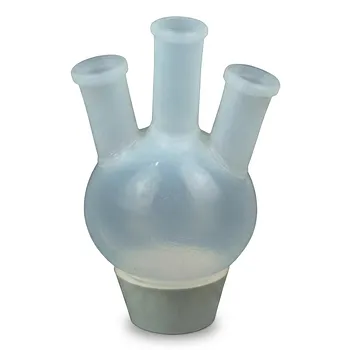
- PTFE Distillation Condensation Apparatus High Temperature Hydrofluoric Acid Resistant Fluorination Reaction Flask
- PFA Chemical Reaction Tank with Customizable Fittings for Corrosive Solvent Synthesis and High Purity Lab Applications
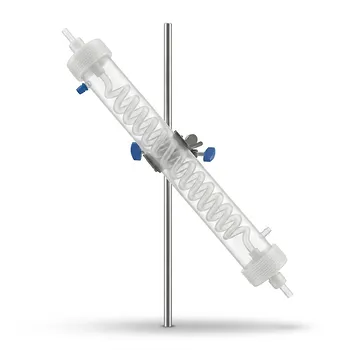
- Custom PFA Serpentine Straight Condenser HF Resistant Reaction Device Laboratory Cooling Column
People Also Ask
- What is the typical operating temperature and pressure range for PTFE valves? Key Specs for Optimal Performance
- What industries commonly use PTFE valves and components? Essential for Chemical & Purity Applications
- What specific advantages do PTFE valves offer? Unmatched Corrosion Resistance for Industrial Chemical Handling
- How do PTFE valves and components support high-purity liquid transfer? Ensure Product Integrity with Inert Materials
- What are the key properties of PTFE valves? Ensure Purity, Safety, and Reliability in Demanding Processes