Fluorinated block structures generally produce denser, more thermally stable materials than standard hydrogenated polymers. Across approximately 300–600 K, fluorinated structures maintain higher bulk density, often reported around 1.4–1.6 g/cm³ compared with roughly 0.6–0.8 g/cm³ for conventional hydrogenated polymers. Density decreases as temperature rises because chain motion and thermal expansion increase, but the response is typically predictable and approximately linear; block length has comparatively little effect on the overall density.
The key engineering advantage is predictability: fully fluorinated structures combine high density with resistance to thermal degradation, allowing labware to retain dimensional stability, seal performance, and chemical purity during demanding high-temperature operations.
Why Fluorinated Structures Are Denser
Fluorine changes chain packing
Fluorine atoms substantially alter polymer geometry, mass distribution, and intermolecular interactions. In fully fluorinated materials, the carbon backbone is heavily shielded by fluorine, producing a structure that is generally denser than many hydrogen-containing polymer systems.
The exact value depends on whether “bulk density” means true material density or the apparent density of a powder, porous article, or molded part. Reported values should therefore be treated as formulation- and processing-dependent rather than universal constants.
Block length has limited influence
Molecular-dynamics assessments indicate that changing internal fluorinated segment length or chain topology has only a modest effect on overall bulk density. The dominant factor is the presence and concentration of fluorinated segments, especially fully fluorinated portions of the chain.
This matters because designers can often adjust block architecture to tune processing or mechanical behavior without assuming a proportionate change in the component’s overall volumetric behavior.
Density falls predictably with temperature
From approximately 300 K to 600 K, increasing temperature increases chain mobility and thermal expansion. As a result, density decreases across both fluorinated and hydrogenated formulations.
The important distinction is not that fluorinated polymers avoid thermal expansion. Rather, their density remains substantially higher and their temperature response is generally more orderly, with no expected abrupt volumetric transition solely from changing block length.
How Fluorinated Structures Improve Thermal Stability
Strong carbon-fluorine bonds resist degradation
Fluorocarbon stability derives in large part from the high energy of C–F and C–C bonds. Fluorine also protects the backbone from chemical attack, helping fully fluorinated polymers withstand combinations of heat, oxidants, acids, bases, and organic solvents.
This stability is especially valuable when a component must retain its shape and purity while exposed to hot, aggressive chemicals.
Hydrogen-containing backbones have a temperature limit
Hydrogen-containing fluoropolymers, including VDF-based materials such as PVDF, can undergo dehydrofluorination at elevated temperatures or in the presence of strong bases and organic amines. The reaction creates carbon-carbon double bonds that become vulnerable sites for further chemical degradation.
For these materials, continuous service temperatures are commonly limited to approximately 200–215°C, depending on grade, stress, atmosphere, and exposure conditions.
Fully fluorinated polymers extend the operating window
Fully fluorinated polymers such as PTFE and PFA contain no hydrogen atoms along the relevant polymer backbone, so they avoid the same dehydrofluorination pathway. They can maintain useful thermal and chemical performance at temperatures approaching or exceeding 260–300°C, depending on the application and supplier’s continuous-use rating.
Their decomposition temperatures can be much higher than their recommended service temperatures. A high thermogravimetric decomposition temperature does not mean that a component can safely operate indefinitely at that temperature under load.
What This Means Across Temperature Ranges
Near ambient and moderate temperatures
At approximately 300 K, fluorinated structures already show a density advantage over the conventional hydrogenated reference range. This supports consistent mass-to-volume relationships in molded parts, tubing, vessels, and machined components.
Hydrogenated polymers may offer higher strength or stiffness in this range, so density alone does not determine component performance.
Elevated processing temperatures
As temperature approaches 400–500 K, both material classes expand and their density declines. Fluorinated polymers retain the advantage of a higher baseline density, while their chemical structure provides better resistance to oxidation and thermally initiated degradation.
The practical result is more stable geometry during heating, provided the component is designed for the polymer’s actual creep, pressure, and stress behavior.
High-temperature chemical operation
Between approximately 500 K and 600 K, the difference in chemical stability becomes increasingly important. Fully fluorinated materials are better suited to hot acids, oxidizing environments, and aggressive alkaline processes than hydrogen-containing alternatives, although operating limits must still be verified for pressure, mechanical loading, and exposure time.
At these temperatures, density trends are only one part of the design calculation. Creep, relaxation, permeability, thermal gradients, and joint design can control service life.
Why This Matters for Fluoropolymer Labware
Dimensional stability protects fit and function
High-performance labware often depends on predictable dimensions. A digestion vessel, crucible, reaction tube, or machined insert must maintain its shape closely enough to preserve capacity, alignment, clearances, and contact with adjacent components.
A stable thermal-density profile helps engineers estimate thermal expansion and avoid unexpected changes in volume or fit during repeated heating cycles.
Seal integrity depends on controlled deformation
Seals and sealing surfaces are sensitive to thermal expansion, compression loss, creep, and chemical attack. If a polymer changes volume or softens unpredictably, the result can be leakage, contamination, or loss of pressure control.
PTFE and PFA do not eliminate these risks, but their thermal and chemical stability makes their behavior more manageable in severe laboratory service. Seal geometry and compression conditions still require independent validation.
Chemical purity is easier to preserve
Fully fluorinated materials provide very low chemical reactivity and minimal sorption compared with many conventional polymers. This is important for trace analysis, microwave digestion, high-purity reagent handling, and processes where leaching or sample absorption would compromise results.
The same structural features that improve thermal endurance also help protect contents from contamination during hot chemical exposure.
Mechanical design must account for trade-offs
PTFE and PFA are preferred for extreme chemical and thermal conditions, but hydrogen-containing fluoropolymers such as ETFE and PVDF can provide higher strength and stiffness at lower temperatures. The correct choice depends on the balance between rigidity, temperature, chemical exposure, and dimensional requirements.
A denser material is not automatically stronger, stiffer, or better for every laboratory component.
Understanding the Trade-offs
Bulk density is not the same as true density
The stated ranges of 1.4–1.6 g/cm³ and 0.6–0.8 g/cm³ should not be applied indiscriminately to all fluoropolymers and hydrogenated polymers. Powder packing, porosity, crystallinity, fillers, processing history, and measurement method can substantially change apparent bulk density.
For design work, use the manufacturer’s data for the specific grade and distinguish among true density, molded-part density, and powder bulk density.
Thermal stability does not mean unlimited service temperature
A polymer may show a high decomposition onset in air while still being unsuitable for continuous mechanical service at that temperature. Load, pressure, thermal cycling, oxygen availability, chemical contact, and part thickness can reduce the practical operating limit.
Use the supplier’s continuous-use temperature and chemical compatibility data as the governing specification.
Fluorinated polymers can be mechanically softer
Fully fluorinated polymers typically provide excellent chemical and thermal resistance but may have lower stiffness, greater creep, and higher elongation than hydrogen-containing alternatives. PTFE, in particular, requires careful consideration when used under sustained compressive loads or at elevated temperatures.
Where rigidity is the primary requirement and the temperature is moderate, ETFE, PVDF, or another hydrogen-containing fluoropolymer may be more appropriate.
Thermal expansion still affects assemblies
Predictable expansion is useful, but it must still be accommodated. Mismatched expansion between a fluoropolymer component and metal, glass, ceramic, or another polymer can generate stress, loosen interfaces, or distort seals.
Designers should evaluate the complete assembly rather than selecting a material based only on its standalone density or decomposition temperature.
Making the Right Choice for Your Goal
The material decision should combine thermal-density data with chemical exposure, mechanical loading, pressure, and purity requirements.
- If your primary focus is extreme chemical resistance and high-temperature digestion: Prefer fully fluorinated materials such as PTFE or PFA, while verifying the supplier’s continuous-use rating and the specific reagent conditions.
- If your primary focus is predictable dimensional behavior during heating: Use the material’s measured thermal expansion and density profile for the exact grade, part geometry, and processing condition.
- If your primary focus is rigidity and load-bearing strength at moderate temperatures: Consider hydrogen-containing fluoropolymers such as ETFE or PVDF, provided their thermal and chemical limits are acceptable.
- If your primary focus is seal reliability: Evaluate creep, compression set, thermal expansion mismatch, and chemical compatibility together rather than relying on density alone.
- If your primary focus is trace-analysis purity: Select a fully fluorinated, low-sorption grade and validate extractables, leachables, and cleaning procedures for the intended chemicals.
For high-performance fluoropolymer labware, the strongest design is one that matches fluorinated structure, thermal-density behavior, and mechanical loading to the actual operating environment.
Summary Table:
| Property | Fluorinated Polymers (e.g., PTFE, PFA) | Hydrogenated Polymers (e.g., PE, PP) |
|---|---|---|
| Bulk Density (approx.) | 1.4–1.6 g/cm³ | 0.6–0.8 g/cm³ |
| Thermal Stability | Excellent; continuous use up to 260–300°C | Limited; typical max ~200–215°C |
| Resistance to Chemical Attack | High; resistant to acids, bases, solvents | Lower; susceptible to oxidation and degradation |
| Dimensional Stability | Predictable thermal expansion | Higher expansion; less predictable |
| Mechanical Strength | Lower stiffness; higher creep | Higher stiffness; lower creep |
| Typical Applications | High-purity labware, digestion vessels, seals | General labware, containers, tubing |
Note: Actual values depend on specific grade and processing conditions.
Maximize the performance of your lab with our high-performance fluoropolymer labware. Our PTFE and PFA products are engineered for exceptional density, thermal stability, and chemical purity, ensuring reliable results even in the most demanding applications. From digestion vessels and crucibles to custom machined parts, we provide the precise tools you need. Contact us today to discuss your requirements and discover how our fluoropolymer solutions can enhance your lab's efficiency and accuracy.
Related Products
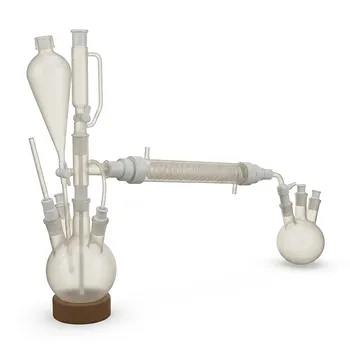
- PTFE Distillation Condensation Apparatus High Temperature Hydrofluoric Acid Resistant Fluorination Reaction Flask
- PFA Chemical Reaction Tank with Customizable Fittings for Corrosive Solvent Synthesis and High Purity Lab Applications
- High Purity PFA Chromatography Column with Collection Bottle Corrosion Resistant Fluoropolymer Filtration System for Trace Analysis
- High Temperature Resistant PTFE Thermal Insulation Board Corrosion Resistant Metal Free Fluoropolymer Stand for Ultra Clean Laboratories
- High Purity PFA Coiled Tubing Custom PTFE Machining PFA Welding and Precision Bending Solutions
People Also Ask
- How does the low surface energy of PTFE benefit the condensation process? Boost Heat Transfer and Prevent Fouling
- What structural characteristics provide PTFE fluoropolymer laboratory apparatus with high thermal stability? Strong C-F bonds, dense fluorine shielding, and rigid helical conformation ensure stability during high-temperature analysis.
- How can autopolymerization of TFE gas be prevented during storage and handling? Master TFE safety with oxygen control, inhibitors, and robust system design.
- When synthesizing fluorinated polymers using volatile and toxic monomers like octafluorocyclopentene (OFCP) or decafluorocyclohexene (DFCH), what material safety and thermal features are required for fluoropolymer laboratory reaction apparatus and fluid h
- How do pyrolysis temperature and steam diluent ratios influence tetrafluoroethylene (TFE) conversion and yield in fluoropolymer monomer reaction apparatus? Optimize TFE yield with temperature and steam control