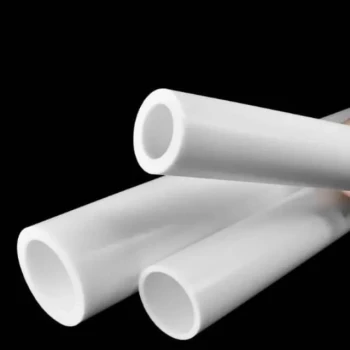
Fluid transport in PTFE capillary tubing is defined by predictable laminar flow and extreme chemical resilience. In these systems, fluid behavior follows the Hagen–Poiseuille law, where the pressure drop is directly proportional to the fluid's viscosity and the tube's length, but inversely proportional to the fourth power of the radius. Because PTFE maintains a low-friction surface, it minimizes effective wall shear stress and prevents the residue buildup common in metal or glass alternatives.
Core Takeaway: PTFE capillary tubing provides a highly stable environment for microfluidic transport by ensuring fully laminar flow and predictable pressure drops. Its unique surface chemistry allows for precise fluid control while resisting the corrosive degradation and friction-induced energy losses found in traditional materials.
The Physics of Flow in PTFE Capillaries
Laminar Flow and the Reynolds Number
Fluid transport within PTFE capillaries typically operates within the microfluidic regime. In this state, Reynolds numbers remain well below the critical threshold of 2300, ensuring the flow is fully laminar.
This lack of turbulence means fluid layers slide past one another in parallel lines. This predictability is essential for applications requiring precise dosing or consistent chemical reactions.
The Hagen–Poiseuille Equation
The Hagen–Poiseuille law serves as the mathematical foundation for calculating the pressure drop across the tubing. It states that the pressure change is dictated by the fluid viscosity, the volumetric flow rate, and the tubing length.
Crucially, the pressure drop is inversely proportional to the fourth power of the radius. Small reductions in internal diameter lead to significant increases in the pressure required to maintain flow, making manufacturing tolerances for PTFE capillaries critical.
Material Influence on Fluid Dynamics
Reduced Wall Shear Stress
PTFE’s primary advantage over glass or metal is its extraordinarily low coefficient of friction. This characteristic reduces the effective wall shear stress encountered by the fluid at the tubing boundary.
By minimizing the "drag" at the tube wall, PTFE allows for a more efficient flow profile. This reduction in friction helps maintain the integrity of sensitive fluids and reduces the energy required for pumping.
Surface Energy and Hydrophobicity
PTFE possesses high surface energy and hydrophobicity, leading to a high contact angle with aqueous solutions. This often results in negative capillary pressure, which can actually suppress the spontaneous rise of water-based liquids.
Conversely, for non-polar liquids, wetting is improved. This selectivity makes PTFE an excellent candidate for membrane distillation or gas-liquid separation, where liquid breakthrough must be prevented while allowing vapors to pass.
Performance in Demanding Environments
Chemical Inertness and Purity
The fluorine sheath surrounding the carbon backbone of PTFE makes it virtually non-reactive. It can transport aggressive acids, such as hydrofluoric acid, and strong bases that would rapidly degrade other materials.
Because the material is chemically inert, it prevents leached ions from entering the fluid stream. This ensures that high-purity reagents used in laboratory or semiconductor processes remain uncontaminated.
Thermal and Structural Stability
PTFE capillaries maintain their mechanical integrity across a staggering temperature range, from cryogenic levels up to 260 °C. In aerospace applications, this allows the tubing to survive extreme thermal cycling and high-vibration environments.
Despite being lightweight—a key factor for reducing aircraft mass—the material remains non-flammable. Its high dielectric strength also ensures safety when fluid lines are routed near sensitive electronics.
Understanding the Trade-offs
Mechanical Limits and "Cold Flow"
While PTFE is chemically superior, it has lower mechanical strength compared to stainless steel. Under high pressure or physical load, PTFE can experience "creep" or cold flow, where the material slowly deforms over time.
This limitation means that for ultra-high-pressure applications, PTFE must often be reinforced or used within specific pressure envelopes. It is essential to match the tubing's wall thickness to the intended system pressure to avoid failure.
Wetting and Priming Challenges
The same hydrophobicity that prevents contamination can make "priming" a system difficult with aqueous fluids. Achieving a consistent flow may require initial high-pressure pulses to overcome the negative capillary pressure.
Engineers must also account for the fact that non-polar solvents will wet the surface much more readily than water. This difference can lead to variations in residual volume when switching between different chemical types.
Making the Right Choice for Your Goal
How to Apply This to Your Project
- If your primary focus is Precision Microfluidics: Prioritize tight tolerances on the internal radius, as even a micron-level deviation will exponentially impact your pressure drop according to the Hagen–Poiseuille law.
- If your primary focus is Chemical Purity: Utilize PTFE’s non-stick properties to minimize residue buildup and eliminate the risk of metallic ion leaching in sensitive analytical streams.
- If your primary focus is High-Pressure Hydraulics: Consider the mechanical trade-offs and ensure the operating pressure does not exceed the material's yield point to prevent permanent deformation or "creep."
- If your primary focus is Gas-Liquid Separation: Leverage the material's high contact angle to create barriers that allow gas transport while resisting liquid breakthrough.
By mastering the intersection of Hagen–Poiseuille physics and PTFE’s unique material science, you can design fluid systems that are both mathematically predictable and resilient to the harshest environments.
Summary Table:
| Feature | Fluid Dynamics Impact | Key Advantage |
|---|---|---|
| Laminar Flow | Reynolds numbers < 2300 | Predictable, layer-by-layer fluid transport |
| Hagen-Poiseuille | $P \propto 1/r^4$ | Precise pressure drop calculations via radius |
| Low Friction | Reduced effective wall shear stress | Energy-efficient pumping and minimal drag |
| Hydrophobicity | Negative capillary pressure | Prevents aqueous residue and contamination |
| Chemical Inertness | Zero material degradation | Maintains reagent purity with no ion leaching |
Elevate Your Lab Performance with KINTEK’s Fluoropolymer Expertise
Optimizing fluid dynamics requires materials that meet the highest standards of precision and chemical resilience. KINTEK specializes in an extensive range of high-performance PTFE and PFA laboratory supplies designed to withstand the most demanding environments.
Whether you require everyday basic labware (beakers, measuring cylinders, crucibles, reagent bottles) or specialized fluid transfer components (tubing, fittings, valves, and filters), our products ensure zero-contamination and predictable flow. For advanced research, we provide bespoke derivative and reaction apparatus, including custom electrochemical cells, battery testing fixtures, and microwave digestion vessels.
Why choose KINTEK?
- End-to-End Customization: Precision CNC fabrication for non-standard parts and complex laboratory setups.
- Total Material Focus: Absolute expertise in high-performance fluoropolymers for extreme chemical and thermal stability.
- Comprehensive Range: From simple stir bars and gaskets to advanced microchannel reactors.
Contact KINTEK today to discuss your custom project or high-volume order!
Related Products
- High Performance PFA Coiled Spring Tubing and Custom PTFE Fabrication Services with Welded Fittings and Precision Bent Components
- Custom High Purity PTFE Digestion Tubes and Centrifuge Tubes for Trace Metal Analysis
- Custom PTFE Condenser Tube Hydrofluoric Acid Resistant Reflux Device Constant Pressure Separatory Funnel
- High Purity PTFE Digestion Tubes and Custom Centrifuge Tubes 100ml for Trace Analysis and Chemical Digestion
- Custom PTFE Condenser Tube Reflux Reaction Condensation Purification Device Semiconductor Chemical Lab Equipment
People Also Ask
- What are the technical advantages of high-precision PFA tubing in MXene production? Maximize Purity and Yield.
- What technical advantages do PFA tubing and fittings offer? Master Precision Fluid Transfer and Flow Chemistry
- What are the technical advantages of high-quality PFA tubing? Achieve Ultimate Purity and Precision in Fluid Handling
- What are the key benefits of PTFE in custom fabrication? Unlock Performance in Extreme Conditions
- What fabrication services are available for PTFE? Shearing, Stamping, Laser Cutting, Molding & Machining