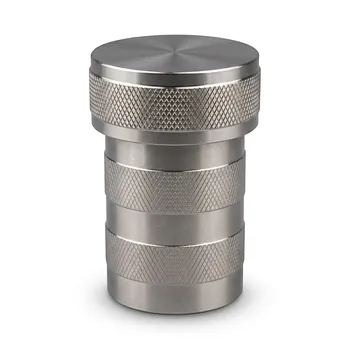
Restricting the loading volume to approximately 70 percent is a critical safety and process requirement designed to accommodate the thermal expansion of the liquid phase and manage internal vapor pressure. During the synthesis of alpha-[Fe2O3-FeOOH] at elevated temperatures (typically around 150°C), this specific fill ratio prevents catastrophic vessel failure while maintaining the precise kinetic environment necessary for the growth of high-quality nanorods.
Core Takeaway: The 70 percent fill limit provides a vital buffer zone (headspace) that prevents the liquid solvent from expanding to fill the entire vessel, which would cause an exponential, non-linear pressure spike and potential autoclave rupture.
The Mechanics of Thermal Expansion and Headspace
Volumetric Expansion of Aqueous Solvents
As the temperature inside the autoclave rises to synthesis levels, such as 150°C, the liquid solvent undergoes significant thermal expansion. Without sufficient headspace, the expanding liquid would eventually compress the remaining air and vapor to a point where the pressure exceeds the structural limits of the reactor.
Maintaining Vapor Pressure Equilibrium
The 30 percent "void" or headspace allows for a stable liquid-vapor equilibrium. This equilibrium ensures that the internal pressure remains governed by the temperature-dependent vapor pressure of the solvent rather than the mechanical force of an expanding, incompressible liquid.
Kinetic Impact on alpha-[Fe2O3-FeOOH] Growth
Stabilization of Internal Pressure
The synthesis of alpha-[Fe2O3-FeOOH] nanorods is highly sensitive to the internal pressure environment. By maintaining a consistent 70 percent loading, researchers ensure that the pressure remains within a predictable range, which directly influences the solubility of precursors and the rate of crystal nucleation.
Facilitating Nanorod Morphology
Stable pressure conditions provided by the 70 percent ratio are essential for the kinetic pathways required for nanorod formation. Fluctuations or excessive pressure caused by overfilling can lead to irregular particle sizes or the formation of undesired iron oxide phases instead of the targeted alpha-[Fe2O3-FeOOH] structure.
Understanding the Trade-offs and Risks
The Danger of Overfilling
If the loading volume exceeds 70-80 percent, the risk of vessel failure increases exponentially. At high fill levels, the liquid can expand to fill the entire volume of the liner; once the headspace is eliminated, any further temperature increase causes a massive, immediate pressure surge that can burst the Teflon liner or the steel autoclave body.
The Inefficiency of Underfilling
While filling below 50 percent is generally safe, it is often inefficient for yield and reaction rates. Low fill levels result in lower autogenous pressure, which may not provide enough energy to drive the phase transformation or crystal growth required for high-quality alpha-[Fe2O3-FeOOH] samples.
How to Optimize Your Synthesis Loading
When preparing your hydrothermal reactor, choose your loading volume based on your specific safety margins and experimental goals:
- If your primary focus is maximum safety and high-temperature stability: Limit your fill volume to 50–60 percent to provide an extra margin of error for unpredictable pressure spikes.
- If your primary focus is standard nanorod synthesis (e.g., at 150°C): Adhere to the 70 percent fill rule to balance high yields with stable kinetic conditions and proven safety protocols.
- If your primary focus is experimental reproducibility: Precisely measure your fill volume to exactly 70 percent every time, as even small variations in headspace can alter the internal pressure and shift the morphology of the resulting nanostructures.
Maintaining a strict 70 percent loading volume is the most effective way to balance the physical safety of the laboratory with the chemical precision required for advanced iron oxide synthesis.
Summary Table:
| Loading Level | Safety Risk | Synthesis Impact | Recommended Use |
|---|---|---|---|
| Below 50% | Very Low | Lower autogenous pressure; potentially lower yields. | High-safety margin testing. |
| 70% (Optimal) | Controlled | Stable kinetics; ideal for high-quality nanorods. | Standard synthesis protocols. |
| Above 80% | Extreme | High risk of vessel rupture due to liquid expansion. | Not recommended. |
Secure Your Synthesis with KINTEK’s High-Performance Fluoropolymer Solutions
Precision and safety in hydrothermal synthesis start with the right materials. KINTEK specializes in premium laboratory supplies crafted exclusively from PTFE and PFA, ensuring your reactions are contained within the highest-quality hydrothermal synthesis liners and microwave digestion vessels.
From everyday essentials like beakers, crucibles, and reagent bottles to complex custom CNC-machined parts, our end-to-end fabrication capabilities meet the most demanding laboratory requirements. Whether you are performing trace analysis or high-volume fluid transfer, our range of tubing, fittings, and advanced reaction apparatus provides the chemical resistance and durability your research deserves.
Elevate your lab’s reliability and performance. Contact us today to explore our full range of standard fluoropolymer labware or to request a bespoke setup tailored to your specific research goals!
References
- John Godwin. Hydrothermal Synthesis of Mixed Nanocomposite of α-[Fe2 O3 -FeOOH] from Iron Nitrate Salt in Teflon Autoclave. DOI: 10.61440/jmset.2025.v3.32
This article is also based on technical information from Kintek Knowledge Base .
Related Products
- High Temperature Corrosion Resistant Hydrothermal Synthesis Reactor with TFM Inner Liner and Straight Cylinder Design
- PTFE Lined High Pressure Digestion Vessel 50ml High Temperature Hydrothermal Synthesis Tank
People Also Ask
- What is the role of a corrosion-resistant reactor in the synthesis of lignin-based carbon dots? Ensure Maximum Purity
- What are the technical advantages of using hydrothermal synthesis reactors for advanced electronic & optical nanomaterials?
- How does a hydrothermal synthesis reactor facilitate the production of crystalline materials with tailored morphologies? Precision Crystal Growth
- Why is the sealing reliability of a hydrothermal synthesis reactor critical for 24-hour cycles? Ensure Nano-Precision
- What role do hydrothermal synthesis reactors play in CQD preparation? Achieve High-Purity Nanomaterial Synthesis