Lower surface tension liquids show higher contact angle hysteresis on fluorinated surfaces because they more readily invade microscopic surface features. On a nominally fluorinated, low-energy surface, that penetration can collapse the intended Cassie–Baxter composite interface and create a partially or fully wetted Wenzel state. The resulting contact-line pinning increases the difference between advancing and receding contact angles, producing higher roll-off angles despite a high static contact angle.
Static contact angle alone does not prove robust superoleophobicity. For low-surface-tension liquids, reliable droplet mobility depends on preventing texture infiltration through re-entrant or carefully engineered multiscale structures.
Why Low Surface Tension Increases Hysteresis
Surface tension controls resistance to penetration
A droplet resting on a textured surface may contact both the solid structure and trapped air. This is the Cassie–Baxter state, and it minimizes solid–liquid contact while supporting a high apparent contact angle.
Low surface tension reduces the energetic penalty associated with deforming the liquid–air interface. As a result, liquids such as silicone oils can more easily enter gaps, pores, and valleys that higher-surface-tension liquids may bridge.
Penetration changes the wetting state
Once the liquid advances into the texture, the droplet shifts toward a Wenzel-like state, where liquid contacts a much larger area of solid.
This transition can occur even when the surface chemistry remains strongly fluorinated. Fluorination lowers the solid’s surface energy, but it does not by itself guarantee that the physical texture will resist infiltration by every liquid.
Contact-line pinning creates hysteresis
Contact angle hysteresis is the difference between the advancing contact angle and the receding contact angle.
When a liquid penetrates or partially wets surface features, the contact line encounters geometric edges, defects, and local variations in wetting state. The droplet therefore requires more force to advance or recede, increasing hysteresis and raising the roll-off angle.
Why a High Static Contact Angle Can Be Misleading
Static and dynamic wetting measure different behavior
A high static contact angle describes the approximate shape of a droplet at rest. It does not reveal how strongly the contact line is pinned or whether the droplet will move under a small gravitational force.
For component performance, low hysteresis and low roll-off angle are often more important than a high static angle.
Fluorinated chemistry is only one part of the solution
Fluoropolymer or fluorinated coatings can provide low surface energy and chemical resistance. However, low surface energy does not eliminate the need for suitable geometry, especially when the working liquid has very low surface tension.
The design must address both surface chemistry and liquid-repellent architecture.
How Component Design Prevents Liquid Infiltration
Use re-entrant structures
A re-entrant structure includes an overhanging or inward-curving geometry rather than a simple pillar or ridge.
This geometry creates a capillary pressure barrier that resists downward and lateral liquid penetration. It can preserve the liquid–air interface even when the liquid has low surface tension.
The key principle is geometric: the liquid interface must encounter an unfavorable shape before it can wet the underlying surface.
Combine micro- and nanoscale texture
A tailored dual-scale texture can improve repellency by reducing the effective solid contact area and supporting the composite interface across multiple length scales.
The smaller features help maintain the interface, while the larger features provide structural support and reduce the likelihood that a droplet will bridge into a fully wetted region.
Design the entire fluid-contact path
The relevant surface is not limited to the visible top face of a component. Edges, corners, holes, channels, fittings, and internal walls can all retain liquid if their geometry permits pinning or infiltration.
For fluoropolymer containers, fluid lines, and sampling tools, the design should therefore consider:
- Internal corners and transitions
- Surface texture continuity
- Dead volumes and recesses
- Interfaces between machined parts
- Cleaning and drainage paths
- Compatibility of the texture with manufacturing methods
Use geometry to support complete drainage
A repellent surface is most useful when the component also allows liquid to leave efficiently.
Inclined or smoothly transitioning surfaces, minimized recesses, and appropriately designed outlets can reduce residual fluid after pouring, dispensing, or sample transfer. This is particularly important where retention could cause cross-contamination or incomplete sample recovery.
Understanding the Trade-offs
Texture improves repellency but can reduce durability
Fine re-entrant or hierarchical textures may be vulnerable to abrasion, machining damage, compression, or contamination.
A texture that performs well in laboratory testing may lose its function if handling or cleaning damages the overhangs. The required geometry must therefore be balanced against the component’s mechanical and maintenance demands.
More texture is not automatically better
Increasing roughness without controlling feature shape can make infiltration and pinning worse.
Simple roughness may enlarge the effective wetting area after liquid enters the texture. The objective is not maximum roughness, but a texture with the correct capillary barrier geometry.
Manufacturing constraints affect performance
Re-entrant features can be difficult to produce consistently, particularly inside narrow channels or complex internal cavities.
Machining, molding, coating, and surface-treatment processes may impose limits on feature size, aspect ratio, dimensional tolerance, and surface continuity. The wetting design should be developed alongside the manufacturing process rather than added afterward.
Contamination can defeat the designed state
Particles, residue, and adsorbed contaminants can fill texture features or alter local surface chemistry.
A component may therefore exhibit higher hysteresis over time even if its original material and geometry were appropriate. Testing should include realistic cleaning cycles and exposure to the actual process fluid.
How to Validate the Design
Measure advancing and receding angles
Static contact angle should be treated as an initial screening measurement.
Dynamic measurements reveal whether the contact line is pinned. A smaller advancing–receding difference generally indicates better droplet mobility and a lower likelihood of problematic retention.
Measure roll-off under realistic conditions
Roll-off angle provides a practical indication of whether droplets will drain under the available force.
Testing should use the actual low-surface-tension liquid, representative droplet sizes, component orientation, and surface condition. Results from water or a higher-surface-tension oil may not predict silicone-oil performance.
Inspect residual liquid and recovery
For analytical or fluid-handling equipment, the final metric may be more operational than geometric.
Measure retained liquid, sample recovery, carryover, and cross-contamination after the component has been used and cleaned. These tests determine whether the texture and component geometry solve the real process problem.
Making the Right Choice for Your Goal
Select the design approach according to the performance requirement, not static contact angle alone.
- If your primary focus is low roll-off and droplet mobility: Use re-entrant or dual-scale textures that preserve the Cassie–Baxter interface and minimize contact-line pinning.
- If your primary focus is complete sample recovery: Combine liquid-repellent surfaces with sloped, smooth, low-dead-volume component geometry.
- If your primary focus is contamination control: Evaluate internal channels, corners, interfaces, and cleaning cycles—not just the exposed fluorinated surface.
- If your primary focus is long-term durability: Choose the simplest texture that provides the required capillary barrier and verify its performance after mechanical and chemical aging.
Reliable low-surface-tension liquid handling comes from integrating fluorinated chemistry, penetration-resistant geometry, and drainage-focused component design.
Summary Table:
| Cause of High Hysteresis | Effect on Droplet Behavior | Design Solution |
|---|---|---|
| Low surface tension promotes liquid penetration into surface texture | Transition from Cassie-Baxter to Wenzel state increases contact-line pinning | Use re-entrant structures to create a capillary pressure barrier |
| Fluorinated chemistry alone cannot prevent texture infiltration | High static contact angle but high roll-off angle and poor droplet mobility | Combine micro- and nanoscale texture to support the composite interface |
| Contact-line pinning at defects and edges | Increased advancing-receding contact angle difference | Design the entire fluid-contact path with smooth transitions and minimized recesses |
| Texture susceptibility to contamination and damage | Increased hysteresis over time | Validate design with realistic cleaning cycles and mechanical/chemical aging tests |
Ready to overcome low-surface-tension liquid handling challenges? At KINTEK, we specialize in high-performance fluoropolymer components crafted from PTFE and PFA. Our expertise in designing penetration-resistant re-entrant structures and seamless component geometry ensures minimal hysteresis, complete drainage, and reliable performance for your demanding applications. Whether you need standard labware, bespoke fluid transfer systems, or custom electrochemical cells, our end-to-end CNC machining capabilities deliver tailored solutions. Contact us today to enhance your lab's efficiency and sample integrity — reach out to our team now!
Related Products
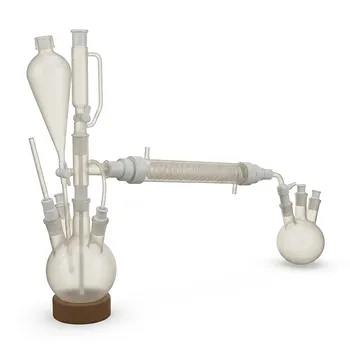
- PTFE Distillation Condensation Apparatus High Temperature Hydrofluoric Acid Resistant Fluorination Reaction Flask
- High Purity PFA Chromatography Column with Collection Bottle Corrosion Resistant Fluoropolymer Filtration System for Trace Analysis
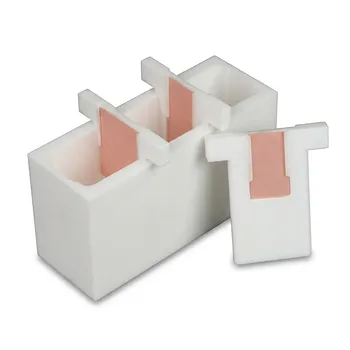
- White PTFE Electrolytic Cell with Movable Slider and Insulated Lid for Fluorine Corrosion Resistance
- PFA Eggplant Flask Custom Molded Pear Shaped Laboratory Flask Corrosion Resistant Glass Alternative
- Customizable PFA Square Tray Corrosion Resistant High Temperature Large Petri Dish Electrolytic Cell
People Also Ask
- How does the low surface energy of PTFE benefit the condensation process? Boost Heat Transfer and Prevent Fouling
- What structural characteristics provide PTFE fluoropolymer laboratory apparatus with high thermal stability? Strong C-F bonds, dense fluorine shielding, and rigid helical conformation ensure stability during high-temperature analysis.
- How can autopolymerization of TFE gas be prevented during storage and handling? Master TFE safety with oxygen control, inhibitors, and robust system design.
- When synthesizing fluorinated polymers using volatile and toxic monomers like octafluorocyclopentene (OFCP) or decafluorocyclohexene (DFCH), what material safety and thermal features are required for fluoropolymer laboratory reaction apparatus and fluid h
- How do pyrolysis temperature and steam diluent ratios influence tetrafluoroethylene (TFE) conversion and yield in fluoropolymer monomer reaction apparatus? Optimize TFE yield with temperature and steam control