Specific fluorinated solvents can often be used without prior distillation because their very low water solubility limits the amount of dissolved moisture available to quench cationic initiators. HCFCs and HFEs typically contain less than about 100 ppm water by weight under appropriate storage conditions, reducing the risk that trace moisture will terminate or deactivate the polymerization. However, this is not a universal exemption from drying: the solvent’s actual water content, initiator sensitivity, and reaction specification still determine whether additional purification is required.
Core takeaway: Low water solubility reduces the solvent’s moisture burden, but reaction integrity still depends on preventing water ingress during storage, transfer, and charging. Use chemically compatible fluoropolymer labware with reliable seals, minimal dead volume, and dry, closed handling practices.
Why Low Water Solubility Matters
Cationic polymerizations are highly moisture-sensitive
Many cationic initiators and active chain ends are readily deactivated by water. Even small quantities of moisture can consume the initiating species, terminate growing chains, or alter the intended polymerization rate and molecular-weight distribution.
The practical consequence is that solvent purification is often performed not merely to remove bulk water, but to eliminate trace moisture that could interfere with initiation.
Fluorinated solvents take up little water
HCFCs and HFEs are strongly lipophobic and generally dissolve very little water. Their typical water solubility is below approximately 100 ppm by weight, which limits how much moisture can be carried into the reaction as dissolved solvent contamination.
This differs from more water-compatible solvents, which can absorb substantially more atmospheric humidity during storage and handling.
Low solubility reduces, but does not eliminate, risk
A fluorinated solvent’s low water solubility makes routine distillation less necessary in some workflows because the solvent is intrinsically less likely to retain significant dissolved moisture. It does not make the solvent immune to contamination.
Water can still enter through:
- Inadequately sealed bottles
- Wet transfer lines or syringes
- Moisture in reagent headspace
- Poorly dried reactors and fittings
- Repeated opening and closing during use
The decision to skip distillation should therefore be based on a measured or qualified moisture specification, not solvent identity alone.
Why Fluoropolymer Labware Supports Reaction Integrity
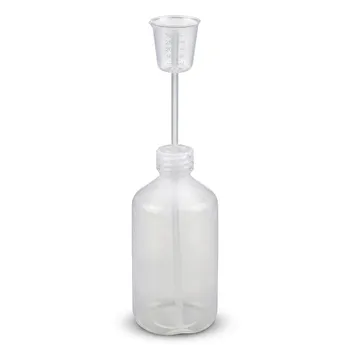
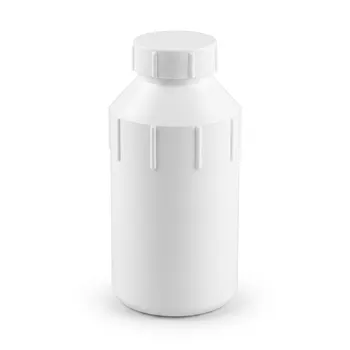
PFA bottles minimize contamination and absorption
High-purity PFA reagent bottles are suitable because PFA is chemically inert, has very low moisture absorption, and presents a smooth, non-wetting internal surface.
These properties reduce residual contamination after cleaning and help prevent solvent or reagent from retaining moisture on the container wall.
PTFE assemblies provide chemical compatibility
PTFE transfer tubing, valves, connectors, and dip tubes are resistant to many aggressive solvents and initiator systems. They are therefore useful for closed transfers in which ordinary elastomers, plastics, or poorly compatible adhesives could swell, leach contaminants, or create leaks.
Compatibility must still be checked for the specific solvent, pressure, temperature, and contact duration.
The closure system is more important than the bottle material alone
PFA and PTFE are not a substitute for an effective seal. Moisture control depends on the complete assembly, including:
- Chemically compatible gaskets and O-rings
- Properly tightened caps and compression fittings
- Minimal permeation paths
- Secure valve seats
- Leak-free connections
- Inert-gas-compatible ports where required
Ambient humidity can enter through a defective or permeable closure even when the container itself has excellent chemical resistance.
Smooth, non-wetting surfaces reduce retained contamination
Fluoropolymer surfaces tend to resist wetting and are easier to drain and clean than rough or contaminated surfaces. This reduces the amount of residual solvent, wash liquid, or moisture that can remain in the transfer path.
The benefit is greatest when the system is designed to avoid pockets, crevices, and stagnant sections.
Labware Design Features That Matter Most
Use a closed transfer path
The solvent should move from storage to reactor through a sealed PFA/PTFE path whenever practical. Closed transfer reduces exposure to ambient air and avoids repeated open pouring.
For highly sensitive reactions, inert-gas pressure transfer or a dry, sealed dispensing system is preferable to open handling.
Minimize dead volume
Tubing, valves, and fittings should have as little stagnant internal volume as the process allows. Dead legs can retain solvent, moisture, or cleaning residues and later introduce them into the reaction.
Short transfer lines and drainable geometries improve reproducibility.
Ensure complete drainability
Orient bottles, dip tubes, valves, and tubing so liquid does not collect in low points. A drainable system is easier to dry, purge, inspect, and validate.
The design should also avoid horizontal sections where residual liquid can remain after transfer.
Separate wetted and non-wetted materials
Only materials demonstrated to be compatible with the fluorinated solvent and reaction chemistry should contact the liquid. Avoid unnecessary elastomers, lubricants, sealants, and adhesives in the wetted path.
Any required gasket or O-ring should be selected for both chemical compatibility and low moisture permeation.
Provide reliable inert-gas management
Where the process requires stringent moisture control, the bottle and reactor should support dry inert-gas blanketing or controlled pressure transfer. Gas inlets should be equipped with suitable dry-gas sources and, where appropriate, moisture traps.
A purge is effective only if the assembly is sufficiently leak-tight and the incoming gas is genuinely dry.
Verification Before Skipping Distillation
Measure or qualify water content
The strongest basis for omitting distillation is a defined water specification supported by measurement, supplier certification, or process validation. Karl Fischer analysis is commonly used for this type of verification, provided the method is suitable for the fluorinated solvent.
A nominal solvent class or product name alone is not enough to guarantee acceptable moisture content.
Consider the initiator threshold
Different cationic initiators tolerate different moisture levels. A solvent containing less than 100 ppm water may be acceptable for one formulation and unsuitable for another.
The relevant question is whether the total water introduced by solvent, reagents, labware, and atmosphere remains below the reaction’s tolerance.
Validate the complete workflow
Moisture can be added after solvent purification. Qualification should therefore cover the actual storage duration, bottle opening frequency, transfer method, tubing, fittings, reactor, and charging sequence.
This identifies contamination sources that solvent-only testing will miss.
Understanding the Trade-offs
Distillation may still be necessary
Low water solubility does not eliminate the need for drying when the solvent has been stored improperly, repeatedly exposed to humid air, or contaminated during transfer.
Distillation or another validated drying procedure may remain appropriate for exceptionally sensitive initiators or tightly specified polymer properties.
Fluoropolymer labware is not automatically moisture-tight
PFA and PTFE have low water absorption, but moisture control is governed by the entire assembly. Caps, seals, threaded joints, tubing connections, and gas ports can become the dominant ingress points.
A fluoropolymer bottle with a poor closure can provide worse protection than a different container with a properly engineered, validated sealing system.
Low wetting can complicate cleaning and rinsing
Non-wetting surfaces help reduce retained contamination, but they can also make aqueous cleaning less straightforward because water may bead rather than spread across the surface.
Cleaning and drying procedures should therefore be validated rather than assumed to be effective.
Water is not the only contamination concern
Fluorinated solvents may still contain or acquire other impurities that affect polymerization, including reactive contaminants, residues from previous use, or incompatible extractables from seals and fittings.
The solvent and labware specification should address the full impurity profile relevant to the reaction.
Applying This to a Polymerization Setup
A robust design combines low-water-solubility solvent with controlled handling, rather than relying on solvent chemistry alone.
- If your primary focus is avoiding routine distillation: Use an HCFC or HFE only after confirming its water content and demonstrating that the complete reaction workflow stays within the initiator’s moisture tolerance.
- If your primary focus is preserving reaction integrity: Use high-purity PFA storage bottles and PTFE transfer assemblies with leak-tight, chemically compatible seals and minimal dead volume.
- If your primary focus is scale-up reproducibility: Validate the full storage, transfer, purging, and charging sequence, not just the initial solvent specification.
- If your primary focus is handling an exceptionally sensitive initiator: Treat distillation or another validated drying step as potentially necessary, even when using a low-water-solubility fluorinated solvent.
The reliable strategy is to combine intrinsically moisture-resistant solvent chemistry with a sealed, validated fluoropolymer handling system.
Summary Table:
| Factor | Impact on Moisture Control | Design / Practice |
|---|---|---|
| Low water solubility of HCFC/HFE | Reduces dissolved moisture (<100 ppm) and minimizes water carryover | Verify solvent water content by Karl Fischer; qualify supplier specs |
| Storage conditions | Prevents water ingress over time; avoids contamination | Use sealed PFA/PTFE containers with minimal headspace; limit opening frequency |
| Transfer path | Prevents atmospheric moisture contact; avoids dead legs | Use closed PFA/PTFE tubing, valves, and fittings; design for full drainability |
| Sealing system | Blocks permeation and leaks at connections | Choose chemically compatible gaskets/O-rings; ensure proper closure torque |
| Inert-gas management | Provides dry blanketing or pressure transfer for sensitive reactions | Connect dry gas source with moisture trap; maintain leak-tight assembly |
| Cleaning/drying validation | Ensures no residual moisture or contaminants | Use validated rinsing and drying procedures; verify with blank runs |
| Initiator sensitivity | Determines acceptable moisture threshold | Match solvent water content to initiator tolerance; perform controlled trials |
Ensure your moisture-sensitive polymerizations run with uncompromised precision using our chemically inert PFA and PTFE labware. Designed for low moisture adsorption and leak-tight sealing, our bottles, transfer lines, valves, and custom assemblies help you achieve reliable reaction integrity. From standard components to fully customized solutions, we support your specific process needs. Contact us today to upgrade your lab with high-purity fluoropolymer equipment and expert guidance. Get in touch with us now.
Related Products
- Custom PTFE Petri Dish 120mm Diameter Corrosion Resistant Low Background High Purity Labware
- Custom PFA Pear Shaped Flask High Purity Corrosion Resistant Labware Custom Molded Fluoropolymer Flask Glass Replacement Solution
- Large Mouth PTFE Sample Storage Drum Custom Chemical Resistant Fluoropolymer Container Acid Base Proof Labware
- Custom PTFE Petri Dishes Corrosion Resistant High Purity Low Background Labware
- High Purity PFA Beaker with Handle and Large Capacity Washable Soak Basket Multi Spec Teflon Laboratory Labware
People Also Ask
- Why are PTFE or PFA Petri dishes preferred for membrane casting? Ensure Damage-Free Recovery & Chemical Purity
- What are the advantages of PTFE in terms of shelf life and service intervals? Maximize Reliability and Minimize Downtime
- What are the chemical resistance properties of PTFE labware? The Ultimate Guide to Inert Labware
- How is PTFE used in laboratory settings? Essential for Chemical Resistance and Sample Purity
- What are the medical and laboratory equipment uses of PTFE? Unlock Biocompatibility and Chemical Resistance