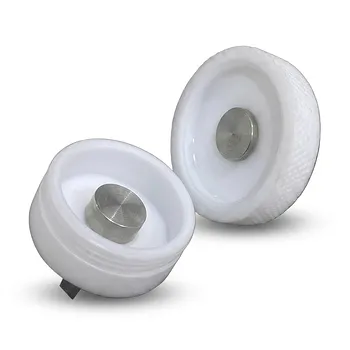
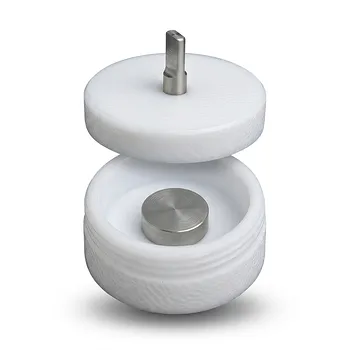
Customized battery fixtures are the critical bridge between electrochemical operation and high-energy photon analysis.
These specialized fixtures utilize micron-scale observation ports sealed with polyimide film to provide a low-attenuation path for X-ray beams, which would otherwise be blocked by standard stainless steel casings. This design allows researchers to capture real-time data on crystal structure evolution (XRD) and valence state changes (XAFS) while the battery is actively cycling, ensuring the data reflects true operational conditions.
Core Takeaway: To observe a battery's internal chemistry without destroying it, you need a "window" that is invisible to X-rays but invincible to electrolytes; customized polyimide fixtures provide this balance of optical transparency and chemical durability.
Overcoming the X-ray Attenuation Barrier
The Limitation of Standard Battery Casings
Standard battery hardware, such as coin cells or split-test cells, is typically constructed from stainless steel or aluminum. These materials are highly effective at containing pressure but are nearly opaque to the X-ray energies used in many synchrotron experiments, leading to massive signal loss.
Polyimide as an X-ray Transparent Medium
Polyimide film (often known by the brand name Kapton) consists of low-atomic-number (low-Z) elements like carbon, nitrogen, and oxygen. This composition allows X-rays to pass through the "window" with minimal attenuation, ensuring that the resulting diffraction patterns or absorption spectra have a high signal-to-noise ratio.
Enabling Real-Time Phase Detection
By integrating these windows, the fixture allows the synchrotron beam to reach the active materials directly. This enables the detection of transient phase transitions and coordination structure changes in catalysts or electrodes that would be invisible in a "post-mortem" (ex-situ) analysis.
Maintaining Electrochemical and Mechanical Integrity
Chemical Stability Against Electrolytes
The internal environment of a battery is highly corrosive, often involving organic solvents and lithium salts. Polyimide is chosen because it possesses exceptional chemical resistance, preventing the electrolyte from degrading the window and compromising the experiment's vacuum or atmosphere.
Mechanical Strength and Hermetic Sealing
Despite being micron-thin, polyimide films offer high tensile strength and thermal stability. This allows the fixture to maintain a hermetic seal and withstand the internal volume changes of the electrodes during charge and discharge cycles without leaking.
Precision Pressure Management
Customized fixtures are designed to apply uniform contact pressure across the electrode stack. This minimizes contact resistance and ensures that the electrochemical data—such as voltage and capacity—accurately represents the material's performance rather than assembly inconsistencies.
Enabling High-Resolution Spatial Mapping
Facilitating Microbeam Lateral Scanning
Synchrotron facilities often use microbeams to scan across the different layers of a battery (e.g., cathode, separator, and anode). Customized fixtures feature precise geometric layouts and apertures that allow the beam to move laterally across the cell, providing spatial resolution of structural changes.
Signal Isolation and Insulation
Many customized fixtures utilize materials like PTFE (Teflon) for internal components to provide electrical insulation. This prevents internal short circuits and ensures that the collected electrochemical signals are isolated from external electrical noise.
Understanding the Trade-offs and Limitations
The Balance of Window Thickness
There is a direct trade-off between signal transparency and mechanical durability. While thinner polyimide films increase X-ray flux, they are more susceptible to puncturing under high internal pressures or during long-term cycling.
Beam Damage and Electrolyte Decomposition
The high intensity of synchrotron radiation can sometimes cause radiolysis of the liquid electrolyte or damage the polyimide window itself over time. Researchers must carefully calibrate the beam exposure time to ensure the observed changes are electrochemical and not induced by the X-ray beam.
Complexity of Assembly
Customized in-situ cells are significantly more difficult to assemble than standard coin cells. Any misalignment in the window or the internal gaskets can lead to electrolyte leakage or uneven pressure, which may invalidate both the electrochemical and the X-ray data.
How to Apply This to Your Research
Selecting the right fixture depends on the specific requirements of your synchrotron beamline and the chemistry of your battery system.
- If your primary focus is high-resolution XRD: Prioritize fixtures with wide-angle windows to capture a broad range of diffraction peaks without interference from the casing frame.
- If your primary focus is XAFS valence state analysis: Ensure the polyimide window is as thin as possible to minimize background scatter, particularly when working with lower-energy X-rays.
- If your primary focus is long-term cycling stability: Choose a fixture design that emphasizes mechanical sealing and utilizes thicker polyimide films or reinforced window supports to prevent leaks over hundreds of hours.
Ultimately, the customized fixture ensures that the "heartbeat" of the battery remains steady while the synchrotron provides the "vision" to see exactly how it functions.
Summary Table:
| Feature | Property | Research Benefit |
|---|---|---|
| Polyimide Window | Low-Z atomic composition | High X-ray transparency and minimal signal loss |
| PTFE Internals | Electrical insulation | Prevents short circuits and isolates electrochemical signals |
| Hermetic Seal | High tensile strength | Maintains internal atmosphere and prevents electrolyte leaks |
| Custom CNC Build | Precision geometry | Ensures uniform contact pressure and accurate spatial mapping |
Elevate Your In-Situ Research with KINTEK’s Precision Engineering
Transitioning from standard lab setups to high-performance synchrotron experiments requires hardware that never compromises your data. At KINTEK, we specialize in the custom CNC fabrication of high-performance fluoropolymer components, ensuring your battery fixtures and reaction apparatus meet the rigorous demands of in-situ testing.
Why partner with KINTEK?
- Expert Fabrication: From complex non-standard machined parts to bespoke electrochemical cells and battery testing fixtures.
- Material Excellence: We focus exclusively on high-performance materials like PTFE and PFA for superior chemical resistance and insulation.
- Comprehensive Range: We provide everything from basic labware (beakers, crucibles, reagent bottles) and fluid transfer components (tubing, valves) to advanced sample prep tools like filters and high-purity digestion vessels.
Whether you need high-volume consumables like O-rings and gaskets or a one-of-a-kind custom reactor, KINTEK delivers the quality your research deserves.
Contact us today to discuss your custom project!
References
- Yuanhe Sun, Daming Zhu. Reversible multivalent carrier redox exceeding intercalation capacity boundary. DOI: 10.1038/s41467-024-55386-5
This article is also based on technical information from Kintek Knowledge Base .
Related Products
- Corrosion Resistant PTFE Coin Cell Battery Testing Clamps and Acid Proof Custom Fluoropolymer Battery Fixtures
- Acid Resistant PTFE Button Cell Battery Test Fixture Customizable Machining High Purity Electrochemical Testing Clamp
People Also Ask
- What is the thermal operating range for PTFE battery clamps in electrochemical research? Stability from -200°C to +260°C
- What are the primary functions and material compositions of PTFE battery clamps? Ensure Precision & Chemical Resistance
- How do coin cell testing fixtures evaluate ZIF-derived LCO cycling stability? Ensure Battery Research Precision
- What are the electrical insulation and signal integrity advantages of using PTFE battery clamps? Ensure Data Accuracy
- How does the chemical inertness of PTFE benefit laboratory-scale battery testing? Ensure high-purity research results.