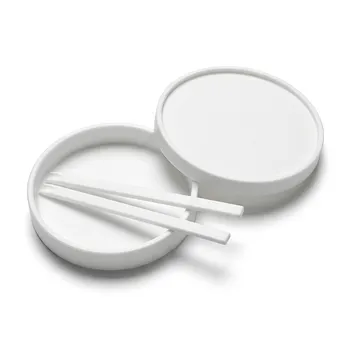
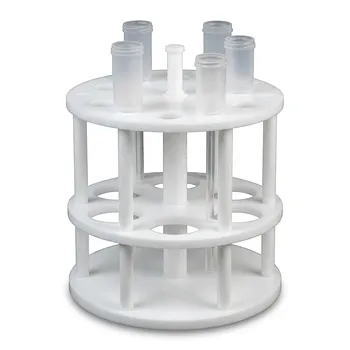
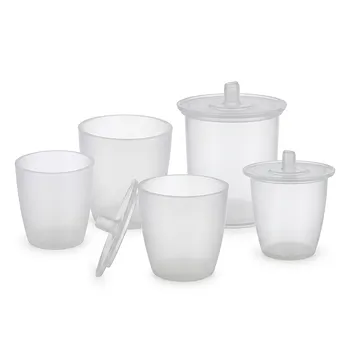
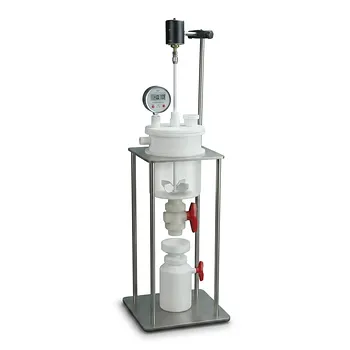
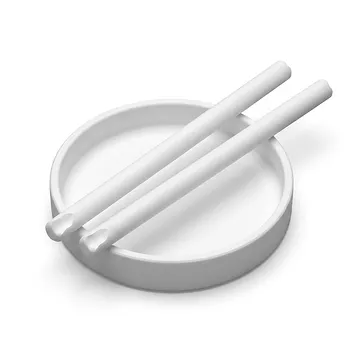
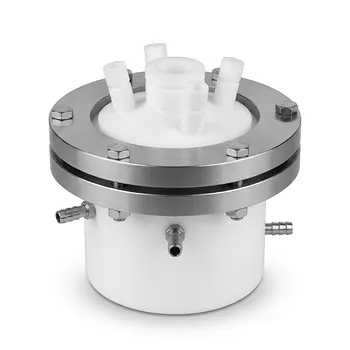
High-performance PTFE laboratory equipment is stable because its carbon backbone is densely protected by fluorine atoms. PTFE consists of repeating –CF₂–CF₂– units arranged in a helical conformation, with fluorine atoms forming a tight sheath around the carbon chain. The combination of strong carbon–fluorine bonds, backbone shielding, and restricted molecular access makes PTFE far less vulnerable to heat, oxidation, acids, bases, and organic solvents than conventional hydrocarbon plastics.
Core takeaway: PTFE’s performance comes less from being simply “thicker” or “stronger” than standard plastic and more from its molecular architecture: a fluorine-protected carbon backbone that is difficult for chemicals or heat to attack.
Why PTFE Resists Chemical Attack
A fluorine shield protects the carbon backbone
In PTFE, fluorine atoms surround the polymer’s carbon backbone. Their size, electronegativity, and tightly packed arrangement create a dense physical and electronic barrier that makes it difficult for reactive chemicals to reach or disrupt the underlying carbon chain.
This shielding is the key structural difference from plastics such as polyethylene, whose carbon backbone is more directly exposed through carbon–hydrogen bonds.
Strong C–F bonds resist molecular disruption
The carbon–fluorine bond is exceptionally strong and highly polarized. Breaking or rearranging these bonds requires substantial energy, so aggressive acids, bases, solvents, and oxidizing environments generally cannot attack PTFE readily under normal laboratory conditions.
Bond-energy values vary by measurement method and chemical context, so the important comparison is qualitative: C–F bonding provides a substantially more chemically resistant structure than the C–H-rich backbones of common plastics.
The polymer is nonpolar and has very low surface energy
PTFE has extremely low surface energy and limited ability to interact with other substances. As a result, many chemicals do not wet, dissolve, or adhere to it readily.
This property helps PTFE labware reduce sample carryover, surface contamination, and chemical leaching, which is particularly valuable in trace analysis and severe acid digestion.
PTFE does not readily dissolve or swell
The tightly shielded, nonpolar structure gives PTFE exceptional resistance to common laboratory acids, bases, and organic solvents. Unlike many standard plastics, it generally remains insoluble and dimensionally stable in environments that would soften, swell, or embrittle conventional polymers.
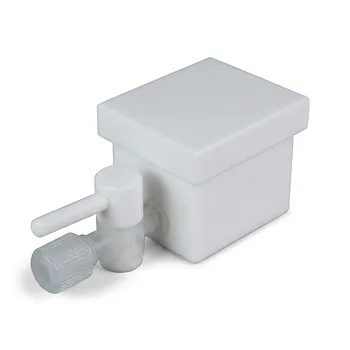
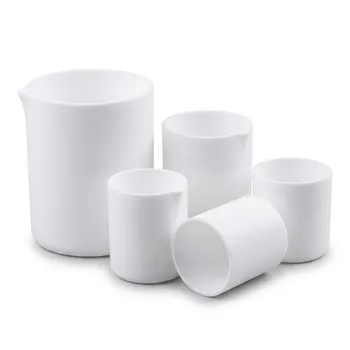
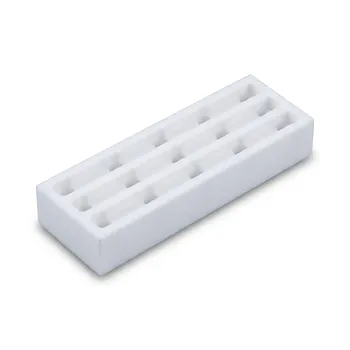
That resistance is why PTFE is used for items such as digestion vessels, crucibles, reagent containers, tubing, fittings, and machined valves.
Why PTFE Tolerates High Temperatures
Strong molecular bonds require more energy to break
Thermal degradation begins when polymer bonds become sufficiently energized to break or rearrange. PTFE’s strong C–F structure raises the energy required for this process, allowing it to retain chemical inertness and useful mechanical integrity at temperatures that exceed the limits of many commodity plastics.
Virgin PTFE melts at approximately 327°C, while practical continuous-use temperatures are commonly specified around 260°C, depending on load, design, exposure time, and the specific grade.
Helical packing restricts chemical access
The fluorinated chains adopt a helical molecular arrangement that helps position fluorine around the backbone. This arrangement reduces direct access to the carbon chain and contributes to PTFE’s resistance to thermal and chemical attack.
The structure does not make PTFE completely immobile: the material can still expand, deform, and creep under load. However, it substantially delays the chemical breakdown that occurs much earlier in many hydrocarbon plastics.
Crystalline regions add thermal and dimensional stability
PTFE contains both crystalline and amorphous regions. Its crystalline domains help organize and stabilize the polymer structure, while the fluorinated chains maintain low chemical reactivity across the material.
This combination supports stable performance during processes such as acid digestion, heated reagent handling, and microwave-assisted preparation, provided the equipment is operated within its specified limits.
Fluorination improves resistance to oxidation and flame
Because the carbon backbone is protected by fluorine and contains relatively few accessible hydrogen atoms, PTFE is less susceptible to oxidation and ignition than many hydrocarbon polymers.
This does not mean PTFE is immune to thermal decomposition. At sufficiently high temperatures, it can degrade and release hazardous products, so overheating must be avoided and appropriate ventilation and manufacturer limits must be followed.
How PTFE Differs from Standard Plastic Labware
Standard plastics expose more reactive chemistry
Many commodity plastics, including polyethylene and polypropylene, are built primarily from carbon–carbon and carbon–hydrogen bonds. These materials can perform well under moderate laboratory conditions, but their backbones are more vulnerable to heat, oxidation, solvents, and strong reagents.
PTFE replaces the usual hydrogen-rich surface chemistry with a fluorine-rich protective structure.
PTFE preserves sample purity more effectively
A chemically resistant container is not only less likely to fail; it is also less likely to contribute contaminants to a sample. PTFE’s low reactivity and low surface energy make it suitable for applications where trace-metal contamination, adsorption, or reagent interaction could affect results.
This is especially important in trace-element analysis and concentrated-acid workflows.
Thermal stability does not mean unlimited mechanical strength
PTFE may remain chemically stable while becoming mechanically softer or more prone to deformation as temperature rises. Compared with rigid engineering plastics or metals, it has relatively high thermal expansion and can exhibit creep, particularly under sustained pressure or clamping.
Therefore, high-performance PTFE equipment often depends on careful geometry, wall thickness, reinforcement, or external support.
Understanding the Trade-offs
PTFE can deform under sustained load
PTFE’s chemical resistance does not eliminate viscoelastic behavior. Under continuous pressure, elevated temperature, or tight compression, it may slowly creep or lose dimensional accuracy.
For pressure-bearing assemblies, the design must account for creep rather than treating PTFE like a rigid metal or ceramic.
Thermal resistance has operating limits
The melting point is not the same as a safe working temperature. Continuous-use ratings are lower because mechanical strength, dimensional stability, and long-term degradation become important before the material reaches its melting point.
High-temperature applications should follow the equipment manufacturer’s temperature, pressure, and exposure-time limits.
A few chemicals can attack PTFE under extreme conditions
PTFE is broadly resistant, but it is not universally inert. Certain highly reactive fluorinating agents, molten alkali metals, and specialized high-temperature chemical systems can attack or degrade it.
Chemical compatibility should therefore be checked against the actual reagent concentration, temperature, pressure, and exposure duration.
Fabrication and purity also affect performance
“PTFE” does not automatically mean identical performance across all products. Virgin PTFE, filled PTFE, sintered components, machined parts, and molded laboratory products can differ in purity, porosity, mechanical behavior, and trace-contamination risk.
For analytical work, material grade and manufacturing cleanliness are as important as the base polymer’s chemistry.
Making the Right Choice for Your Goal
PTFE is most valuable when the laboratory problem involves a combination of chemical aggressiveness, elevated temperature, and contamination sensitivity.
- If your primary focus is chemical resistance: Choose high-purity PTFE for strong-acid, strong-base, solvent, and digestion applications, while checking compatibility with unusual fluorinating or molten-metal chemistries.
- If your primary focus is thermal performance: Use PTFE within its specified continuous operating range—commonly around 260°C—and distinguish chemical stability from mechanical load-bearing capability.
- If your primary focus is sample integrity: Select virgin, low-contamination PTFE equipment with low surface energy to minimize leaching, adsorption, and carryover.
- If your primary focus is dimensional or pressure stability: Consider PTFE designs with external support, reinforcement, or a different engineering material where creep and thermal expansion would be unacceptable.
PTFE’s exceptional laboratory performance comes from a fluorine-shielded, strongly bonded molecular structure that protects the carbon backbone from both chemical attack and thermal degradation.
Summary Table:
| Feature | PTFE | Standard Plastics |
|---|---|---|
| Backbone | Carbon shielded by fluorine atoms | Carbon-hydrogen backbone |
| Bond strength | Strong C-F bonds resist attack | Weaker C-H bonds more vulnerable |
| Chemical resistance | Excellent against acids, bases, solvents | Limited resistance; can swell or degrade |
| Temperature tolerance | Up to 260°C continuous use | Lower melting points and degradation temps |
| Surface energy | Very low, reduces sticking and contamination | Higher, allows interaction with chemicals |
| Oxidation resistance | High due to fluorination | Lower, more susceptible to oxidation |
Ensure the highest purity and performance in your critical lab processes. KINTEK's PTFE and PFA labware, from digestion vessels to custom machined parts, provides the chemical resistance and thermal stability you need. Contact us today to find the perfect solution for your application!
Related Products
- Custom PTFE Laboratory Apparatus Corrosion Resistant Low Background Reaction Cells Precision CNC Fabrication
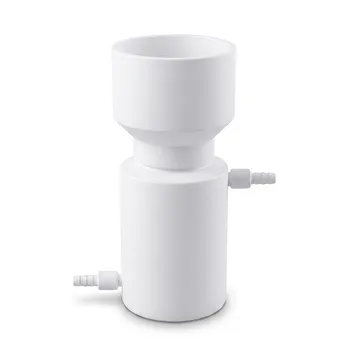
- PTFE PFA Vacuum Filtration System Corrosion Resistant Customizable Shatterproof Laboratory Device
- Heat Resistant Custom PTFE Laboratory Beaker for Hot Plate Heating and Trace Analysis
- Large Scale PTFE Beakers and Flasks for High Temperature Corrosion Resistant Laboratory Applications with Custom CNC Fabrication
- High Purity PTFE Buchner Funnel Vacuum Filtration System Corrosion Resistant Low Trace Laboratory Suction Filter Apparatus
People Also Ask
- How does PTFE's melting behavior affect custom lab apparatus? Key insights for manufacturing.
- What are the primary fabrication methods for PTFE laboratory apparatus? Expert Insights into Fluoropolymer Engineering
- What does the technological maturity of PTFE mean for the quality and reliability of standard laboratory apparatus? Achieve consistent lab results with mature PTFE tech.
- What is the chemical compatibility range for PTFE laboratory apparatus? Explore Near-Universal Chemical Resistance.
- What are the primary chemical resistance properties of PTFE laboratory apparatus? Unmatched Purity and Inertness