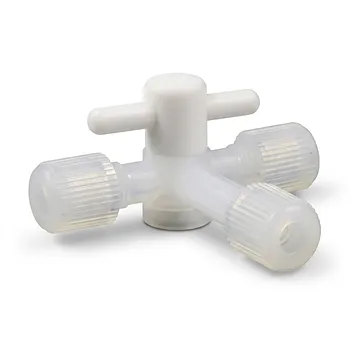
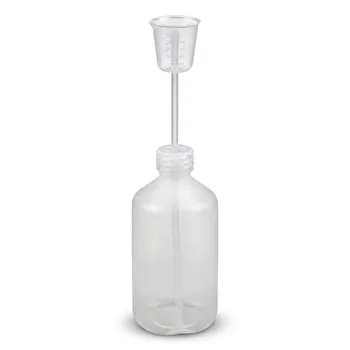
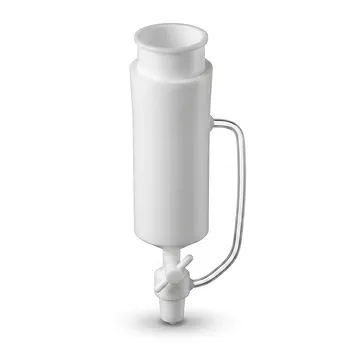
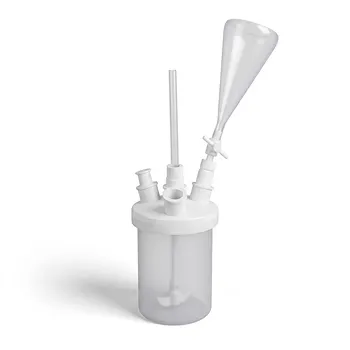
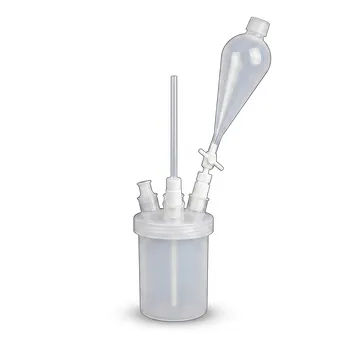
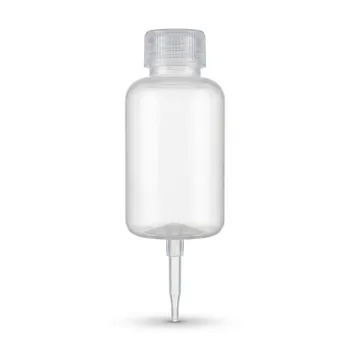
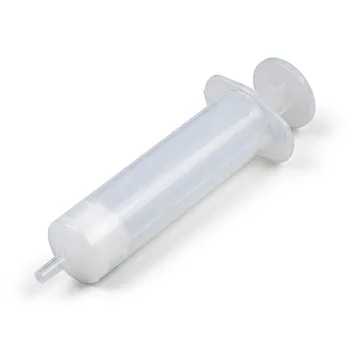
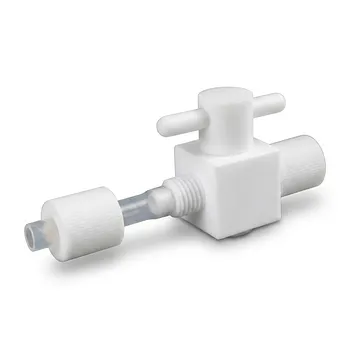
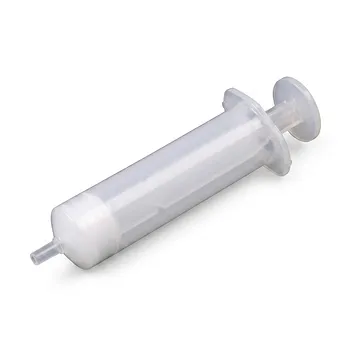
PFA is advantageous because its copolymer structure gives it melt flow without sacrificing the fluorinated chemistry that makes PTFE resistant. PFA incorporates perfluoroalkoxy vinyl ether comonomers into a tetrafluoroethylene backbone, disrupting PTFE’s highly regular crystal structure and greatly reducing melt viscosity. As a result, PFA can be extruded, injection-molded, thermoformed, and welded into intricate fittings, valves, and low-dead-volume fluid paths that standard PTFE generally requires compression molding, sintering, or machining to produce.
PFA combines PTFE-like chemical and thermal performance with true melt-processability. That processing difference enables more complex, precise, seamless, and consistently leak-tight laboratory fluid-transfer components.
Why Standard PTFE Is Difficult to Mold
PTFE Has an Extremely Regular Molecular Structure
Standard PTFE consists primarily of a highly regular tetrafluoroethylene chain. Its fully fluorinated backbone provides exceptional chemical inertness, low surface energy, and high thermal stability.
That molecular regularity also promotes crystallinity and very high melt viscosity. When heated above its melting transition, PTFE does not become a freely flowing liquid suitable for ordinary injection molding; it behaves more like a stiff, non-flowing gel.
PTFE Requires Specialized Fabrication
Because standard PTFE cannot conventionally flow through an injection-molding tool, manufacturers typically use compression molding, sintering, ram extrusion, or CNC machining.
These methods are effective for seals, simple shapes, and machined components, but they become more demanding when a fitting contains intersecting bores, internal threads, valve seats, thin sections, or complex external geometry.
Machining Creates Process and Design Constraints
Machining can produce precise PTFE parts, but it adds labor, material waste, and opportunities for dimensional variation. Internal passages and enclosed geometries can also be difficult or impossible to machine economically.
The result may be a component assembled from multiple pieces, with additional joints or dead volume that are undesirable in high-purity fluid handling.
How PFA’s Structure Enables Melt Processing
Perfluoroalkoxy Comonomers Disrupt Crystallization
PFA copolymerizes tetrafluoroethylene with perfluoroalkoxy vinyl ether units, such as PPVE. The bulky side groups interrupt the regular packing of the PTFE chain.
This reduces crystallinity and lowers the resistance to molecular movement during heating. PFA therefore develops sufficient melt flow for extrusion and injection molding while retaining a fully fluorinated carbon backbone.
PFA Retains the Core Fluoropolymer Properties
The comonomer modification changes processing behavior more than chemical identity. PFA maintains very high resistance to aggressive chemicals, low surface energy, hydrophobicity, electrical insulation, and high-temperature capability comparable to PTFE.
Post-polymerization end-group stabilization, including conversion of reactive end groups to stable CF3 groups, further supports thermal stability during processing and service.
PFA Can Be Processed Through Conventional Tooling
PFA’s melt flow allows heated material to fill detailed molds and narrow passages. Manufacturers can form valve bodies, threaded connectors, tubing fittings, manifolds, vessel components, and other geometries in a single controlled molding operation.
PFA can also be thermoformed, extruded, and melt-welded. These capabilities are particularly valuable when a design requires integrated features or a continuous fluoropolymer construction.
Why This Matters for Laboratory Fluid Fittings
Complex Internal Flow Paths Become Practical
A molded PFA fitting can incorporate intersecting channels, internal shoulders, valve seats, and connection features directly into the part. This reduces dependence on secondary machining and simplifies the production of geometries that would be difficult to create from a solid PTFE blank.
Complex molding also supports low-dead-volume designs, which help reduce retained fluid and carryover between analytical steps.
Molded Surfaces Support High-Purity Handling
Controlled melt processing can produce smooth, non-porous surfaces with fewer machining marks and fewer opportunities for micro-voids or irregularities. Smooth internal surfaces make it harder for contaminants or process residues to remain trapped in the fluid path.
This is important in trace analysis, semiconductor chemical handling, and other applications where extractables, particle release, and cross-contamination must be minimized.
Fewer Joints Can Improve Leak Tightness
PFA molding and melt-welding can produce integrated or seamless constructions that reduce the number of interfaces in contact with the process fluid. Fewer joints mean fewer potential leak paths and fewer locations where contamination can accumulate.
This does not make every molded PFA assembly leak-proof by default; sealing design, tolerances, weld quality, and operating conditions remain critical.
Dimensional Repeatability Improves Production
Injection molding uses a defined tool to reproduce the same geometry across many parts. For fittings with standardized ports, valve interfaces, or tubing connections, this can improve consistency and reduce the variation associated with manual machining and assembly.
Molding is especially attractive when production volume justifies dedicated tooling.
The Performance Balance Between PFA and PTFE
Chemical Resistance Remains Comparable for Many Applications
Both materials are perfluorinated fluoropolymers and are selected for their resistance to a broad range of acids, bases, solvents, and aggressive laboratory chemicals. PFA is therefore not a compromise based solely on ease of manufacturing.
The appropriate grade must still be checked against the specific chemicals, concentrations, temperatures, exposure times, and mechanical loads involved.
Thermal Capability Remains High
PFA supports high-temperature laboratory service and is commonly used in applications with continuous temperatures around the upper range associated with PTFE, often approximately 260°C depending on grade and design.
Actual allowable temperature depends on pressure, wall thickness, load, thermal cycling, and the manufacturer’s data. A material comparison should not rely on a nominal maximum temperature alone.
PFA Offers Useful Transparency
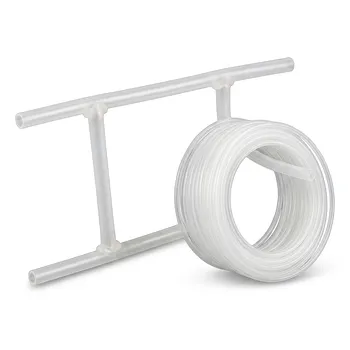
Many PFA grades are translucent or highly translucent, whereas standard PTFE is typically opaque. This can help users inspect fluid presence, bubbles, deposits, or flow behavior in tubing and vessels.
Transparency is an application benefit, but it should not override more important requirements such as pressure rating, chemical compatibility, or light sensitivity of the fluid.
Understanding the Trade-offs
PTFE Can Remain the Better Choice for Machined Parts
Standard PTFE is still highly effective for custom one-off components, heavy sections, seals, and geometries that are straightforward to machine. It may also be preferred where the design requires the particular mechanical or thermal behavior of a high-molecular-weight PTFE grade.
PFA’s processing advantage matters most when complexity, repeatability, seamless construction, or production volume is important.
PFA Molding Requires More Process Control
PFA must be processed at elevated temperatures, and mold design, thermal control, shrinkage, weld lines, and cooling behavior affect final dimensions. Tight-tolerance fittings therefore require qualified tooling and process validation.
A molded part is not automatically more precise than a machined part; precision depends on the complete material, tooling, and manufacturing process.
PFA May Have Different Mechanical Behavior
Although PFA retains strong fluoropolymer performance, its mechanical properties, stiffness, creep behavior, and resistance to deformation may differ from those of the selected PTFE grade. Fittings exposed to pressure, clamping loads, or elevated temperatures must be evaluated as engineered components.
Material selection should compare grade-specific data rather than treating all PTFE and PFA products as interchangeable.
Tooling Economics Affect the Decision
Injection molding requires upfront tooling and process development. For small quantities or frequently changing custom designs, machining PTFE may be more economical despite its higher per-part labor.
For repeat production of complex fittings, the tooling investment can be offset by reduced machining, assembly, and inspection costs.
Making the Right Choice for Your Goal
Select the material and process according to the fitting’s geometry, purity requirements, production volume, and service conditions.
- If your primary focus is complex geometry: Choose PFA when the fitting requires molded internal passages, integrated valve features, intricate threads, or low-dead-volume flow paths.
- If your primary focus is high-purity fluid handling: Choose PFA when smooth, low-extractable, non-porous surfaces and reduced joint count are important.
- If your primary focus is low-volume customization: Choose PTFE when machining a small number of parts is more practical than investing in PFA tooling.
- If your primary focus is extreme chemical and thermal service: Evaluate both materials by grade and operating conditions, since PFA can retain comparable fluoropolymer resistance but is not automatically equivalent in every mechanical application.
- If your primary focus is repeatable production: Choose injection-molded PFA when consistent, complex fittings are needed in quantities that justify dedicated tooling.
The central engineering distinction is simple: PTFE provides exceptional fluoropolymer performance but resists melt flow, while PFA modifies the chain structure enough to make complex molding practical without giving up the properties that laboratory fluid systems depend on.
Summary Table:
| Property | PTFE | PFA |
|---|---|---|
| Molecular structure | Highly regular, crystalline | Copolymer with side groups, less crystalline |
| Melt flow | Very high viscosity, does not flow freely | Melt-processable, suitable for injection molding |
| Typical fabrication | Compression molding, sintering, machining | Injection molding, extrusion, thermoforming, welding |
| Complexity of parts | Limited, often requires assembly | Complex geometries, integrated features possible |
| Surface quality | Machining marks, potential porosity | Smooth, non-porous molded surfaces |
| Joint count | More joints due to assembly | Fewer joints, seamless constructions possible |
| Dimensional repeatability | Variable, manual processes | High repeatability with tooling |
| Chemical resistance | Excellent | Comparable |
| Thermal stability | Excellent | Comparable |
| Transparency | Opaque | Translucent |
Unlock the full potential of your fluid systems with KINTEK's precision PFA fittings. Our exclusively dedicated PTFE/PFA manufacturing capabilities deliver complex, leak-tight components that meet the highest purity standards. Whether you need custom-molded fittings, low-dead-volume manifolds, or contaminant-free fluid paths, we provide tailor-made solutions backed by our end-to-end CNC machining expertise. Contact us today to discuss your requirements and see how KINTEK can optimize your lab's performance.
Related Products
- High Purity PFA Valves and Weldable Corrosion Resistant Transparent Tubing for Semiconductor Sensor Manufacturing Fluid Transfer
- Corrosion Resistant PFA Tubing 1/4 Inch Custom Molded Welded Fluid Transfer Components
- Corrosion Resistant High Purity PFA Valve and Weldable Transparent Tubing for Semiconductor Fluid Transfer
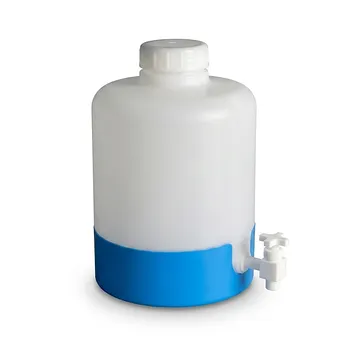
- High Corrosion Resistant PTFE Faucet Polytetrafluoroethylene Valve for Chemical Storage Drums and Fluid Transfer Systems Customizable Industrial Grade
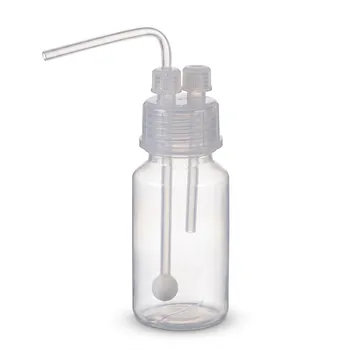
- Corrosion Resistant PFA Bottle Top Dispenser Translucent Squeeze Liquid Extraction System for Ultra Pure Chemical Handling
People Also Ask
- Why are high-purity PFA fluid transfer components required for OSDAs and silica? Ensure Precision in Zeolite Synthesis
- Why are high-purity PFA fluid transfer components preferred for battery electrolytes? Ensure Purity & Data Accuracy
- How does high-purity PFA tubing maintain reagent purity? Achieve Ultra-Smooth, Zero-Contamination Fluid Transfer
- What role do PFA tubing and valves play in high-precision laboratory fluid transfer systems? Ensure Ultra-Pure Results
- How do PFA fluid transfer components contribute to chemical research precision? Achieve high-purity results today.