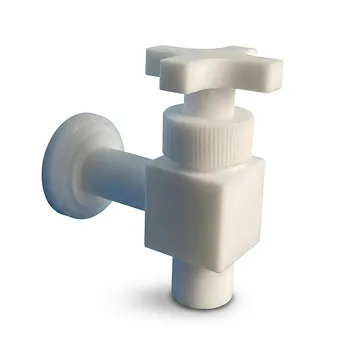
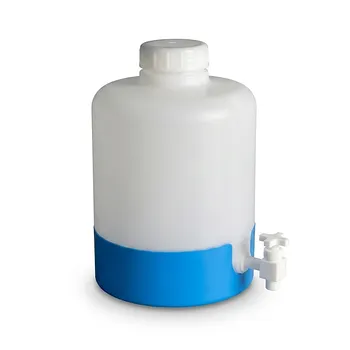
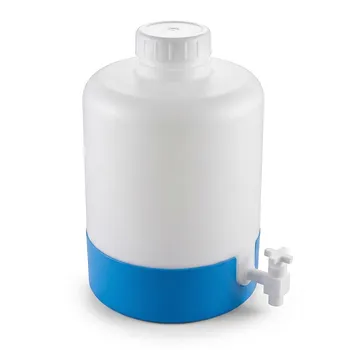
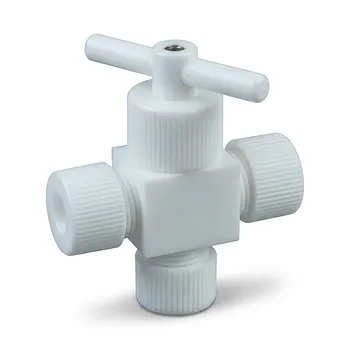
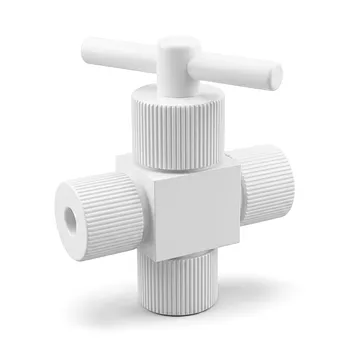
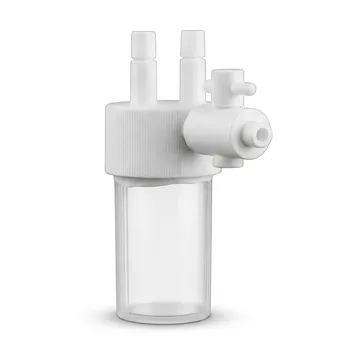
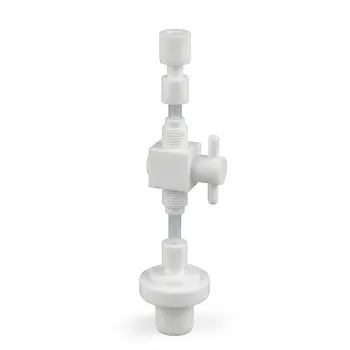
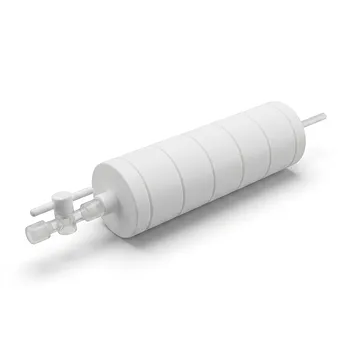
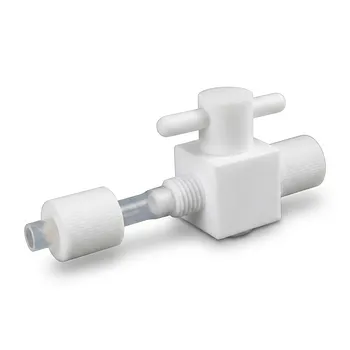
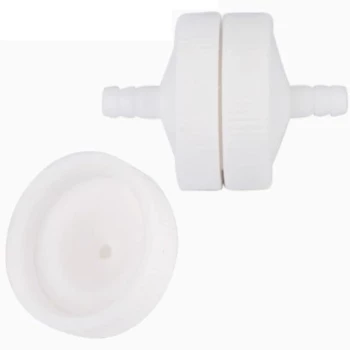
PTFE valves serve as the primary containment and flow-control barrier against chemical contamination in semiconductor fabrication. These components ensure that ultrapure water, aggressive etchants, and photoresist strippers reach the wafer without introducing ions or particles that could destroy microscopic circuits. By leveraging chemical inertness and a non-stick surface, these valves maintain the parts-per-trillion (ppt) purity levels required for high wafer yields.
Core Takeaway: PTFE valves are indispensable in semiconductor manufacturing because they provide a chemically inert, low-shedding interface for handling the industry's most aggressive fluids, directly protecting silicon wafers from yield-killing impurities.
Preventing Chemical and Ionic Leaching
The Shield Against Aggressive Etchants
Semiconductor manufacturing relies on highly corrosive substances like hydrofluoric acid and various peroxides. PTFE is chosen for valves because it is virtually chemically inert, meaning it does not react with or degrade when exposed to these harsh chemicals.
Eliminating Extractables and Ions
Standard materials can "leak" trace amounts of metallic ions or organic compounds into the process stream. PTFE valves feature low extractables, which is vital for maintaining the sub-ppb (parts-per-billion) and ppt purity levels necessary to prevent electrical defects in the final chip.
Controlling Physical Particle Contamination
Minimizing Particle Shedding
Physical friction within a valve can cause the material to wear down and release microscopic particles into the fluid. PTFE has an extremely low friction coefficient, which results in minimal particle shedding during the opening and closing cycles of the valve.
Preventing Residue Accumulation
The non-stick nature of PTFE is critical when handling Chemical Mechanical Planarization (CMP) slurries. These slurries contain abrasive particles that tend to settle and harden; PTFE’s surface prevents this deposition, ensuring the valve remains clean and functional.
Eliminating Dead-Legs and Entrapment
The internal geometry of PTFE valves is often designed to be incredibly smooth to prevent particle entrapment. By reducing "dead-legs" (areas where fluid can stagnate), these valves ensure that contaminants cannot hide or accumulate within the distribution system.
Understanding the Trade-offs
Mechanical and Thermal Limitations
While PTFE is chemically superior, it is a "soft" plastic compared to stainless steel. It is susceptible to mechanical deformation under extreme pressure and has a high coefficient of thermal expansion, which requires careful engineering in high-temperature environments.
Permeability Concerns
At a molecular level, certain gases can permeate through PTFE over long periods. In extremely sensitive vacuum environments, this permeability must be managed to prevent trace amounts of atmospheric gases from entering the process chamber.
Cost and Complexity
High-purity PTFE components are significantly more expensive than standard industrial valves. The manufacturing process for these valves involves stringent cleanroom assembly and specialized testing, increasing the total cost of ownership for the fluid delivery system.
Making the Right Choice for Your Goal
How to Apply This to Your Project
- If your primary focus is handling aggressive acids: Prioritize PTFE valves with reinforced housings to ensure chemical resistance is matched by mechanical durability.
- If your primary focus is maximizing wafer yield: Select valves specifically rated for "ultra-high purity" (UHP) that guarantee the lowest possible extractable levels and particle counts.
- If your primary focus is CMP slurry management: Choose valves with a "straight-through" flow design and PTFE internals to prevent abrasive build-up and clogging.
By correctly integrating PTFE valves into the fluid distribution network, manufacturers can achieve the extreme levels of cleanliness essential for the next generation of semiconductor technology.
Summary Table:
| Feature | Role in Contamination Control | Semiconductor Application |
|---|---|---|
| Chemical Inertness | Prevents leaching of metallic ions/extractables | Handling aggressive etchants like Hydrofluoric Acid |
| Low Friction | Minimizes physical particle shedding during cycles | Moving parts in fluid distribution networks |
| Non-Stick Surface | Prevents residue accumulation and clogging | Management of abrasive CMP slurries |
| Smooth Geometry | Eliminates dead-legs and fluid stagnation | High-purity chemical and ultrapure water delivery |
| Low Permeability | Reduces atmospheric gas intrusion | Sensitive vacuum and process chamber environments |
Ensure Unmatched Purity with KINTEK’s Fluoropolymer Expertise
In the world of semiconductor manufacturing, contamination is the enemy of yield. KINTEK is your dedicated partner in providing high-performance PTFE and PFA solutions designed to maintain parts-per-trillion (ppt) purity levels. We manufacture virtually all imaginable laboratory supplies, from everyday basic labware (beakers, measuring cylinders, crucibles, dishes, and reagent bottles) and fluid transfer components (tubing, fittings, and valves) to specialized sample prep and filtration tools like separatory funnels, filters, and pipettes.
Our expertise extends to advanced reaction apparatus, including custom electrochemical cells, battery testing fixtures, and microwave digestion vessels, all backed by end-to-end custom CNC fabrication. Whether you require complex non-standard machined parts or high-volume orders of general consumables like O-rings and gaskets, KINTEK delivers the chemical inertness and reliability your process demands.
Ready to optimize your contamination control? Contact KINTEK today and let our experts build your bespoke high-performance laboratory setup.
Related Products
- Corrosion Resistant PTFE Polytetrafluoroethylene Valve and Customizable Laboratory Fluid Dispensing Faucet for Aggressive Chemical Handling in Industrial Storage Tanks and Plastic Drums
- High Corrosion Resistant PTFE Faucet Polytetrafluoroethylene Valve for Chemical Storage Drums and Fluid Transfer Systems Customizable Industrial Grade
- High Purity PTFE Faucet Corrosion Resistant Polytetrafluoroethylene Drum Valve Customizable Lab Chemical Fluid Control
- Custom PTFE Valve 2-Way 3-Way Corrosion Resistant Low Background Virgin Fluoropolymer Industrial Fluid Control
- Corrosion Resistant PTFE Valves Customizable 2 Way 3 Way 4 Way High Temperature Teflon Fluid Control Solutions
People Also Ask
- How do PTFE valves and components support high-purity liquid transfer? Ensure Product Integrity with Inert Materials
- What industries commonly use PTFE valves and components? Essential for Chemical & Purity Applications
- What specific advantages do PTFE valves offer? Unmatched Corrosion Resistance for Industrial Chemical Handling
- What are the key properties of PTFE valves? Ensure Purity, Safety, and Reliability in Demanding Processes
- What is the typical operating temperature and pressure range for PTFE valves? Key Specs for Optimal Performance