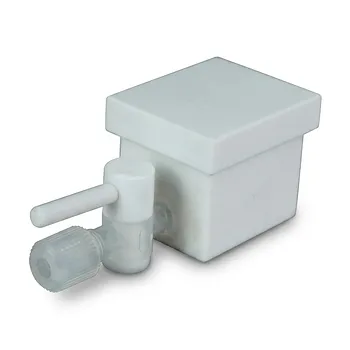
Precision dosing and stirring systems are fundamental to maintaining the chemical and physical stability of the electrochemical environment during seawater electrolysis. These systems ensure accurate electrolyte composition, remove gas bubbles that shield the catalyst surface, and eliminate concentration gradients that would otherwise skew measurements of catalytic activity and stability.
Precision dosing and stirring systems bridge the gap between a theoretical experiment and a high-fidelity simulation by stabilizing the chemical environment and clearing the electrode surface. This level of control is essential for isolating a catalyst's true performance from environmental interference and measurement errors.
The Role of Precision Dosing in Complex Electrolytes
Maintaining Electrolyte Integrity
Simulated seawater is a complex mixture of ions, often involving combinations like KOH and NaCl. Precision dosing systems ensure that the ratios of these components remain constant throughout the experiment, preventing drift in the chemical environment.
Managing the OER vs. ClOR Competition
In seawater electrolysis, the Oxygen Evolution Reaction (OER) competes directly with the Chlorine Oxidation Reaction (ClOR). Accurate dosing allows researchers to maintain specific concentrations necessary to assess catalyst selectivity and resistance to chlorine corrosion effectively.
Preventing Unintended Chemical Fluctuations
Without precise control, the local pH and ion concentrations near the electrode can shift as the reaction progresses. Dosing systems mitigate these fluctuations, ensuring that the catalyst is tested under the exact conditions intended by the experimental design.
The Impact of Stirring and Flow Systems
Mitigating Electrode Shielding
During electrolysis, $O_2$ and $H_2$ bubbles form rapidly on the electrode surface. An efficient stirring or flow system physically removes these bubbles, preventing them from shielding the active sites of catalysts like NiFe-LDH.
Reducing Ion Concentration Polarization
As ions are consumed or produced at the electrode, a "boundary layer" with different concentrations can form. Active stirring disrupts this layer, mitigating local ion concentration polarization and ensuring a steady supply of reactants to the catalyst surface.
Improving Kinetic and Stability Assessments
By clearing the surface and stabilizing the environment, stirring allows for an accurate assessment of a catalyst’s intrinsic kinetics. This prevents mass-transport limitations from being mistaken for poor catalyst performance.
Ensuring Data Accuracy and Comparability
Enabling Precise iR Compensation
Customized electrochemical cells use specific fluid chamber designs to maintain a consistent environment between the working, counter, and reference electrodes. This consistency is vital for iR compensation, which involves deducting the ohmic voltage drop to reveal the true activity of the material.
Facilitating Three-Electrode Precision
The integration of these systems within a standard three-electrode setup allows for precise monitoring of the working electrode potential. This precision is the only way to reliably compare different catalytic materials under identical, controlled conditions.
Standardizing Simulated Environments
Stirring and dosing transform a static "beaker test" into a dynamic, reproducible environment. This standardization is critical for peer-to-peer data validation and the scaling of laboratory results to industrial applications.
Understanding the Trade-offs
Mechanical Complexity and Noise
Integrating pumps and stirrers increases the mechanical complexity of the setup, which can lead to higher maintenance requirements. Furthermore, mechanical stirring can sometimes introduce electrical noise into sensitive electrochemical measurements if not properly shielded.
Impact of Shear Stress
High-intensity stirring or flow can create significant shear stress on the electrode surface. While this clears bubbles, it may also physically detach delicate catalyst coatings, leading to a false perception of poor material durability.
Calibration and Maintenance Overhead
Precision dosing systems require frequent calibration to maintain their accuracy over long-term stability tests. Any failure in the dosing pump or a clog in the flow lines can result in compromised data that is difficult to detect after the fact.
How to Apply This to Your Project
When designing your electrochemical testing protocol, the level of environmental control should match your specific research objectives.
- If your primary focus is catalyst selectivity (OER vs. ClOR): Prioritize a precision dosing system to maintain exact NaCl and KOH ratios, as even minor concentration shifts can change the dominant reaction pathway.
- If your primary focus is high-current density performance: Invest in a high-efficiency flow or stirring system to ensure gas bubbles are removed instantly, preventing "bubble-induced" overpotential.
- If your primary focus is determining intrinsic activity: Utilize a cell design that allows for both active stirring and accurate iR compensation to ensure you are measuring the catalyst, not the electrolyte resistance.
- If your primary focus is long-term durability: Use a controlled flow system but calibrate the flow rate to avoid excessive shear stress that might mechanically degrade the catalyst layer.
By mastering the balance between chemical dosing and physical agitation, you ensure that your experimental results reflect the true potential of your catalytic materials.
Summary Table:
| System Component | Key Function | Impact on Research Accuracy |
|---|---|---|
| Precision Dosing | Maintains constant ion ratios (e.g., NaCl/KOH) | Prevents chemical drift and ensures catalyst selectivity (OER vs. ClOR). |
| Active Stirring | Removes $O_2$ and $H_2$ bubbles from surface | Eliminates electrode shielding and reduces ion concentration polarization. |
| Flow Control | Regulates electrolyte movement | Mitigates mass-transport limitations for accurate kinetic assessments. |
| Cell Integration | Standardizes 3-electrode environment | Enables precise iR compensation and reproducible potential monitoring. |
Elevate Your Electrochemical Research with KINTEK
Precision in seawater electrolysis requires equipment that can withstand corrosive environments while maintaining absolute purity. KINTEK specializes in high-performance fluoropolymer solutions tailored for advanced laboratory needs.
From everyday basic labware like beakers, crucibles, and reagent bottles to specialized fluid transfer components (tubing, fittings, valves) and sample prep tools, we provide the infrastructure for precise dosing and stirring. Our expertise extends to custom CNC fabrication, allowing us to deliver bespoke electrochemical cells, battery testing fixtures, and microwave digestion vessels crafted entirely from premium PTFE and PFA.
Whether you require high-volume consumables or a complex, non-standard machined setup, KINTEK’s end-to-end manufacturing ensures your hardware never compromises your data.
Ready to optimize your lab's performance? Contact us today to discuss your custom project.
References
- Xin Li, Fufa Wu. NiFe-LDH as a bifunctional electrocatalyst for efficient water and seawater electrolysis: enhanced oxygen evolution and hydrogen evolution reactions. DOI: 10.1039/d5na00350d
This article is also based on technical information from Kintek Knowledge Base .
Related Products
- Corrosion Resistant PTFE Electrochemical Cell for New Energy Research Inert Insulating Customizable Lab Reaction Vessel
- Square PTFE Electrochemical Cell for Silicon Wafer Processing and Hydrofluoric Acid Resistance in Semiconductor and New Energy Research
- White PTFE Electrolytic Cell with Movable Slider and Insulated Lid for Fluorine Corrosion Resistance
- Custom PTFE Reaction Box Opaque White Square Electrochemical Cell Tank
- Custom PTFE Electrolytic Cell Corrosion Resistant Low Background Reaction Vessel with Inlet Outlet Ports
People Also Ask
- What parameters govern the electrochemical decomposition of perfluorooctanoic acid (PFOA) in aqueous solutions, and why are custom PTFE electrochemical cells preferred? Key factors include anode material, current density, electrolyte, and cell design.
- How do custom PTFE electrochemical cells improve the accuracy of stability testing for alkaline catalysts compared to glass cells?
- How does the hydrophobicity of PTFE benefit electrochemical measurements? Enhance Stability and Precision in Your Lab
- What makes PTFE an ideal construction material for custom electrochemical cells and electronic analytical instrumentation housings? Discover superior chemical resistance and electrical insulation
- Why must seawater electrolysis test cells have high corrosion resistance? Protect catalyst stability & data accuracy.