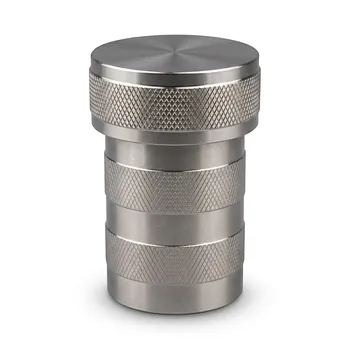
The hydrothermal synthesis autoclave acts as the essential high-pressure reaction vessel that transforms raw Giloy stem biomass into functionalized carbon dots. It creates a "sub-critical" water environment where high temperature and pressure force the dehydration, carbonization, and in-situ nitrogen and sulfur doping of the plant precursors into nanoscale fluorescent materials.
The autoclave provides a sealed, high-energy environment that allows water to remain liquid far above its boiling point, significantly increasing the solubility and reactivity of the Giloy stem. This process is the engine for the chemical transitions—carbonization and doping—that define the optical properties of the resulting N,S-CDs.
Creating the Extreme Reaction Environment
The Power of Sub-critical Water
In a standard open container, water evaporates at 100°C, limiting the energy available for chemical reactions. The hydrothermal synthesis autoclave uses a sealed design to prevent evaporation, allowing water to reach temperatures typically between 120°C and 200°C while remaining in a liquid state.
Enhanced Solubility and Reactivity
Under these high-pressure conditions, the physical properties of water change, making it an aggressive solvent. This environment significantly enhances the solubility and reactivity of the Giloy stem raw material, breaking down its complex organic structures more efficiently than atmospheric boiling ever could.
Facilitating the Chemical Transformation of Biomass
Dehydration and Carbonization
The autoclave provides the necessary thermal energy to trigger the dehydration and condensation of the biomass precursors. As the Giloy stem components break down, they undergo carbonization, forming the core "carbon dot" structure that serves as the foundation for the nanomaterial.
In-Situ Nitrogen and Sulfur Doping
The high-pressure environment is critical for in-situ doping, where nitrogen and sulfur elements from the Giloy stem (or added precursors) are integrated directly into the carbon lattice. This structural modification is what gives N,S-CDs their unique electronic and fluorescent properties, which are essential for applications like bio-imaging or sensing.
Nucleation and Passivation
The controlled environment within the reactor facilitates the nucleation and polymerization of the carbon structures. It also promotes surface passivation, where functional groups are attached to the surface of the dots, ensuring they remain stable and exhibit a high fluorescence quantum yield.
Ensuring Material Purity and Performance
The Critical Role of the PTFE Liner
Most hydrothermal autoclaves utilize a PTFE (Teflon) or PFA liner inside a stainless steel shell. This liner is chemically inert, meaning it does not react with the acidic or basic solutions often generated during the decomposition of biomass like Giloy stem.
Preventing Metal Ion Contamination
The liner serves as a barrier that prevents the reaction solution from corroding the stainless steel outer vessel. Without this protection, metal ions (like iron or chromium) could leach into the solution, contaminating the carbon dots and severely degrading their optical performance and purity.
Understanding the Trade-offs
Temperature and Pressure Limitations
While autoclaves are powerful, they have strict safety limits; exceeding the rated temperature of the PTFE liner (usually around 200°C-220°C) can cause the liner to deform or release toxic fumes. Additionally, the internal pressure must be carefully monitored to prevent vessel failure, especially when working with high concentrations of organic matter.
Heating and Cooling Cycles
Hydrothermal synthesis is not an instantaneous process; it requires significant time for the vessel to reach the target temperature and, more importantly, to cool down safely. Rapid cooling can damage the liner or alter the crystal structure of the carbon dots, leading to inconsistent batches.
How to Apply This to Your Project
Making the Right Choice for Your Goal
To achieve the best results when synthesizing N,S-CDs from Giloy stem, consider your specific research or production priorities:
- If your primary focus is High Fluorescence Yield: Prioritize a high-quality PTFE liner and precise temperature control (typically 180°C to 200°C) to ensure complete carbonization and effective surface passivation.
- If your primary focus is Material Purity: Ensure the autoclave liner is thoroughly cleaned with acid between runs to prevent "memory effects" or metal ion contamination that could quench fluorescence.
- If your primary focus is Scalability: Utilize a stainless steel autoclave with a higher volume capacity, but ensure the heating mantle provides uniform thermal distribution to maintain consistent particle size.
The hydrothermal synthesis autoclave is the indispensable "pressure cooker" of the nanoworld, turning raw botanical matter into sophisticated, high-value carbon nanomaterials through controlled chemical stress.
Summary Table:
| Process Phase | Function of the Autoclave | Key Benefit for N,S-CDs |
|---|---|---|
| Sub-critical Environment | Maintains liquid water at 120°C–200°C | Enhances solubility and reactivity of biomass |
| Carbonization | Provides high thermal energy and pressure | Triggers dehydration and forms the core structure |
| In-Situ Doping | Facilitates element integration into lattice | Enables unique electronic and fluorescent properties |
| Material Protection | Uses inert PTFE/PFA liners | Prevents metal ion contamination and ensures purity |
Elevate Your Research with High-Performance Fluoropolymer Solutions
At KINTEK, we understand that material purity is the cornerstone of successful nanomaterial synthesis. Whether you are producing N,S-CDs or conducting complex trace analysis, our precision-engineered laboratory supplies provide the chemical resistance and thermal stability your work demands.
We offer an extensive range of products crafted exclusively from high-performance PTFE and PFA, including:
- Everyday Basic Labware: Beakers, measuring cylinders, crucibles, dishes, and reagent/wash bottles.
- Trace Analysis & Storage: High-purity instruments, digestion tubes, and specialized cleaning/storage tanks.
- Fluid Transfer & Sample Prep: Tubing, fittings, valves, separatory funnels, filters, pipettes, and tweezers.
- General Consumables: Stirring bars, O-rings, gaskets, seal tapes, and septa.
- Advanced Reaction Apparatus: Hydrothermal synthesis liners, microwave digestion vessels, electrochemical cells, and microchannel reactors.
Backed by end-to-end custom CNC fabrication, KINTEK is equipped to deliver everything from complex non-standard machined parts to high-volume orders. Ensure your results are never compromised by contamination or equipment failure.
Contact KINTEK today to discuss your custom laboratory needs!
References
- S. Swain, Ashis Kumar Jena. Green Synthesis of N,S-Doped Carbon Dots from the Giloy Stem for Fluorimetry Detection of 4-Nitrophenol, Triple-Mode Detection of Congo Red, and Antioxidant Applications. DOI: 10.1021/acsomega.4c09748
This article is also based on technical information from Kintek Knowledge Base .
Related Products
- High Temperature Corrosion Resistant Hydrothermal Synthesis Reactor with TFM Inner Liner and Straight Cylinder Design
- PTFE Lined High Pressure Digestion Vessel 50ml High Temperature Hydrothermal Synthesis Tank
People Also Ask
- What is the role of a corrosion-resistant reactor in the synthesis of lignin-based carbon dots? Ensure Maximum Purity
- What are the technical advantages of using hydrothermal synthesis reactors for advanced electronic & optical nanomaterials?
- How does a hydrothermal synthesis reactor facilitate the production of crystalline materials with tailored morphologies? Precision Crystal Growth
- Why is the sealing reliability of a hydrothermal synthesis reactor critical for 24-hour cycles? Ensure Nano-Precision
- What role do hydrothermal synthesis reactors play in CQD preparation? Achieve High-Purity Nanomaterial Synthesis