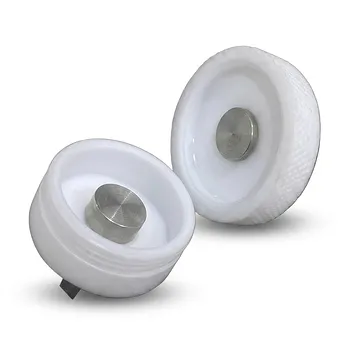
Battery testing fixtures are the bridge between raw coal-based quantum dot (CQD) materials and reliable electrochemical data. They provide the stable physical framework and low-resistance electrical pathways necessary to measure a supercapacitor’s true performance. Without these fixtures, data points like specific capacitance and ion transport rates would be obscured by hardware-induced errors rather than reflecting the material's actual potential.
Core Takeaway: Battery testing fixtures ensure data integrity by providing uniform mechanical pressure and reliable electrical contact. This eliminates parasitic resistance, allowing researchers to isolate and evaluate the intrinsic energy storage capabilities of coal-based carbon nanomaterials.
The Role of Fixtures in Accurate Data Capture
Minimizing Contact Resistance and ESR
The primary function of a fixture is to create a low-impedance connection between the current collectors and the CQD-modified electrodes. By minimizing Equivalent Series Resistance (ESR), fixtures ensure that the energy release capabilities measured during testing are not artificially throttled by poor physical contact.
Facilitating Ion Transport and Electrode Wetting
Fixtures hold the electrode plates in a position that ensures they are fully wetted by the electrolyte. Proper orientation and support allow for the accurate capture of ion transport rates during cyclic voltammetry (CV) and galvanostatic charge-discharge (GCD) tests.
Ensuring Data Repeatability
Specialized fixtures eliminate the fluctuations associated with manual setups by utilizing optimized electrical structures. This consistency is vital for maintaining high repeatability across different testing batches and different researchers.
Engineering a Controlled Testing Environment
Maintaining Uniform Mechanical Pressure
Dedicated fixtures, such as coin cell or pouch cell modules, apply constant and uniform pressure across the two-electrode system. This pressure ensures tight contact between the electrodes, separators, and the electrolyte interface, which is critical for reflecting accurate energy and power density limits.
Ensuring Airtightness and Chemical Stability
High-seal modules, like Swagelok-type fixtures, provide a controlled environment with high airtightness. This prevents electrolyte leakage and protects the system from atmospheric contamination, ensuring the reliability of long-term electrochemical data.
Mitigating Thermal and Voltage Effects
Precisely designed structures minimize voltage drops and thermal effects caused by unstable physical connections. During high-frequency current load switching, the fixture ensures that the signals collected reflect the CQDs' energy storage characteristics rather than hardware-induced noise.
Understanding the Trade-offs
Precision vs. Flexibility
While high-precision fixtures like Swagelok cells offer superior sealing and pressure control, they can be slower to assemble and less versatile for rapid prototyping compared to standard coin cells. Choosing the wrong fixture for a specific electrolyte, such as a corrosive liquid, can lead to chemical interference if the fixture is not made of corrosion-resistant materials.
Pressure Management Risks
Applying excessive mechanical pressure can damage delicate separators or deform the coal-based quantum dot layer, leading to internal short circuits. Conversely, insufficient pressure results in high contact resistance, which falsely penalizes the material's performance metrics, particularly its rate capability.
Optimizing Your Supercapacitor Performance Evaluation
Selecting the right hardware depends on the specific metrics you need to validate for your coal-based nanomaterials.
- If your primary focus is high-current density testing: Use high-performance fixtures with low-impedance connections to accurately measure energy release without ESR interference.
- If your primary focus is long-term cycle life: Prioritize high-seal fixtures or 2032 coin cell components to maintain stable contact resistance and prevent electrolyte evaporation over thousands of cycles.
- If your primary focus is material benchmarking: Utilize fixtures that provide adjustable and constant pressure to ensure that variations in specific capacitance are due to the material chemistry alone.
By stabilizing the physical and electrical environment, testing fixtures transform coal-based quantum dots from experimental powders into verifiable components of energy storage technology.
Summary Table:
| Key Function | Impact on Performance Evaluation | Critical Requirement |
|---|---|---|
| Minimizing ESR | Ensures power density isn't throttled by resistance. | Low-impedance electrical pathways. |
| Uniform Pressure | Optimizes electrode-electrolyte contact for capacitance. | Constant mechanical load across plates. |
| Airtight Sealing | Protects long-term cycle life from contamination. | High-seal modules (e.g., Swagelok-type). |
| Controlled Wetting | Facilitates accurate ion transport rate capture. | Proper electrode orientation/support. |
| Standardization | Eliminates variability between researchers/batches. | Precision-engineered physical frameworks. |
Optimize Your Electrochemical Research with KINTEK
Precise data starts with superior hardware. KINTEK specializes in manufacturing high-performance laboratory supplies designed to eliminate hardware-induced errors in energy storage testing.
From advanced battery testing fixtures, electrochemical cells, and battery testing fixtures to essential high-purity trace analysis instruments, we provide everything needed for evaluating coal-based quantum dots and other cutting-edge materials. Our expertise extends across:
- High-Performance Materials: Virtually all laboratory supplies crafted from PTFE and PFA.
- Custom Engineering: End-to-end custom CNC fabrication for complex, non-standard machined parts and bespoke lab setups.
- Comprehensive Inventory: Basic labware (beakers, crucibles, tubes), fluid transfer components (tubing, valves), and general consumables (O-rings, gaskets, stirring bars).
Don't let parasitic resistance or poor sealing compromise your results. Whether you need high-volume consumables or custom-machined reaction apparatus, KINTEK delivers the precision your research demands.
Contact KINTEK today to discuss your custom testing requirements
References
- Linjing Hao, Baolin Xing. Coal-based carbon/graphene quantum dots: formation mechanisms and applications. DOI: 10.1515/revic-2024-0071
This article is also based on technical information from Kintek Knowledge Base .
Related Products
- Acid Resistant PTFE Button Cell Battery Test Fixture Customizable Machining High Purity Electrochemical Testing Clamp
- Corrosion Resistant PTFE Coin Cell Battery Testing Clamps and Acid Proof Custom Fluoropolymer Battery Fixtures
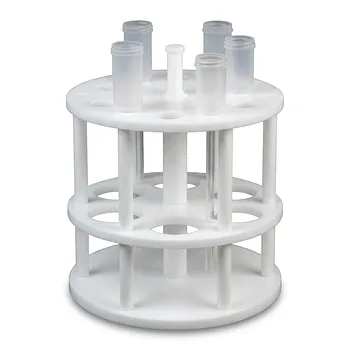
- Custom PFA Microcolumn Racks and PTFE Machined Low Background Corrosion Resistant Laboratory Fixtures
People Also Ask
- How does the chemical inertness of PTFE benefit laboratory-scale battery testing? Ensure high-purity research results.
- In what ways do PTFE battery testing fixtures enhance laboratory throughput and reliability? Maximize Research Efficiency
- In what industrial manufacturing contexts are PTFE battery clamps or fixtures utilized? Optimize Battery Production.
- What is the thermal operating range for PTFE battery clamps in electrochemical research? Stability from -200°C to +260°C
- What are the primary functions and material compositions of PTFE battery clamps? Ensure Precision & Chemical Resistance