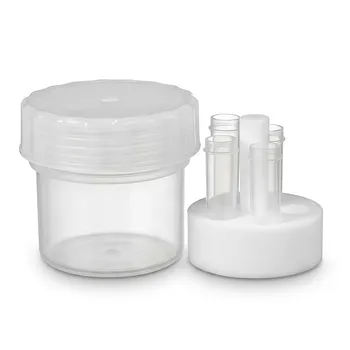
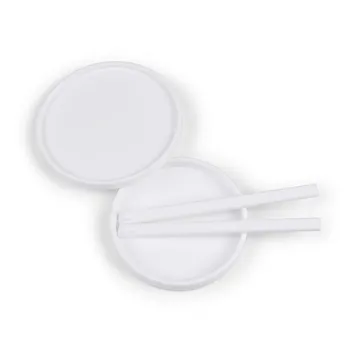
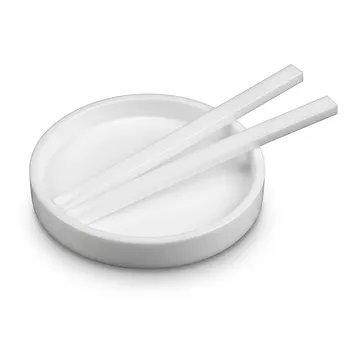
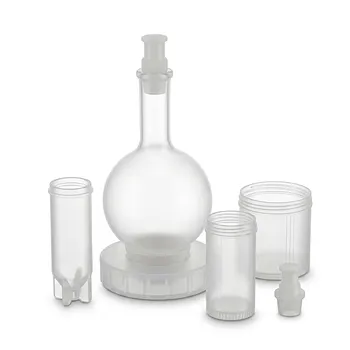
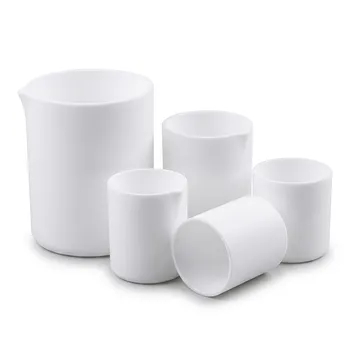
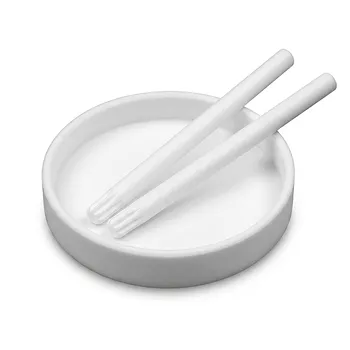
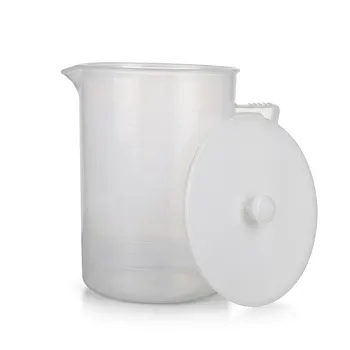
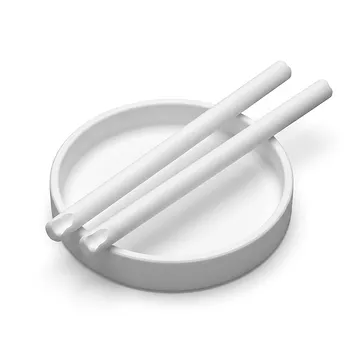
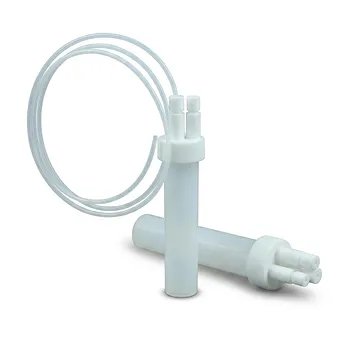
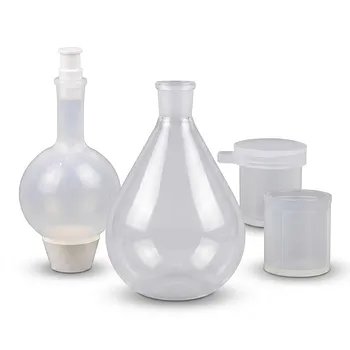
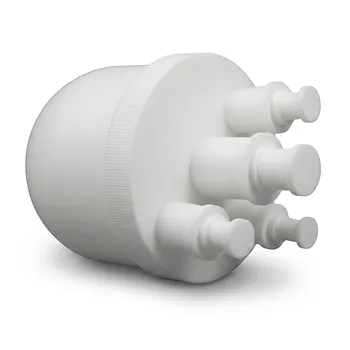
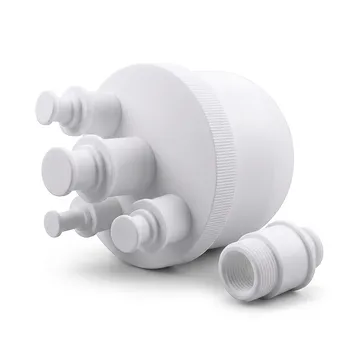
The operational difference is that PFA and FEP can be formed as flowing thermoplastics, while unmodified PTFE cannot. PFA and FEP can therefore be extruded, injection-molded, and in suitable applications blow-molded into complex labware and fittings. PTFE must first be compression-molded and sintered, paste-extruded, or formed into stock shapes that are later machined, making fabrication more dependent on tooling and CNC operations.
PFA and FEP offer direct molding and extrusion for complex or higher-volume parts; PTFE offers excellent chemical and thermal performance but generally requires powder-based forming and secondary machining. The material choice therefore affects not only chemical compatibility, but also geometry, production method, surface continuity, cost, and achievable repeatability.
Why PTFE Requires a Different Manufacturing Route
PTFE Does Not Flow Like a Conventional Melt
Unmodified PTFE has an exceptionally high melt viscosity, approximately 10¹¹–10¹² poise near 380°C. Although it reaches a melting transition around 327–342°C, it does not develop usable fluid flow above that temperature.
This is the critical distinction: reaching the melting point does not make PTFE behave like ordinary injection-molding resin.
PTFE Is Formed From Powder
Granular PTFE resin is commonly compression-molded and then sintered to produce billets, sheets, tubes, and other stock shapes. Fine PTFE powders are used in paste extrusion for tubing, seals, and similar products.
The resulting stock can then be precision CNC-machined into custom reaction vessels, electrochemical cells, manifolds, fittings, and specialized labware.
Machining Controls the Final Geometry
For one-off or low-volume custom parts, machining sintered PTFE stock provides substantial geometric flexibility. Features such as threads, channels, bores, sealing lands, and mounting interfaces can be defined directly from the design.
However, the process is subtractive. Material must be removed from a molded blank, and the achievable geometry depends on tool access, wall thickness, distortion control, and the behavior of the sintered stock during machining.
How PFA and FEP Change the Process
Comonomers Enable Melt Processing
PFA and FEP contain comonomers that reduce crystallinity and melt viscosity compared with unmodified PTFE. PFA incorporates perfluoroalkoxy groups, while FEP incorporates hexafluoropropylene.
These structural changes allow the polymers to flow through conventional thermoplastic equipment without sacrificing the broad chemical resistance expected from perfluorinated materials.
Complex Shapes Can Be Molded Directly
PFA and FEP can be injection-molded into intricate valve bodies, fluid fittings, closures, and vessel components. They can also be melt-extruded into tubing, profiles, and continuous shapes.
Because the final form can be created directly in the mold or die, this route is well suited to repeated production of complex geometries.
PFA Supports Seamless Fluid-Handling Components
PFA is particularly useful for high-purity labware, trace-analysis containers, digestion vessels, tubing assemblies, and molded fittings. Melt processing can produce continuous, seamless structures with fewer machined interfaces and fewer assembly points.
PFA is also commonly translucent, which can help with visual inspection of contents and fluid movement.
What This Means for Custom Labware
PTFE Fits Specialized, Low-Volume Parts
PTFE is often the practical choice when the design is highly customized, production volume is low, or the part must be machined from robust solid stock. This includes unusual reaction apparatus, custom holders, electrochemical components, and heavy-duty labware.
The manufacturing workflow is typically: select a suitable PTFE stock form, machine the required features, and inspect the finished component.
PFA Fits Complex or Repeatable Parts
PFA is advantageous when the part has a complex three-dimensional form, thin or continuous walls, integrated ports, or a geometry that would require extensive machining and assembly in PTFE.
It becomes more attractive as production volume increases because tooling and molding can replace repeated manual machining.
FEP Fits Lower-Temperature Melt-Processed Applications
FEP provides the same basic manufacturing advantage as PFA: it can be extruded and molded into complex parts. Its continuous-use temperature is generally lower, approximately 200°C, compared with approximately 260°C for PFA.
FEP is therefore more appropriate when the application benefits from melt-processing and does not require PFA's higher continuous-temperature capability.
How the Processes Affect Part Performance
Machined PTFE Uses Interfaces Intentionally
A machined PTFE assembly may contain threaded joints, drilled passages, press fits, or bonded and mechanically retained sections. These features can be useful, but each interface introduces another location to evaluate for leakage, contamination, dead volume, or mechanical movement.
The design should account for the fact that the final component may be assembled from several machined features rather than formed as one continuous molded shape.
Molded PFA Can Reduce Assembly Complexity
A molded PFA component can incorporate several functional features into one part. Reducing the number of joints can simplify fluid paths and improve consistency between production units.
This benefit depends on appropriate mold design, process control, and validation of the molded component. Melt-processing does not eliminate the need to inspect for defects, dimensional variation, or contamination.
Transparent or Translucent Construction Can Aid Inspection
PFA and FEP can provide translucent components that allow operators to observe fluid levels, bubbles, deposits, or flow behavior. This can be valuable in trace-analysis and high-purity fluid-handling systems.
PTFE's opaque, machined construction may be preferable when opacity, stiffness, or a particular stock-shape requirement is more important than visual access.
Understanding the Trade-offs
PTFE Has More Fabrication Constraints
PTFE cannot simply be loaded into standard injection-molding equipment and molded like a typical thermoplastic. Powder preparation, compression, sintering, paste extrusion, and secondary machining require specialized process knowledge.
Large or intricate parts may also involve more material waste and longer production times when manufactured from billet.
PFA Requires Tooling and Process Investment
PFA and FEP reduce the need for secondary machining, but injection molding and extrusion require dedicated tooling. For a single custom vessel or an early prototype, tooling costs may outweigh the benefits of direct molding.
Mold design must also account for shrinkage, dimensional tolerances, weld lines, gate locations, and the behavior of thin sections.
PFA and FEP Are Not Thermally Equivalent
PFA generally preserves a continuous-use temperature close to that of PTFE, around 260°C. FEP has a lower continuous-use limit, around 200°C, because its mechanical properties decline more significantly at elevated temperatures.
Selecting FEP solely because it is melt-processible can create a temperature-related performance problem.
Machining Does Not Automatically Make PTFE More Precise
CNC machining provides direct control over dimensions, but PTFE stock can still be affected by thermal expansion, creep, stress relief, and deformation. Tolerances must be specified in relation to the operating temperature, load, sealing method, and part geometry.
The process route should be validated against the actual service conditions rather than judged by machining capability alone.
Making the Right Choice for Your Goal
Choose the material and manufacturing method according to the part's geometry, volume, temperature, and fluid-handling requirements.
- If your primary focus is one-off or low-volume custom apparatus: Use PTFE stock with precision CNC machining when the design requires unusual features, robust solid sections, or frequent design changes.
- If your primary focus is complex molded geometry: Use PFA when integrated ports, thin walls, seamless fluid paths, or reduced assembly are important.
- If your primary focus is high-temperature melt-processed labware: Favor PFA over FEP when the application approaches the higher continuous-use temperature range.
- If your primary focus is repeatable production: Evaluate PFA or FEP molding and extrusion when tooling costs can be distributed across multiple parts.
- If your primary focus is lower-temperature tubing or fittings: Consider FEP when its temperature and mechanical limits are compatible with the application.
The best choice is the one that aligns the polymer's processing behavior with the part's geometry, production volume, and operating conditions.
Summary Table:
| Factor | PTFE | PFA | FEP |
|---|---|---|---|
| Melt processability | No (high melt viscosity) | Yes | Yes |
| Typical manufacturing methods | Compression molding + sintering, paste extrusion, CNC machining | Injection molding, extrusion | Injection molding, extrusion |
| Continuous use temperature | ~260°C | ~260°C | ~200°C |
| Translucency | Opaque | Translucent | Translucent |
| Best suited for | Low-volume, complex custom parts; stock shapes for machining | Complex molded parts, high-purity fluid handling | Lower-temperature melt-processed applications |
Ready to select the right fluoropolymer for your custom labware? At KINTEK, we specialize in high-performance PTFE and PFA products, offering everything from standard labware to complex custom machined parts. Our CNC machining capabilities and melt-processing expertise ensure you get the exact performance and geometry you need. Contact us today to discuss your project and receive a tailored solution.
Related Products
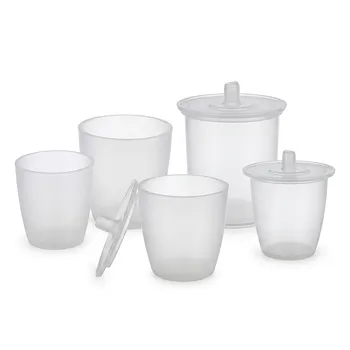
- High Purity PFA Crucible and Corrosion Resistant PTFE Beaker for Trace Analysis and Custom Laboratory Applications
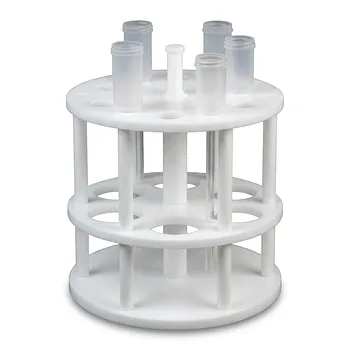
- Custom PFA Microcolumn Racks and PTFE Machined Low Background Corrosion Resistant Laboratory Fixtures
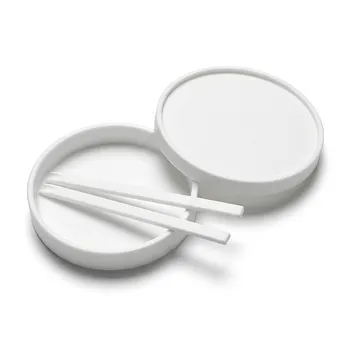
- Custom Polytetrafluoroethylene PTFE Petri Dishes 60mm Corrosion Resistant Low Background Labware
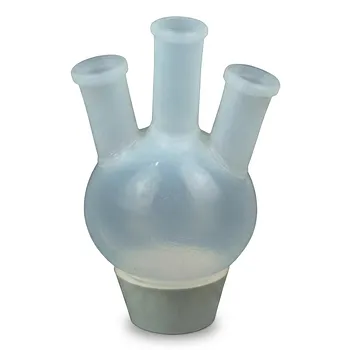
- Custom Corrosion Resistant PFA PTFE Multi Neck Laboratory Reaction Flask GL Standard Mouth Fluoropolymer Flasks
- Corrosion Resistant PTFE Support with PFA Transparent Reaction Tank and High Purity PFA Sampling Tube for Trace Analysis
People Also Ask
- Why are high-purity vessels critical for BiFeO3 synthesis? Ensuring Phase Purity
- Why is the use of high-purity PFA or PTFE labware critical during TiO2 nanoparticle purification? Protect Sample Purity
- Why is high-purity PFA labware necessary for Znx@LS-2 zeolite ICP-OES analysis? Ensure Trace-Level Precision
- Why is high-purity PFA trace analysis labware used for MXene? Ensure Superior Material Integrity in Research
- What key material characteristics make PTFE and PFA suitable for high-purity laboratory labware, trace analysis containers, and medical microporous tubing? Discover the essential properties that ensure purity.