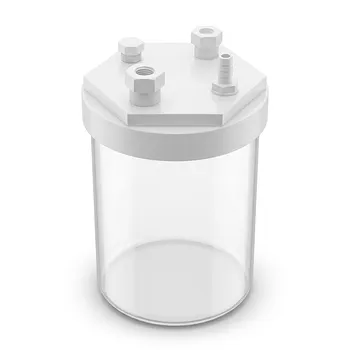
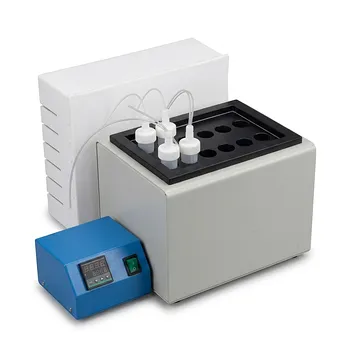
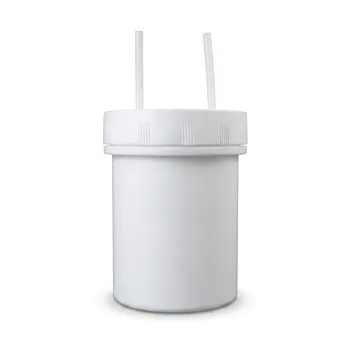
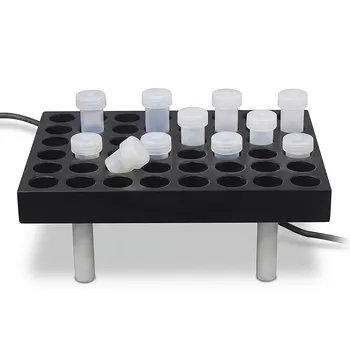
The mechanical function of sealed heating containers is to provide a stable hydrothermal environment that facilitates the precise structural evolution of NiFe-LDH. During the aging stage, these containers maintain a constant temperature—typically 65 °C—for approximately 18 hours to enable a process known as Ostwald ripening. This specialized environment ensures that the material transitions from unstable primary particles into a highly crystalline, layered microstructure with specific morphological features.
Core Takeaway: Sealed heating containers act as pressurized micro-reactors that drive Ostwald ripening, allowing for the dissolution and redeposition of particles to create a refined, high-crystallinity layered structure.
The Role of Controlled Thermal Environments
Constant Temperature for Microcrystalline Growth
The primary mechanical role of the container is to maintain a steady thermal state of 65 °C throughout the 18-hour aging period. This specific temperature provides the necessary kinetic energy for atoms to rearrange themselves without over-accelerating the reaction into a disordered state.
Maintaining Chemical Concentration Through Sealed Conditions
By remaining hermetically sealed, the container prevents the evaporation of solvents and the loss of volatile components. This keeps the internal chemical concentration constant, ensuring that the growth of the NiFe-LDH layers remains uniform across the entire batch.
Driving the Mechanism of Ostwald Ripening
Dissolution of Primary Particles
Under the constant heat of the sealed container, small and unstable primary particles begin to dissolve back into the precursor solution. These particles have higher surface energy, making them thermodynamically less stable than their larger counterparts.
Redeposition and Structural Refinement
The dissolved material from the smaller particles redeposits onto the surface of larger, more stable particles. This systematic migration of mass is what allows the NiFe-LDH to grow from a raw precipitate into a more robust and organized crystalline form.
Impact on Morphology and Crystallinity
Developing the Porous Flower-Cluster Structure
The sealed aging process is responsible for the formation of specialized microstructures, such as the porous flower-cluster morphology. This complex arrangement significantly increases the surface area of the material, which is vital for its performance in electrochemical applications.
Enhancing Layered Regularity
As the redeposition occurs, the layered double hydroxide (LDH) structure becomes more refined and distinct. The mechanical stability of the heating environment ensures that these layers are stacked with high regularity, minimizing defects within the crystal lattice.
Understanding the Trade-offs
The Constraint of Time
The 18-hour aging process represents a significant temporal trade-off in the synthesis workflow. While necessary for high crystallinity, this duration limits the throughput of material production and increases the energy footprint of the synthesis.
Sensitivity to Temperature Fluctuations
The process is highly sensitive to even minor thermal variances within the container. If the seal fails or the temperature fluctuates, the Ostwald ripening process can become uneven, leading to a heterogeneous mixture of particle sizes rather than the desired uniform flower-cluster morphology.
How to Apply This to Your Project
The use of sealed heating containers is essential when the final application requires high structural integrity and specific surface characteristics.
- If your primary focus is Maximum Crystallinity: Ensure the container remains sealed for the full 18-hour duration at a precise 65 °C to allow complete Ostwald ripening.
- If your primary focus is High Surface Area: Monitor the aging stage closely to facilitate the development of the porous flower-cluster morphology, which is critical for catalytic efficiency.
- If your primary focus is Rapid Prototyping: Consider that reducing aging time will likely result in smaller, less stable primary particles and a lack of refined layered structures.
The mastery of the aging stage through controlled containment is the definitive factor in transforming raw chemical precursors into high-performance NiFe-LDH materials.
Summary Table:
| Function | Mechanism | Impact on NiFe-LDH |
|---|---|---|
| Thermal Stability | Maintains constant 65 °C | Facilitates precise atomic rearrangement |
| Hermetic Sealing | Prevents solvent evaporation | Ensures uniform chemical concentration |
| Ostwald Ripening | Dissolution & Redeposition | Refines layered structures and grain size |
| Morphological Control | Controlled pressurized environment | Drives formation of porous flower-clusters |
Precision Labware for High-Performance Synthesis
To achieve superior structural integrity in NiFe-LDH materials, your hydrothermal environment must be flawless. KINTEK specializes in high-performance fluoropolymer labware designed for the most demanding chemical environments. From standard PTFE and PFA beakers, digestion vessels, and liners to custom-engineered microchannel reactors and complex CNC-machined components, we provide the tools necessary for precise thermal and chemical control.
Whether you require high-purity trace analysis instruments, bespoke reaction apparatus, or high-volume lab consumables, KINTEK’s end-to-end fabrication ensures your setup meets exact specifications. Contact our technical team today to discuss how our custom PTFE/PFA solutions can enhance your laboratory's efficiency and material performance.
References
- Ting Guan, Yongxia Yang. High-Performance La-, Mo-, and W-Doped NiFe-Layered Double Hydroxide for Methyl Orange Dye and Cr(VI) Adsorption. DOI: 10.3390/pr13010156
This article is also based on technical information from Kintek Knowledge Base .
Related Products
- PTFE Lined High Pressure Digestion Vessel 50ml High Temperature Hydrothermal Synthesis Tank
- Custom High Purity PTFE Storage Barrel with Corrosion Resistant Threaded Sealing Lid and Low Background Properties 15L
- PFA Reaction Tank 6L Customizable Fittings Corrosion Resistant Solvent Resistant PFA Reaction Bottle for New Material Synthesis
- High Purity Methylmercury Ethylmercury Determination Heating System Six Hole Customizable Module PFA Distillation Vessels
- Custom PTFE Beaker 350ml High Purity Laboratory Vessel with Optional Lid for Hot Plate Heating Applications
People Also Ask
- What are the benefits of using a PTFE-lined vessel for carbon-sulfur cathode treatment? Maximize Purity & Performance
- Why are PTFE-lined pressure digestion vessels required for the preparation of Ag/CeO2 catalysts? Purity & Performance
- What safety features are typically incorporated into high-pressure PTFE digestion vessel designs? Ensure Lab Safety
- What is the function of PTFE lined high-pressure vessels in g-C3N4 synthesis? Achieve High-Purity Material Growth
- Role of High-Pressure Digestion Tanks in Perovskite Synthesis: Achieve Superior Stability and Latent Heat