The precision of semiconductor band alignment is entirely dependent on the stability of the testing environment. Using a specialized electrochemical cell and workstation for $Bi_2WO_6/BiOCl$ catalysts ensures a stable potential scanning environment required to measure accurate capacitance values. These measurements allow researchers to derive flat-band potentials ($E_{fb}$), which are critical for determining conduction and valence band positions and understanding the charge transfer mechanisms that drive pollutant degradation, such as in TNT wastewater.
Specialized hardware provides the physical and electrical stability necessary to isolate the depletion layer capacitance from background noise. This allows for the accurate mapping of energy bands, which is the foundational step in verifying how a heterojunction catalyst facilitates charge separation.
Mapping Energy Bands with Precision
Deriving Flat-Band Potentials
A specialized workstation applies precise AC voltages and frequencies to measure the depletion layer capacitance of the semiconductor film. By analyzing these values, researchers can calculate the flat-band potential ($E_{fb}$) for both $BiOCl$ and $Bi_2WO_6$.
Determining Band Positions
The derived $E_{fb}$ is the key variable used to calculate the conduction band (CB) and valence band (VB) positions. These positions define the thermodynamic limits of the catalyst and determine its ability to generate reactive species for pollutant degradation.
Revealing Internal Charge Transfer
Understanding the relative band positions of $Bi_2WO_6$ and $BiOCl$ reveals how electrons and holes move across the heterojunction interface. This data is essential for verifying the internal principles of how catalysts break down complex pollutants like TNT.
Hardware Architecture and Data Integrity
Optimizing Electric Field Distribution
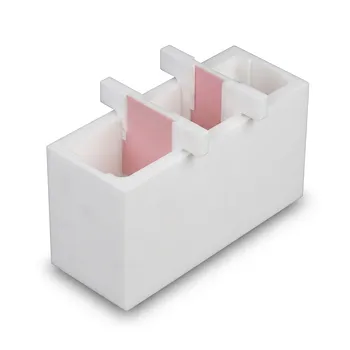
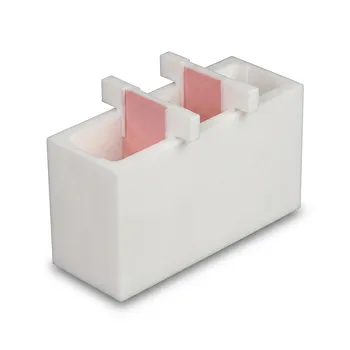
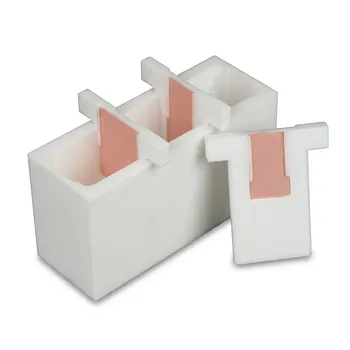
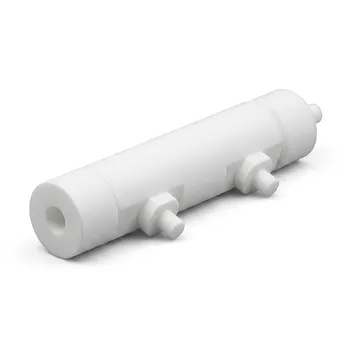
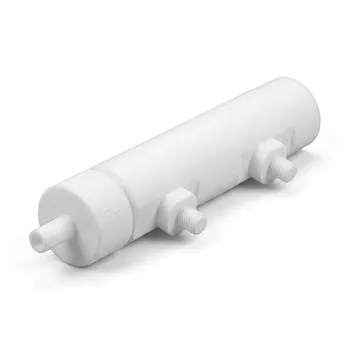
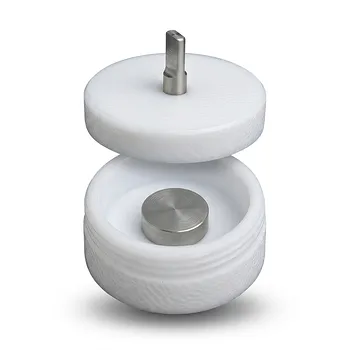
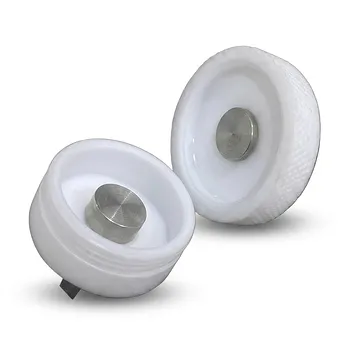
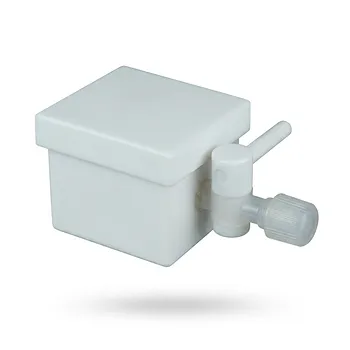
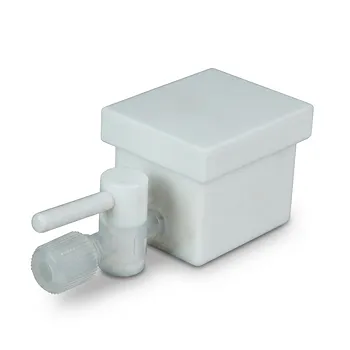
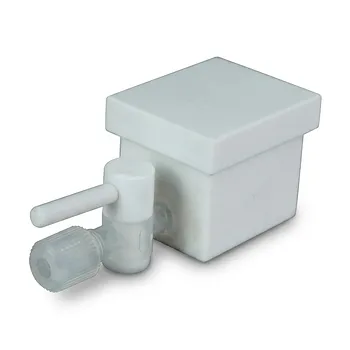
A specialized cell features a precise structural design that provides stable physical support for the electrodes. This design optimizes the electric field distribution, ensuring that the measured capacitance reflects the intrinsic properties of the catalyst rather than hardware artifacts.
Material Durability and Interference
Cells constructed from high-performance fluoropolymers (PTFE) can withstand corrosive electrolytes while maintaining a perfect seal. This prevents electrolyte leakage and eliminates external impurity interference, which is critical for obtaining high-quality electrochemical data over long-cycle tests.
Minimizing Solution Resistance ($R_s$)
A dedicated three-electrode setup maintains fixed distances between the working, reference, and counter electrodes. This spatial consistency minimizes interference from solution resistance ($R_s$), allowing for the acquisition of accurate kinetic data and stable potential scanning.
Understanding the Trade-offs
The Risk of Standard Lab Glassware
Using generic glassware instead of a specialized cell often leads to non-uniform current distribution and unstable triple-phase interfaces. This instability introduces noise into the Mott-Schottky plot, making it impossible to accurately determine the slope and $x$-intercept required for $E_{fb}$ calculations.
Frequency Dependency Challenges
Mott-Schottky measurements can be highly sensitive to the chosen frequency. A high-performance workstation is required to perform multi-frequency analysis, which helps identify and compensate for frequency dispersion caused by surface states or electrode roughness.
Systemic Errors in Simplified Setups
Simplified setups may suffer from gas bypassing or poor sealing, especially if gas evolution occurs during testing. Specialized cells ensure that gas-solid-liquid interfaces remain stable, preventing fluctuations in current density that would otherwise skew the final band-gap analysis.
Applying This to Your Research Project
Recommendations for Catalyst Characterization
- If your primary focus is determining semiconductor type and band levels: Prioritize a workstation with high-frequency resolution to ensure the linearity of your Mott-Schottky plots.
- If your primary focus is testing catalyst longevity in harsh media: Utilize a specialized cell made from PTFE or similar fluoropolymers to prevent hardware degradation from corrosive electrolytes.
- If your primary focus is optimizing heterojunction interfaces: Use a dedicated three-electrode cell to maintain fixed geometry, which ensures that changes in capacitance are due to the interface design rather than setup variability.
By integrating a specialized electrochemical environment, you move beyond simple observation to a quantitative understanding of the driving forces behind catalyst performance.
Summary Table:
| Feature | Benefit for Mott-Schottky Testing | Impact on Research |
|---|---|---|
| Stable Geometry | Minimizes solution resistance ($R_s$) | Accurate $E_{fb}$ & band position mapping |
| PTFE Construction | Resists corrosive electrolytes | High-quality data with zero contamination |
| Fixed 3-Electrode Setup | Uniform electric field distribution | Prevents noise in capacitance measurement |
| Sealed Environment | Stable gas-solid-liquid interface | Reliable data for heterojunction analysis |
Elevate Your Research with KINTEK’s Precision Fluoropolymer Solutions
Achieving accurate semiconductor band alignment requires more than just standard glassware—it demands the chemical resistance and structural precision of high-performance materials. KINTEK specializes in manufacturing virtually all imaginable laboratory supplies crafted from PTFE and PFA, ensuring your electrochemical environment is free from interference and corrosion.
From everyday basic labware (beakers, crucibles, and reagent bottles) and sample prep tools (filters, pipettes, and spatulas) to advanced custom electrochemical cells, battery testing fixtures, and microwave digestion vessels, we provide the hardware necessary for high-integrity data. Our end-to-end custom CNC fabrication allows us to deliver bespoke laboratory setups and complex non-standard parts tailored to your specific Mott-Schottky testing requirements.
Ready to optimize your catalyst characterization? Contact KINTEK today to discuss your custom laboratory needs and experience the difference of high-performance fluoropolymer engineering.
References
- Xiyang Zhou, Xiaoteng Liu. In situ synthesis of three-dimensional core–shell structure Bi2WO6/BiOCl and photocatalytic degradation of trinitrotoluene wastewater. DOI: 10.1007/s42114-024-01134-8
This article is also based on technical information from Kintek Knowledge Base .
Related Products
- Corrosion Resistant PTFE Electrochemical Cell for New Energy Research Inert Insulating Customizable Lab Reaction Vessel
- Square PTFE Electrochemical Cell for Silicon Wafer Processing and Hydrofluoric Acid Resistance in Semiconductor and New Energy Research
- White PTFE Electrolytic Cell with Movable Slider and Insulated Lid for Fluorine Corrosion Resistance
- Custom PTFE Reaction Box Opaque White Square Electrochemical Cell Tank
- Custom PTFE Electrolytic Cell Corrosion Resistant Low Background Reaction Vessel with Inlet Outlet Ports
People Also Ask
- How do custom PTFE electrochemical cells improve the accuracy of stability testing for alkaline catalysts compared to glass cells?
- How does the hydrophobicity of PTFE benefit electrochemical measurements? Enhance Stability and Precision in Your Lab
- What makes PTFE an ideal construction material for custom electrochemical cells and electronic analytical instrumentation housings? Discover superior chemical resistance and electrical insulation
- Why must seawater electrolysis test cells have high corrosion resistance? Protect catalyst stability & data accuracy.
- What are the key steps for structural integrity in molded PTFE lab reaction vessels? Master fine powder processing.