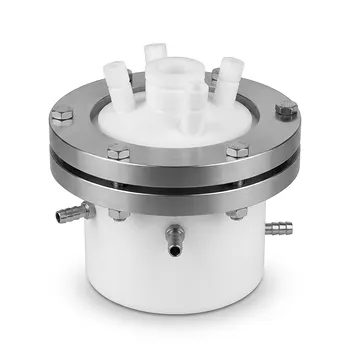
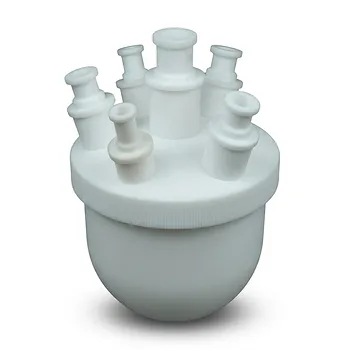
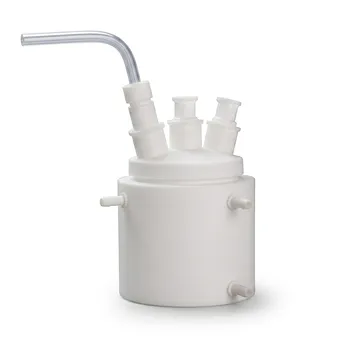
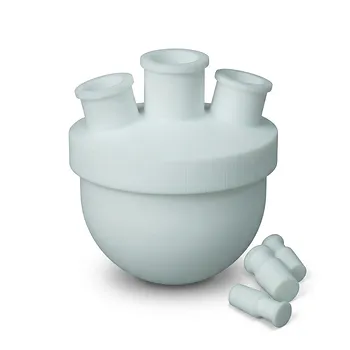
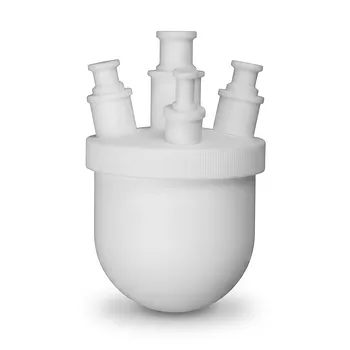
The high-pressure reactor is the fundamental vessel for Bismuth Sulfide ($Bi_2S_3$) aerogel synthesis. By providing a sealed environment, the reactor allows the reaction mixture to be heated to 200°C, generating autogenous pressure that facilitates the chemical reaction between bismuth and sulfur sources under solvothermal conditions. This process is critical for the formation of $Bi_2S_3$ nanoparticles and their initial bonding with chitosan templates, which establishes the necessary precursor framework for the final aerogel.
Core Takeaway: The high-pressure reactor enables subcritical conditions that drive the chemical synthesis of $Bi_2S_3$ and its integration with structural templates. Without this controlled, high-energy environment, the precursors would fail to achieve the crystallinity and bonding required for a stable aerogel structure.
Driving the Solvothermal Synthesis
Creating the Sealed Environment
A high-pressure reactor, often referred to as an autoclave, creates a hermetically sealed space that prevents the escape of vapors. As the internal temperature rises to 200°C—well above the boiling point of many solvents—the vessel generates autogenous pressure. This pressure keeps solvents in a liquid state, creating a superheated environment that significantly enhances the reactivity of the precursors.
Facilitating Bismuth and Sulfur Reactions
Under these solvothermal conditions, the bismuth and sulfur sources undergo a targeted chemical reaction that would be inefficient at standard pressure. The high energy within the reactor promotes the formation of $Bi_2S_3$ nanoparticles. These nanoparticles serve as the building blocks for the aerogel’s solid matrix.
Enhancing Solubility and Diffusion
The pressurized environment increases the solubility of precursors, allowing for a more homogenous reaction mixture. This state accelerates ion diffusion, ensuring that the bismuth and sulfur ions can interact rapidly and consistently throughout the solution. This uniformity is essential for creating a consistent material rather than a fragmented precipitate.
Structural Formation and Template Integration
Bonding with Chitosan Templates
A unique function of the reactor in this specific synthesis is facilitating the initial bonding between the $Bi_2S_3$ nanoparticles and chitosan. The chitosan acts as a template or "scaffold" for the aerogel. The high-pressure environment provides the thermal energy required to trigger these cross-linking or bonding mechanisms, which are the first steps in creating the precursor framework.
Controlled Nucleation and Growth
The reactor allows for controlled nucleation, where the $Bi_2S_3$ crystals begin to form at a specific rate. By maintaining a constant high temperature and pressure, the reactor ensures that these crystals grow with specific morphology and crystallinity. This control is vital for the aerogel's final properties, such as its surface area and structural porosity.
Overcoming Capillary Resistance
In complex synthesis involving templates, the high-pressure environment helps the reaction solution overcome capillary resistance. This allows the metal ions to penetrate deeply into the internal channels of the template structure. The result is a more uniform dispersion of the inorganic phase within the organic template, leading to a more robust composite material.
Understanding the Trade-offs and Risks
Equipment Stress and Maintenance
Operating at 200°C and high autogenous pressure places significant mechanical stress on the reactor’s seals and walls. Over time, repeated thermal cycling can lead to material fatigue or seal failure. Regular inspection and the use of high-quality PTFE liners are mandatory to prevent contamination and ensure safety.
Reaction Sensitivity
Hydrothermal synthesis is highly sensitive to the filling degree (the volume of liquid relative to the vessel size). If the reactor is overfilled, the pressure can rise exponentially and exceed safety limits. Conversely, underfilling may lead to insufficient autogenous pressure, resulting in poor crystallinity or incomplete bonding with the chitosan template.
Safety Protocols
The primary risk associated with high-pressure reactors is vessel rupture due to runaway reactions or equipment failure. Users must strictly adhere to temperature limits and utilize pressure relief valves or rupture disks. Because the reaction occurs in a "black box" environment, real-time monitoring is often difficult without specialized, high-cost sensors.
Applying This to Your Synthesis Goals
Optimizing the Hydrothermal Process
To achieve the best results in $Bi_2S_3$ aerogel synthesis, you must align your reactor parameters with your specific material requirements.
- If your primary focus is Maximum Surface Area: Ensure the temperature is strictly maintained to favor rapid nucleation over crystal growth, preventing the formation of large, heavy particles.
- If your primary focus is Structural Integrity: Extend the dwell time in the reactor to allow for more complete bonding between the $Bi_2S_3$ nanoparticles and the chitosan scaffold.
- If your primary focus is High Purity: Utilize a high-quality PTFE-lined reactor to prevent the leaching of metallic impurities from the vessel walls into the aerogel framework.
The high-pressure reactor is not merely a heater, but a sophisticated tool that manipulates thermodynamics to force the creation of complex, high-performance nanostructures.
Summary Table:
| Function | Mechanism | Impact on Aerogel Quality |
|---|---|---|
| Solvothermal Synthesis | Generates autogenous pressure at 200°C | Drives Bi and S reaction into nanoparticles |
| Template Integration | High-energy thermal cross-linking | Bonds inorganic phase to chitosan scaffold |
| Kinetic Control | Enhanced solubility and ion diffusion | Ensures uniform morphology and high surface area |
| Structural Growth | Controlled nucleation rates | Prevents fragmentation and ensures stable porosity |
Elevate Your Synthesis Precision with KINTEK
Achieving consistent results in high-pressure hydrothermal synthesis requires equipment that can withstand extreme chemical environments and thermal stress. KINTEK specializes in high-performance fluoropolymer solutions designed specifically for demanding laboratory applications.
From high-purity PTFE liners for high-pressure reactors and microwave digestion vessels to essential labware like beakers, crucibles, and reagent bottles, we provide the durability your research demands. Our expertise extends to comprehensive fluid transfer components (tubing, valves, fittings) and advanced reaction apparatus, including standard or custom electrochemical cells and hydrothermal synthesis liners.
Why choose KINTEK?
- Custom Fabrication: End-to-end CNC machining for complex, non-standard parts.
- Material Excellence: Absolute focus on high-performance PTFE and PFA for maximum chemical inertness.
- Scalable Solutions: From individual bespoke setups to high-volume orders.
Ensure the integrity of your Bismuth Sulfide aerogels and other advanced materials. Contact us today to discuss your specific laboratory requirements and discover how our high-performance fluoropolymer products can optimize your workflow.
References
- Renren Wang, Lin Zhu. One-step hydrothermal synthesis of bismuth sulfide aerogel for efficient iodine capture. DOI: 10.3389/fenvs.2025.1709936
This article is also based on technical information from Kintek Knowledge Base .
Related Products
- High Temperature Corrosion Resistant Hydrothermal Synthesis Reactor with TFM Inner Liner and Straight Cylinder Design
- PTFE Lined High Pressure Digestion Vessel 50ml High Temperature Hydrothermal Synthesis Tank
- High Pressure Custom TFM Reactor Stainless Steel Outer Vessel PTFE Inner Cup for Corrosive Synthesis
- Custom TFM Reaction Vessel with Stainless Steel Jacket and PTFE Inner Cup for High Corrosion Resistance
- High Purity PFA Constant Pressure Condensation Reaction System Acid Resistant High Temperature Customizable Teflon Labware
People Also Ask
- What is the role of a corrosion-resistant reactor in the synthesis of lignin-based carbon dots? Ensure Maximum Purity
- What are the technical advantages of using hydrothermal synthesis reactors for advanced electronic & optical nanomaterials?
- How does a hydrothermal synthesis reactor facilitate the production of crystalline materials with tailored morphologies? Precision Crystal Growth
- Why is the sealing reliability of a hydrothermal synthesis reactor critical for 24-hour cycles? Ensure Nano-Precision
- What role do hydrothermal synthesis reactors play in CQD preparation? Achieve High-Purity Nanomaterial Synthesis