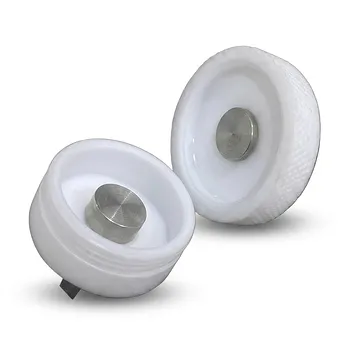
The 2032 type coin cell case serves as the foundational architecture for bench-top electrochemical evaluation. It provides a standardized, sealed environment that ensures constant mechanical pressure and electrical contact between electrodes. This setup is essential for accurately measuring the specific capacitance, energy density, and cycle life of advanced materials like nanocomposites within a stable testing cell.
The 2032 coin cell assembly acts as a precision testing vessel that converts raw materials into a measurable device by maintaining uniform internal pressure and environmental isolation. Its primary role is to eliminate experimental variables related to physical contact and atmospheric contamination, ensuring that the resulting data reflects the material's true performance.
The Role of Mechanical Pressure and Contact
Wave Springs and Spacers
The inclusion of stainless steel wave springs and spacers is critical for maintaining constant mechanical pressure within the cell. These components compensate for the internal volume of the case, ensuring that the electrodes and separators are compressed tightly against one another.
Minimizing Internal Resistance
By providing uniform pressure, the assembly ensures excellent electrical contact between the active materials and the current collectors. This minimizes ohmic resistance and interfacial gaps, which is vital for obtaining reproducible data during high-rate charge and discharge cycles.
Enhancing Ion Transport
The assembly facilitates the proper function of the separator, often made of porous filter paper. This component provides physical insulation to prevent short circuits while simultaneously absorbing the electrolyte to ensure the free transport of ions between the positive and negative electrodes.
Environmental Isolation and Reliability
Preventing Atmospheric Infiltration
High-quality 2032 cases are designed to be hermetically sealed using a sealing machine. This protects the internal chemistry from atmospheric moisture and oxygen, which could otherwise degrade sensitive components like ionic liquid electrolytes or nanocomposites.
Ensuring Data Reproducibility
The standardized nature of the 2032 module allows researchers to compare results across different laboratories with high confidence. Because the geometry and pressure are consistent, variations in recorded energy density or cycle life can be attributed to the materials themselves rather than the testing fixture.
Supporting Long-Cycle Evaluations
For devices like supercapacitor-battery hybrids, stability over thousands of cycles is a key metric. The rugged construction of the stainless steel casing ensures that the cell remains pressure-stable and leak-proof throughout extended testing periods.
Understanding the Trade-offs and Pitfalls
Pressure Sensitivity
While compression is necessary for contact, excessive pressure can lead to the deformation of porous electrodes or the piercing of the separator. This can cause internal short circuits or restricted ion flow, leading to inaccurate performance readings.
Potential for Electrolyte Leakage
If the sealing gasket is misaligned or the crimping pressure is insufficient, the cell may leak. This not only poses a contamination risk to testing equipment but also leads to electrolyte depletion, which artificially shortens the perceived cycle life of the device.
Material Compatibility
Stainless steel is the standard for 2032 components, but it may react with certain highly aggressive electrolytes or at extreme voltages. In these specialized cases, standard components may require coatings or alternative materials to prevent corrosion from skewing the electrochemical data.
How to Apply This to Your Testing Project
Making the Right Choice for Your Goal
- If your primary focus is material characterization: Use high-precision stainless steel spacers and springs to ensure that the internal resistance is as low as possible, allowing the material's intrinsic properties to shine.
- If your primary focus is long-term stability: Prioritize the quality of the sealing gaskets and the calibration of your crimping machine to prevent moisture ingress over months of testing.
- If your primary focus is high-rate performance: Ensure the use of wave springs that provide maximum tension to maintain tight interfacial contact during rapid ion movement.
By mastering the assembly and mechanics of the 2032 coin cell, you ensure that your electrochemical data is both a precise and reliable reflection of your material's potential.
Summary Table:
| Component | Key Function | Impact on Testing |
|---|---|---|
| Wave Springs & Spacers | Maintains constant mechanical pressure | Minimizes ohmic resistance and improves contact |
| Stainless Steel Case | Provides hermetic sealing | Prevents atmospheric contamination and moisture ingress |
| Gasket | Environmental isolation | Ensures leak-proof operation and maintains electrolyte volume |
| Separator | Physical insulation & ion transport | Prevents short circuits while facilitating ionic flow |
| Internal Assembly | Standardized geometry | Guarantees data reproducibility across different labs |
Maximize Your Lab’s Precision with KINTEK’s High-Performance Solutions
Ensure the integrity of your electrochemical data with KINTEK, your premier partner for high-performance fluoropolymer laboratory supplies. From standard 2032 battery testing fixtures and electrode accessories to advanced PTFE and PFA labware like beakers, high-purity trace analysis instruments, and custom-machined reaction apparatus, we provide the tools necessary for cutting-edge research.
Our end-to-end custom CNC fabrication capabilities allow us to deliver everything from high-volume orders of everyday consumables (stirring bars, O-rings, and filters) to complex, non-standard machined parts like hydrothermal synthesis liners and microwave digestion vessels.
Ready to upgrade your experimental setup? Contact us today to discover how KINTEK’s absolute focus on high-performance materials and bespoke engineering can solve your most demanding laboratory challenges.
References
- Murat Ateş. Sulfur dopant effects on hybrid rGO/MoS2/PANI nanocomposites for SupercapBattery devices. DOI: 10.59287/iccar.780
This article is also based on technical information from Kintek Knowledge Base .
Related Products
People Also Ask
- What is the thermal operating range for PTFE battery clamps in electrochemical research? Stability from -200°C to +260°C
- What are the primary functions and material compositions of PTFE battery clamps? Ensure Precision & Chemical Resistance
- How do coin cell testing fixtures evaluate ZIF-derived LCO cycling stability? Ensure Battery Research Precision
- What are the electrical insulation and signal integrity advantages of using PTFE battery clamps? Ensure Data Accuracy
- How does the chemical inertness of PTFE benefit laboratory-scale battery testing? Ensure high-purity research results.