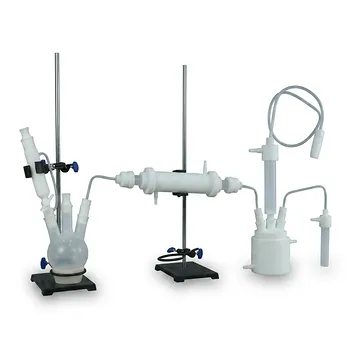
TFE monomer purification requires sequential acid removal, water washing, caustic neutralization, drying, low-temperature condensation, and high-efficiency fractional distillation. A representative train uses aqueous HCl washing, cool-water scrubbing, dilute NaOH treatment, concentrated H₂SO₄ drying, followed by condensation near −80°C and reduced-pressure distillation. Corrosion-resistant PTFE or PFA transfer components are necessary because the process combines HF, hot or concentrated HCl, caustic solutions, sulfuric acid, cryogenic fluorocarbon streams, and extremely tight contamination limits.
Core takeaway: The purification train must remove both corrosive inorganic acids and trace organic or fluorocarbon impurities that can terminate TFE polymer chains. PTFE and PFA components protect the equipment and help prevent metallic or organic contamination from entering a monomer stream that may require impurity levels in the sub-ppm range.
Why TFE purification is unusually demanding
Acidic pyrolysis gas is highly corrosive
TFE is commonly produced by pyrolysis of chlorofluorocarbon precursors. The crude gas can contain HCl, HF, unreacted precursor gases, and fluorocarbon side-products.
The combination is aggressive toward ordinary metals, glass, elastomers, and many conventional plastics. Corrosion can create leaks, equipment damage, particulates, and dissolved metal contamination.
Trace impurities affect polymer molecular weight
Some impurities containing hydrogen or chlorine behave as telogenic, or chain-transfer, species during polymerization. They interrupt chain growth and can reduce the molecular weight and performance of the resulting PTFE.
Trifluoroethylene is therefore controlled at very low levels. Depending on the process specification, target limits may be approximately below 0.2–0.5 ppm, while some process descriptions specify a limit below 0.5 ppm.
Oxygen creates a separate hazard
Residual oxygen is not merely a purity concern. It can promote unwanted TFE autopolymerization, generating localized heat and potentially causing rapid decomposition.
Industrial systems therefore control oxygen ingress during purification, storage, and transfer. Oxygen scavengers such as terpene-based inhibitors may be used where compatible with the process and product specification.
The chemical scrubbing sequence
The exact equipment arrangement depends on the feed composition and plant design, but the referenced purification sequence follows four principal wet-treatment steps.
1. Aqueous HCl washing
The crude pyrolysis gas is first contacted with an aqueous HCl solution, described in the reference as approximately 30 wt% HCl.
This step is used as an initial washing or conditioning operation to remove or control water-soluble contaminants and unwanted components carried with the pyrolysis gas. It also establishes a controlled acidic environment before the subsequent water and alkaline stages.
Because this stream contains concentrated acid and may also contain dissolved fluoride species, the scrubber, distributor, demister, piping, valves, and drains must all be selected for the actual HF/HCl service—not merely for generic “acid resistance.”
2. Cool-water scrubbing
The gas then passes through a cool-water scrubber.
Cooling improves absorption of water-soluble acidic species and helps reduce the vapor load entering the alkaline neutralization stage. Temperature control is important because absorption performance, gas solubility, and equipment corrosion rates all change with temperature.
The scrubber should include effective mist elimination. Carryover of acidic droplets into downstream caustic or drying equipment can upset chemistry and create localized corrosion.
3. Dilute NaOH neutralization
A dilute sodium hydroxide solution is then used to neutralize remaining acidic contaminants, particularly residual HCl and HF.
The caustic stage must be controlled to avoid both insufficient neutralization and excessive entrainment of alkaline droplets into the dryer. Online monitoring of pH, acid loading, pressure drop, and scrubber circulation condition is typically important for stable operation.
The waste liquor is also a significant chemical-handling concern because it can contain fluoride and chloride salts. Materials selection and waste treatment must account for those species rather than treating the liquor as ordinary aqueous caustic waste.
4. Concentrated H₂SO₄ drying
After acid removal and neutralization, the gas is dried using concentrated sulfuric acid.
This step removes residual moisture before low-temperature condensation and distillation. Water must be tightly controlled because it can freeze in cold sections, affect separation behavior, and contribute to corrosion or contamination.
The sulfuric-acid dryer requires compatible packing, circulation hardware, mist elimination, and transfer lines. Acid aerosol carryover must be prevented because it can contaminate downstream cryogenic and distillation equipment.
Condensation and multi-stage distillation
Low-temperature condensation
The dried gas is condensed at low temperature, with the reference giving approximately −80°C and 0.5 MPa as representative conditions.
These values should be treated as process examples rather than universal design requirements. Actual temperature and pressure depend on feed composition, phase-equilibrium data, refrigeration capacity, allowable operating envelope, and the separation strategy.
The cold section must be designed for rapid pressure excursions and polymerization control. TFE systems require appropriate relief protection, oxygen exclusion, monitoring, and procedures for abnormal conditions.
Fractional distillation removes volatile and closely related species
The condensed material is refined in multi-stage fractional distillation columns. High-efficiency columns—described in the reference as having 80 or more theoretical plates—provide the separation capability needed for closely boiling fluorocarbon components.
The distillation train separates TFE from:
- Low-boiling species that can concentrate in overhead streams.
- Unreacted precursor compounds and chlorinated fluorocarbons.
- Difluoromethane and related fluorocarbon impurities.
- Trifluoroethylene and other chain-transfer-active species.
- Heavier fluorocarbon side-products and polymerization-relevant contaminants.
The objective is not simply a high assay percentage. It is a controlled impurity profile suitable for high-molecular-weight PTFE polymerization.
Impurity specifications must be defined by polymer performance
The reference cites example limits of approximately below 5 ppm difluoromethane and below 0.5 ppm trifluoroethylene. Other specifications in the supplied material cite overall TFE purity around 99.99995% and tighter trifluoroethylene limits near 0.2–0.3 ppm.
These figures are not interchangeable universal standards. The correct limits must come from the polymer grade, reactor chemistry, inhibitor strategy, and validated process specification.
Product handling continues after distillation
Purification can be defeated by contaminated downstream equipment. Product-contact surfaces, sampling systems, storage vessels, valves, and transfer lines must therefore be cleaned, dried, and qualified for high-purity fluorocarbon service.
The system must also prevent re-entry of oxygen, moisture, lubricants, particles, and metal ions after the distillation columns have achieved the required purity.
Why PTFE and PFA fluid-transfer components are necessary
They resist HF, HCl, sulfuric acid, and caustic solutions
PTFE and PFA offer broad chemical resistance against the principal wet-treatment chemicals:
- Hydrofluoric acid
- Hydrogen chloride
- Concentrated sulfuric acid
- Sodium hydroxide
- Water containing dissolved fluoride and chloride salts
This resistance reduces wall attack, cracking, loss of mechanical integrity, and contamination caused by corrosion products.
They reduce trace-metal contamination
A metal component may survive visually while still releasing trace ions into an ultra-pure stream. For TFE purification, even low-level contamination can compromise product quality or interfere with polymerization.
Fluoropolymer wetted surfaces help reduce the risk of iron, nickel, chromium, and other metallic leachables entering the monomer stream. This is particularly important in sampling lines, small-bore tubing, valve cavities, and dead legs where contamination can accumulate.
They protect gas purity during transfer
The purification train includes multiple transitions between wet scrubbing, dry gas handling, cryogenic condensation, and distillation. Every transfer point is a potential source of:
- Moisture ingress
- Acid or caustic carryover
- Particulate shedding
- Organic contamination
- Metal-ion leaching
- Seal degradation
PTFE and PFA tubing, fittings, valves, and scrubber components help maintain the purity achieved by the separation equipment.
They tolerate demanding temperature changes
The process moves between ambient or heated acid service and cryogenic operation. PFA and PTFE can be useful in these environments because of their chemical inertness and low contamination potential.
However, material selection must still consider pressure rating, creep, permeation, thermal cycling, mechanical support, and valve design. Chemical compatibility alone does not make a component suitable for every pressure or temperature location.
Understanding the trade-offs
Fluoropolymers are not a complete mechanical design
PTFE has relatively high creep and lower mechanical strength than many metals. It may require external support, confinement, liners, or a mechanically robust valve body.
PFA is often preferred where fabricated fluoropolymer tubing, weldable construction, or improved dimensional stability is valuable. The choice should be based on the component’s pressure, temperature, flexing, and fabrication requirements.
Not every piece of equipment must be solid PTFE or PFA
Large columns, vessels, and structural equipment may use appropriately selected and passivated metals, fluoropolymer linings, or composite construction. The critical requirement is that all wetted materials and potential contamination sources be compatible with the chemistry and purity target.
A blanket material substitution without checking permeation, static charge, thermal expansion, and pressure capability can create a different failure mode.
Scrubbing does not replace distillation
Wet scrubbing removes acid gases and water-soluble contaminants effectively, but it cannot generally provide the final separation of closely related fluorocarbons.
Conversely, distillation does not substitute for proper acid removal. Acidic impurities can corrode the column system, disrupt refrigeration and separation, and create unsafe downstream conditions.
Corrosion resistance does not eliminate process hazards
TFE remains a highly hazardous monomer because of its flammability, toxicity concerns, and potential for rapid polymerization or decomposition under unfavorable conditions.
The purification system therefore requires engineered containment, oxygen control, pressure relief, temperature monitoring, compatible instrumentation, validated cleaning, and site-specific hazard analysis. These safeguards cannot be replaced by selecting PTFE or PFA alone.
How to apply this to an industrial design
The purification sequence should be treated as an integrated purity-and-corrosion-control system, not as a collection of independent scrubbers and columns.
- If your primary focus is acid removal: Use staged aqueous HCl, cool-water, and dilute-NaOH scrubbing with demisting and materials qualified specifically for HF/HCl and caustic service.
- If your primary focus is final monomer purity: Follow drying with low-temperature condensation and high-efficiency fractional distillation, validating impurity limits for difluoromethane, trifluoroethylene, moisture, and oxygen.
- If your primary focus is equipment life: Use PTFE or PFA for critical wetted transfer components, while separately checking pressure rating, creep, thermal cycling, permeation, and mechanical support.
- If your primary focus is polymer molecular weight: Control hydrogen- and chlorine-containing telogenic impurities at the validated sub-ppm specification rather than relying only on the headline TFE assay.
- If your primary focus is operational safety: Design for oxygen exclusion, autopolymerization prevention, pressure relief, acid and fluoride waste handling, and rapid isolation of abnormal conditions.
A reliable TFE purification system combines selective scrubbing, high-efficiency distillation, strict contamination control, and materials engineered for both chemical attack and hazardous monomer service.
Summary Table:
| Process Step | Purpose | Key Parameters | Materials Requirement |
|---|---|---|---|
| Aqueous HCl washing | Initial acid removal | ~30 wt% HCl | Corrosion-resistant (PTFE/PFA) |
| Cool-water scrubbing | Cool gas, absorb water-soluble acids | Temperature control | Resistant to acidic water |
| Dilute NaOH neutralization | Neutralize residual acids | pH control | Alkali-resistant |
| Concentrated H₂SO₄ drying | Remove moisture | Concentrated acid | Acid-resistant |
| Low-temperature condensation | Condense TFE | ~-80°C, 0.5 MPa | Cryogenic-compatible |
| Multi-stage distillation | Separate impurities | 80+ theoretical plates | High-purity materials |
Ensure the highest purity and safety in your TFE purification process. At KINTEK, we offer a comprehensive range of PTFE and PFA components, from tubing and fittings to custom-machined parts, designed to withstand the harshest chemical environments. Protect your monomer quality and extend equipment life. Contact us today to discuss your requirements and benefit from our expertise in high-performance fluoropolymers.
Related Products
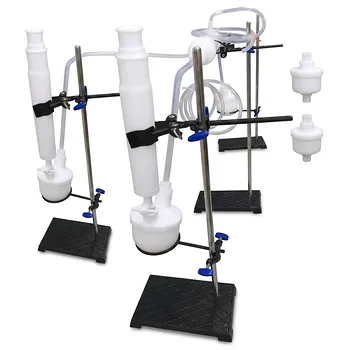
- Custom PTFE Condensation Reflux Distillation Purification System 500ml Corrosion Resistant Low Background
- Custom PTFE Condenser Tube Reflux Reaction Condensation Purification Device Semiconductor Chemical Lab Equipment
- Custom Virgin PTFE Gravity Leaching Pure Water System Corrosion Resistant Low Background Ultra High Purity Laboratory Processing Device
- High Purity PTFE Ultrapure Liquid Sampler for Acid Extraction and Reactor Sampling Customizable Dimensions
- High Purity TFM Microwave Digestion Vessels PTFE Acid Evaporation Liners Domestic GT-400 Equivalent Laboratory Reaction Containers
People Also Ask
- How does PTFE's melting behavior affect custom lab apparatus? Key insights for manufacturing.
- What are the mechanical and safety advantages of using PTFE apparatus in a laboratory? Enhance Safety & Durability
- How can PTFE be customized for specific applications? Tailor Performance with Fillers & Fabrication
- How does the low surface energy of PTFE benefit the condensation process? Boost Heat Transfer and Prevent Fouling
- What makes PTFE filtration systems advantageous for industrial and scientific use? Unmatched Chemical & Thermal Stability