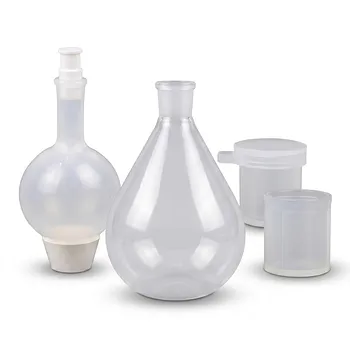
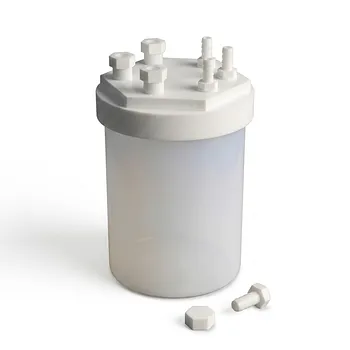
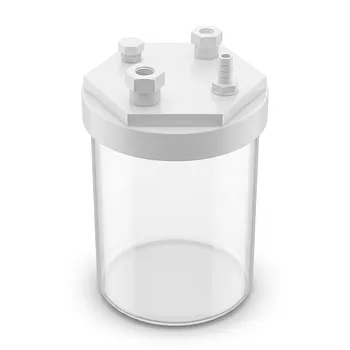
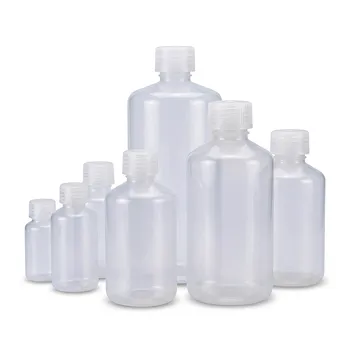
Weight change or swelling in fluoropolymer laboratory containers is usually caused by physical solvent absorption, not chemical degradation. Halogenated organic solvents can penetrate the polymer matrix in small amounts, producing slight weight gain and dimensional expansion. Significant weight change or pronounced swelling generally points to porosity, thin-wall construction, unsuitable polymer chemistry, or extreme temperature exposure rather than breakdown of the fluoropolymer itself.
The key performance factor is controlled solvent absorption. High-density, low-porosity components made from highly fluorinated resins minimize absorption, dimensional change, chemical retention, and sample contamination.
Why Fluoropolymers Change Weight or Dimensions
Solvent absorption causes the primary effect
Perfluorinated fluoropolymers are highly chemically inert, but they are not completely impermeable to every organic solvent. Halogenated solvents can diffuse into the material and remain temporarily within its structure.
This absorbed solvent produces a small weight increase and may cause minor swelling. The process is physical absorption rather than dissolution or chemical attack.
Temperature increases absorption risk
Absorption generally becomes more noticeable as temperature rises because solvent molecules move more readily through the polymer structure. For example, FEP exposed to carbon tetrachloride showed reported weight gains from approximately 0.6% at 25°C after extended exposure to 3.7% at 200°C.
These changes occurred without significant structural breakdown in the cited testing. Temperature, exposure duration, solvent identity, and component geometry must still be evaluated together.
Significant change can indicate porosity
A fabricated fluoropolymer component that shows unusually high weight gain or swelling may contain interconnected pores, voids, or defects. These pathways allow the solvent to penetrate more deeply than it would in a dense, well-consolidated material.
This distinction is important: high absorption is often evidence of part quality or morphology problems, not evidence that the polymer has chemically decomposed.
How Component Density Affects Performance
Dense material limits solvent pathways
High-density fluoropolymer labware contains fewer voids through which solvent can travel. As a result, it absorbs less liquid, experiences less swelling, and releases less retained solvent after exposure.
Low-porosity construction is particularly important for containers, fittings, tubing, and machined components used in trace analysis or organic sample preparation.
Solid parts outperform thin structures
Thin films and lightly consolidated structures can show more noticeable solvent effects because they have a higher surface-area-to-volume ratio and may contain more accessible free volume. Reported effects include swelling, clouding, increased flexibility, and weight gains of several percent in some solvent exposures.
Thick molded or solid machined fluoropolymer labware generally provides better dimensional stability under comparable ambient conditions. The material's density and manufacturing quality therefore matter alongside its nominal resin type.
CNC machining does not replace material quality
CNC machining can produce precise vessels, fittings, and custom components, but machining precision cannot compensate for a porous or poorly consolidated starting material. The finished part must be fabricated from a dense, low-void fluoropolymer stock.
For high-precision applications, material certification, processing history, wall thickness, and inspection should be considered along with dimensional tolerances.
Why Fluorine Content Matters
Higher fluorine content improves swelling resistance
Swelling resistance depends partly on the amount of fluorine incorporated into the polymer's molecular structure. In the cited comparison, increasing fluorine content from 65% to 71% reduced volume swelling in benzene from approximately 20% to 3%.
Higher fluorine content generally reduces the compatibility between the polymer and hydrocarbon solvents, limiting solvent penetration and dimensional change.
Fully fluorinated resins are strong choices
Fully fluorinated materials such as PTFE, PFA, and FEP are commonly selected for demanding chemical containment and fluid transfer because of their broad resistance to halogenated solvents and other aggressive chemicals.
However, resin selection must still account for temperature, pressure, exposure time, mechanical loading, and the specific solvent mixture.
Polymer structure also influences behavior
Total fluorine content is not the only variable. Monomer structure affects how a fluoropolymer interacts with solvents. Materials containing vinylidene fluoride units, for example, can show more swelling in low-molecular-weight esters, ketones, and amines than highly fluorinated alternatives.
Therefore, “fluoropolymer” is not a sufficient specification by itself. The exact resin chemistry and component construction determine performance.
What This Means for Laboratory Use
Dimensional stability protects containment
Swelling can change the dimensions of threads, joints, valve seats, and sealing surfaces. Even small changes may affect fit, torque, flow, or leak performance in precision assemblies.
Dense, low-porosity components reduce these risks and are preferable where dimensional tolerances are tight.
Low absorption protects sample integrity
Retained solvent can create carryover, delayed release, or contamination concerns. This matters especially in trace analysis, high-purity storage, and organic sample preparation.
A dense fluoropolymer surface minimizes the amount of solvent that can be retained and later transferred to another sample.
Minor weight change is not automatically a failure
A small measured weight increase does not by itself demonstrate chemical incompatibility. It may reflect reversible physical absorption, particularly after prolonged exposure or elevated-temperature operation.
The practical question is whether the change affects dimensions, strength, cleanliness, leak tightness, or analytical accuracy.
Understanding the Trade-offs
Chemical inertness does not mean zero absorption
Fluoropolymers resist chemical reaction exceptionally well, but they can still absorb small amounts of certain solvents. Treating “chemically inert” as equivalent to “completely impermeable” can lead to inaccurate design assumptions.
For critical applications, measure mass, dimensions, and recovery after exposure rather than relying only on a general compatibility label.
Higher density does not eliminate all risk
Dense construction reduces absorption but cannot prevent every solvent interaction. High temperature, long exposure, thin walls, aromatic solvents, and unusual solvent mixtures can increase physical uptake.
Compatibility data should reflect the actual operating conditions, not only room-temperature immersion.
Extreme mixtures require verification
Fluoropolymer performance can become less predictable under severe conditions, such as high-temperature mixtures of chlorobenzene and benzene. Temperature limits and mixture-specific data should be verified before processing.
Avoid confusing density with fluorine content
Component density describes the physical consolidation and porosity of the manufactured part. Fluorine content describes the polymer's molecular chemistry.
Both affect solvent resistance, but they solve different problems: density limits physical penetration through voids, while fluorine-rich chemistry reduces molecular affinity for many solvents.
How to Apply This to Your Project
Select the component based on the actual solvent, temperature, exposure duration, and dimensional requirements.
- If your primary focus is minimum solvent absorption: Specify a high-density, low-porosity component made from a highly fluorinated resin such as PTFE, PFA, or FEP.
- If your primary focus is dimensional precision: Use thick, solid molded or CNC-machined fluoropolymer parts and validate swelling under the real operating conditions.
- If your primary focus is trace-analysis integrity: Choose materials with minimal porosity and assess solvent retention, leachables, and post-exposure weight recovery.
- If your primary focus is high-temperature service: Confirm solvent-specific data at the intended temperature and exposure time rather than relying on room-temperature compatibility.
- If your primary focus is leak prevention: Evaluate resin chemistry, fluorine content, part density, wall thickness, and seal geometry as one design requirement.
The most reliable fluoropolymer container is not merely chemically inert; it is made from the right fluorine-rich resin and a dense, low-porosity structure suited to the actual solvent and temperature.
Summary Table:
| Factor | Impact on Performance |
|---|---|
| Solvent absorption | Physical absorption of halogenated solvents causes slight weight gain and dimensional change; not chemical degradation. |
| Temperature | Higher temperatures increase absorption rates (e.g., FEP in CCl4: 0.6% at 25°C vs 3.7% at 200°C). |
| Porosity | High porosity/voids amplify absorption and swelling; dense materials reduce solvent penetration. |
| Fluorine content | Higher fluorine content (e.g., 71% vs 65%) reduces swelling in hydrocarbons (e.g., 3% vs 20% in benzene). |
| Component thickness | Thick, solid parts provide better dimensional stability than thin films or porous structures. |
| Resin type | Fully fluorinated resins (PTFE, PFA, FEP) offer superior resistance compared to partially fluorinated ones. |
Ensure consistent performance with our dense, low-porosity PTFE and PFA labware, designed to minimize solvent absorption and swelling. From standard beakers to custom CNC-machined components, we provide high-fluorine-content solutions for demanding chemical applications. Contact our experts today to select the right fluoropolymer for your needs — get in touch!
Related Products
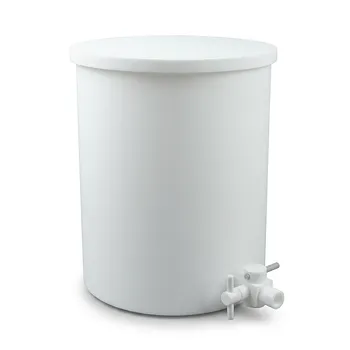
- Large Mouth PTFE Sample Storage Drum Custom Chemical Resistant Fluoropolymer Container Acid Base Proof Labware
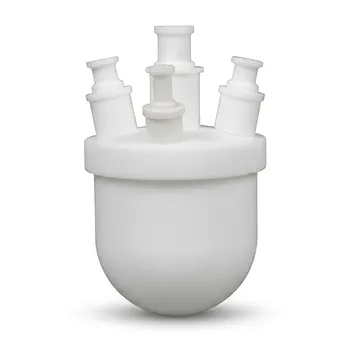
- Custom PTFE Flask 250ml High Purity Fluoropolymer Laboratory Vessel for Chemical Research
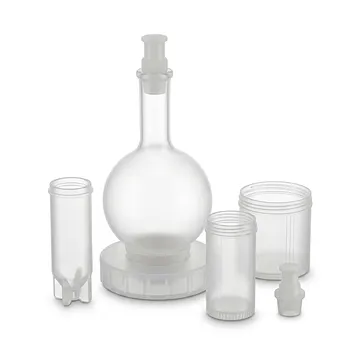
- Custom PFA Pear Shaped Flask High Purity Corrosion Resistant Labware Custom Molded Fluoropolymer Flask Glass Replacement Solution
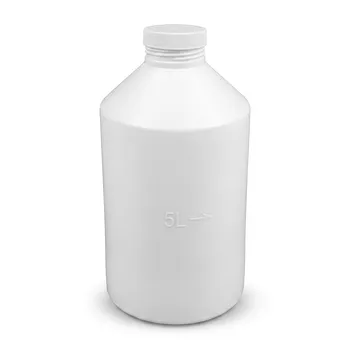
- Large Capacity 5L PTFE Storage Tank and Custom Reagent Bottle Corrosion Resistant Leakproof Screw Seal Laboratory Container with PTFE Cap
- Custom PTFE Flask Large Volume 18L Corrosion Resistant Low Background High Purity Chemical Vessel
People Also Ask
- Are PTFE Laboratory Containers and Fluid Fittings Resistant to All Chemical Solvents? Discover Key Exceptions and Safe Handling Tips
- How are PTFE laboratory containers and apparatus typically manufactured? Inside the Precision Machining Process
- What chemical conditions or reagents can compromise the integrity of PTFE chemical containers and laboratory equipment? Avoid Alkali Metals, Fluorinating Gases, Extreme Conditions
- How do the distinct solubility characteristics of multi-segment fluorinated block and star polymers influence sample preparation container selection? Choose PTFE/PFA for reliable recovery
- What inherent material characteristics of non-melt-processable PTFE make it suitable for manufacturing high-purity laboratory containers and custom-machined apparatus?