Fluorine gives fluoropolymer surfaces their characteristic non-wetting behavior through a combination of atomic size, electron distribution, and bonding. Fluorine has a small covalent radius, very high electronegativity, and exceptionally low polarizability. When densely arranged at the polymer surface—as in PTFE and PFA—these properties produce weak intermolecular attraction, low surface energy, high water repellency, and limited liquid adhesion.
The key is not fluorine’s electronegativity alone, but the dense, externally exposed C–F structure. Fluorine tightly holds its electron cloud, is difficult to distort, and forms a protective, low-polarizability surface that liquids do not readily spread across.
Why Fluorine Produces Low Surface Energy
Small atomic size enables dense surface coverage
Fluorine is only slightly larger than hydrogen, allowing it to replace hydrogen atoms along a carbon chain without creating excessive steric strain. In highly fluorinated polymers, this permits a dense outer layer of fluorine atoms around the carbon backbone.
That fluorine-rich envelope reduces the degree to which the underlying polymer can interact with contacting molecules. It also helps shield the backbone from chemical attack, contributing to the durability of fluoropolymer labware.
Low polarizability weakens intermolecular attraction
Polarizability describes how easily an atom’s electron cloud can be distorted by a nearby charge or dipole. Fluorine holds its electrons tightly, so its electron cloud is difficult to distort.
As a result, fluorinated surfaces have relatively weak dispersion interactions and weak induced-dipole attractions with liquids. Fewer attractive interactions are available to pull a liquid across the surface, which lowers the surface energy.
Strong C–F bonds create a chemically stable surface
Fluorine’s high electronegativity produces strongly polarized carbon–fluorine bonds. These bonds have high bond strength, and the surrounding fluorine atoms help protect the carbon backbone from chemical and oxidative attack.
This stability is not the sole cause of hydrophobicity, but it enables the fluorine-rich surface to remain intact under aggressive laboratory conditions. The low-energy surface therefore persists during contact with acids, solvents, and elevated temperatures.
How Low Surface Energy Produces Hydrophobicity
Liquids spread less readily
Wetting occurs when a liquid spreads across a solid because the liquid–solid attraction is sufficiently favorable. On a low-surface-energy fluoropolymer, that attraction is comparatively weak.
Water and many polar solutions therefore tend to form rounded droplets rather than spreading into a continuous film. The practical indicator is a relatively high water contact angle, although the exact value depends on polymer grade, surface roughness, contamination, and measurement method.
Surface fluorine is the decisive structural feature
Fluoropolymer performance depends strongly on whether fluorinated groups are exposed at the outermost interface. In PTFE and PFA, densely exposed fluorine atoms and perfluorinated groups create the classic non-stick, low-adhesion surface.
In partially fluorinated polymers or materials where fluorinated groups are buried or shielded, the reduction in surface energy may be less pronounced. Thus, “more fluorine” is useful only when it results in greater fluorine exposure at the surface.
Fluorinated segments can migrate toward the interface
During formation of some fluoropolymer coatings, blends, and copolymers, fluorinated segments can segregate toward the air–material interface. This occurs because placing low-surface-energy groups at the surface reduces interfacial energy.
The resulting fluorine-enriched outer layer can increase water and oil repellency even when the bulk material contains other chemical groups. In molded PTFE and PFA labware, the effect instead comes primarily from the polymer’s inherently fluorine-rich molecular structure.
Why Fluoropolymers Have Low Dielectric Constants
Low electronic polarizability limits polarization
A material’s dielectric response depends partly on how readily its electrons and molecular dipoles respond to an electric field. Because fluorine’s electron cloud is tightly held and difficult to distort, fluorinated polymer chains have a relatively small electronic polarization response.
This contributes to the low dielectric constant characteristic of PTFE and related materials. The same low polarizability also supports weak intermolecular attraction at the surface.
Bond polarity does not mean strong bulk dielectric behavior
The C–F bond is strongly polar because fluorine attracts electron density. However, a polar bond does not automatically produce a high dielectric constant for the whole polymer.
In fluoropolymers, the highly bound electrons, molecular arrangement, and limited segmental mobility keep the overall polarization response relatively low. The relevant property is the material’s total response to an electric field, not the polarity of an individual bond in isolation.
Why These Properties Matter in Labware
Less sample retention
Low surface energy reduces adhesion between the polymer and many aqueous, polar, and organic liquids. Droplets are less likely to remain on vessel walls, tubing interiors, fittings, or machined surfaces.
This supports high sample recovery in trace analysis and reduces the amount of analyte left behind after transfer or discharge.
Lower cross-contamination risk
Reduced wetting and adsorption can limit the retention of residues from one sample or reagent to the next. This is particularly valuable for trace-element work, digestion vessels, fluid-transfer lines, valves, and storage containers.
Fluoropolymer surfaces are not universally adsorption-free, however. Molecules can still be retained through particulate trapping, electrostatic effects, surface defects, or specific chemical interactions.
Easier cleaning and fluid release
Because liquids do not readily spread across or adhere to the surface, fluoropolymer labware is generally easier to rinse and clean. PTFE and PFA tubing, bottles, beakers, digestion vessels, and fittings can provide efficient drainage and minimal residual film.
The benefit is greatest when the component is properly designed to avoid dead legs, sharp transitions, roughness, and trapped volumes.
Understanding the Trade-offs
Hydrophobicity is not identical to oleophobicity
Fluoropolymers repel many oils better than ordinary polymers, but water repellency and oil repellency are not the same property. Very low-surface-tension liquids can wet surfaces that readily repel water.
The actual result depends on the liquid’s surface tension, the fluoropolymer’s surface condition, and the presence of contamination or additives.
Contact angle values are not universal
Reported water contact angles vary substantially among fluoropolymers and test methods. Fully fluorinated materials such as PTFE commonly show contact angles above 100 degrees under typical measurements, while some fluorinated coatings or partially fluorinated structures can show lower values.
A contact angle near 88–90 degrees should not be treated as a universal value for fluoropolymers. Surface roughness, aging, cleaning, measurement timing, and chemical composition can all change the result.
Low adhesion does not guarantee zero adsorption
Fluoropolymer surfaces minimize many nonspecific interactions, but they do not eliminate every possible source of sample loss. Trace analytes may interact with contaminants, particulates, metal-containing residues, or imperfections in the component.
For critical measurements, material blanks, recovery studies, and validated cleaning procedures remain necessary.
Chemical resistance and surface energy are related but distinct
Strong C–F bonding and backbone shielding explain much of fluoropolymers’ chemical and thermal stability. Low polarizability and exposed fluorinated groups explain much of their low surface energy and non-wetting behavior.
These properties support one another, but they should not be treated as a single mechanism.
How to Apply This to Your Project
The correct material choice depends on whether the priority is liquid recovery, chemical resistance, electrical insulation, or all three.
- If your primary focus is maximum non-wetting and sample recovery: Prefer fully fluorinated materials such as PTFE or PFA with smooth, clean surfaces and minimal dead volume.
- If your primary focus is trace-analysis cleanliness: Validate blank levels, recovery, and cleaning performance rather than assuming low surface energy eliminates adsorption.
- If your primary focus is aggressive chemical or high-temperature service: Evaluate the complete fluoropolymer component, including seals, fillers, joints, and mechanical design—not just its fluorine content.
- If your primary focus is electrical insulation: Use the polymer’s measured dielectric properties at the relevant frequency, temperature, and humidity rather than inferring performance from bond polarity alone.
Fluorine’s small size, tightly held electron cloud, low polarizability, and strong C–F bonding combine to create the durable, low-energy surfaces that make fluoropolymer labware hydrophobic, non-stick, and resistant to sample retention.
Summary Table:
| Property | Contribution to Low Surface Energy |
|---|---|
| Small atomic size | Allows dense surface coverage of fluorine atoms, shielding the carbon backbone. |
| Low polarizability | Weak intermolecular attraction, reducing liquid adhesion. |
| Strong C-F bonds | Chemically stable surface, maintaining low energy under harsh conditions. |
| Surface fluorine exposure | Critical for non-wetting; buried or shielded fluorines reduce effect. |
Optimize your lab's sample recovery and chemical resistance with KINTEK's precision PTFE and PFA labware. Our custom CNC machining delivers tailored solutions for high-purity analysis, fluid handling, and reaction apparatus. Contact us today to enhance your workflow—get in touch!
Related Products
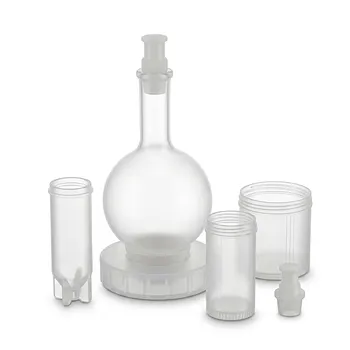
- Custom PFA Pear Shaped Flask High Purity Corrosion Resistant Labware Custom Molded Fluoropolymer Flask Glass Replacement Solution
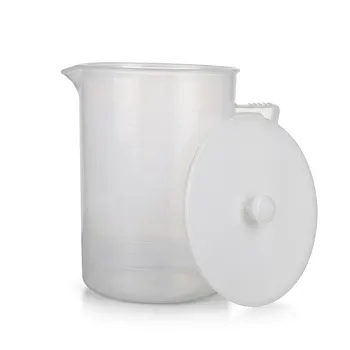
- High Purity PFA Beaker with Handle and Large Capacity Washable Soak Basket Multi Spec Teflon Laboratory Labware
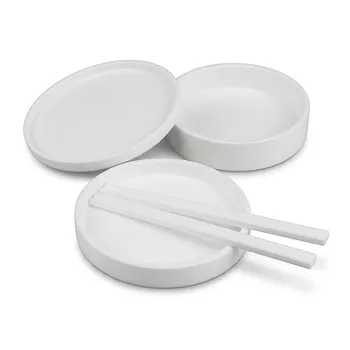
- Custom PTFE Petri Dish 200mm High Purity Corrosion Resistant Low Background Laboratory Ware
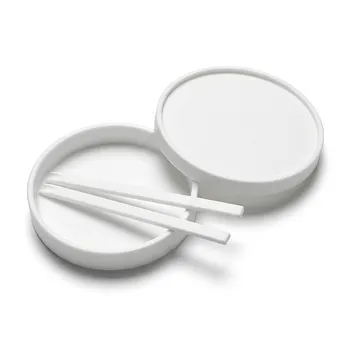
- Custom Polytetrafluoroethylene PTFE Petri Dishes 60mm Corrosion Resistant Low Background Labware
- Custom PTFE Petri Dish 120mm Diameter Corrosion Resistant Low Background High Purity Labware
People Also Ask
- Why Use PFA Labware for MnFe2O4/rGO Precursors? Ensure Stoichiometric Precision and Purity
- Why is PFA labware recommended for CuBi2O4? Protect high-purity precursors and ensure semiconductor bandgap accuracy.
- How does PFA labware enhance the accuracy of ultra-trace element analysis? Achieving PPT Precision with Zero Leaching
- What are the primary properties of PFA for high-performance labware? Achieve ultra-trace purity & thermal stability.
- What role does PFA labware play in semiconductor manufacturing? Ensuring Ultra-Pure Yields and Zero Contamination