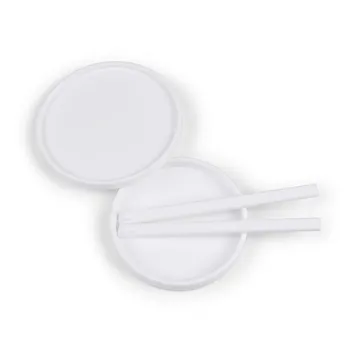
PTFE laboratory equipment is exceptionally resistant to chemical attack, but it is not universally immune to swelling or reactive degradation. No known solvent dissolves PTFE below its melting point, and common hydrogen-containing solvents such as hexane, toluene, chloroform, alcohols, and water typically produce less than 1% weight gain at room temperature. The important exceptions are certain non-hydrogenated halogenated or perfluorinated solvents, which can cause substantially greater swelling, and highly reactive fluorinating or alkali-metal reagents, which can chemically degrade the polymer.
The practical limit is usually dimensional change rather than dissolution. Standard organic solvents, strong acids, bases, and most corrosive laboratory reagents are compatible with PTFE, while solvent uptake increases when a solvent is structurally similar to the fluoropolymer or when exposure temperature rises.
What PTFE Resists
Common Organic Solvents
PTFE shows minimal absorption of typical hydrogen-containing organic solvents. Hexane, toluene, chloroform, alcohols, and similar solvents generally cause less than 0.8% weight gain at room temperature.
This low uptake usually corresponds to negligible dimensional change, little loss of mechanical integrity, and no meaningful leaching from the PTFE itself.
Aromatic Solvents Over Long Exposures
Toluene provides a useful long-term example. After continuous exposure at 25°C for 365 days, PTFE showed approximately 0.3% weight change with no significant structural change.
At 50°C for 365 days or 70°C for 14 days, the reported weight change remained approximately 0.6%, with no material degradation observed.
Chlorinated Solvents
PTFE components are generally highly compatible with aggressive chlorinated solvents, including undiluted chloroform, chlorobenzene, and carbon tetrachloride.
At ambient temperatures and temperatures up to approximately 75°C or the solvent’s boiling point, PTFE typically shows no visible chemical attack. Carbon tetrachloride exposure at 25°C for 365 days produced approximately 0.6% weight change in one reported evaluation.
Acids, Bases, and Corrosive Reagents
PTFE is resistant to virtually all standard laboratory acids, bases, oxidizers, and organic solvents across its usable temperature range. This includes strong acids such as hydrofluoric acid, which can attack many conventional materials.
The fluorine-rich surface and stable carbon-fluorine backbone limit chemical interaction, helping PTFE equipment preserve sample purity during storage, transfer, and reaction work.
How Solvent Swelling Occurs
Hydrogen-Containing Solvents
Hydrogen-containing solvents generally have very low affinity for the PTFE structure. Their absorption is typically below 1% by weight at room temperature, even when the solvents differ in polarity or solubility parameter.
For routine fluid handling, this means that PTFE tubing, valves, vessels, and containers normally retain their dimensions and mechanical function.
Halogenated and Perfluorinated Solvents
The behavior changes with non-hydrogenated halogenated solvents and highly fluorinated liquids. These solvents can penetrate the polymer more readily when their molecular structure and solubility characteristics resemble those of PTFE.
Maximum reported swelling approaches 10–11% weight gain when the solvent solubility parameter is near approximately 6 (cal/cm³)^(1/2). This is swelling through solvent uptake, not dissolution of the polymer.
Temperature Effects
Solvent uptake generally increases as temperature rises because thermal energy expands the polymer structure and facilitates molecular penetration.
Pure PTFE can remain structurally intact at high temperatures, but chemical compatibility data obtained at room temperature should not automatically be applied to elevated-temperature service. Temperature, exposure duration, pressure, and the specific solvent must be evaluated together.
What the Resistance Data Mean
Weight Change Is a Useful Screening Metric
Weight gain provides a practical indication of solvent absorption and swelling. A small change, such as 0.3–0.6%, generally indicates strong mass stability under the tested conditions.
Weight change alone is not sufficient, however. Dimensional change, visual appearance, and retained mechanical properties also determine whether a component remains suitable for precise laboratory use.
Resistance Ratings Combine Several Effects
The Plastics Design Library resistance scale evaluates more than whether a sample visibly dissolves. It considers changes in weight, length or diameter, volume, tensile strength, elongation, modulus, impact strength, and appearance.
Ratings of 9–10 indicate negligible dimensional effects and high retention of mechanical properties. The cited rating framework associates the highest ratings with approximately 94–97% or greater mechanical-property retention and weight change around 0.5% or less, depending on the specific test and material.
Component Design Still Matters
A PTFE resin may be chemically compatible while a finished assembly is not fully suitable for the application. Valves, fittings, seals, reinforcements, machining residues, and other wetted materials can introduce different chemical limits.
For trace analysis and high-purity work, compatibility must therefore be assessed for the complete fluid-contact path rather than PTFE alone.
Understanding the Trade-offs
Swelling Can Affect Precision
Even when PTFE is not chemically degraded, significant solvent uptake can change dimensions, mass, clearances, and calibration. A swelling level near 10–11% weight gain is not appropriate to treat as negligible in precision tubing, metering components, valve seats, or fitted assemblies.
This matters especially where internal volume, flow resistance, sealing force, or analytical blank levels must remain stable.
High Temperature Reduces the Margin
PTFE maintains excellent chemical resistance at elevated temperatures, but heat can increase solvent absorption and accelerate dimensional changes. Carbon tetrachloride exposure, for example, was associated with reported swelling of up to approximately 3.7% weight change at temperatures approaching 200°C.
High-temperature compatibility should be confirmed using data for the exact solvent, temperature, duration, and component geometry.
Reactive Exceptions Are Serious
Molten sodium and potassium can defluorinate and degrade PTFE. Gaseous fluorine and chlorine trifluoride can also attack the polymer, particularly under aggressive conditions.
These are chemical-reaction limits rather than ordinary solvent-swelling effects. PTFE should not be selected for direct containment of molten alkali metals or highly reactive fluorinating agents without specific, validated compatibility data.
“Chemically Inert” Does Not Mean “Unconditionally Suitable”
PTFE is an excellent choice for most laboratory acids, bases, solvents, and corrosive media, but compatibility claims are conditional on operating temperature and the full assembly design.
Mechanical requirements can also become limiting before chemical degradation occurs. Pressure, flexing, creep, permeation, and seal performance may govern service life even when the PTFE polymer remains chemically intact.
Making the Right Choice for Your Goal
The most reliable selection process matches the solvent class and operating conditions to the required dimensional stability.
- If your primary focus is routine organic-solvent containment: PTFE is generally suitable for hydrogen-containing solvents such as hexane, toluene, alcohols, chloroform, and water, with typically less than 1% weight gain at room temperature.
- If your primary focus is perfluorinated or non-hydrogenated halogenated solvents: Assume that swelling may be significant, potentially approaching 10–11% weight gain, and validate dimensions and mechanical performance before use.
- If your primary focus is long-term aromatic-solvent exposure: PTFE offers strong mass stability; long-term toluene testing at room temperature produced only about 0.3% weight change.
- If your primary focus is high-temperature extraction or synthesis: Confirm elevated-temperature data for the exact solvent, because solvent uptake can increase even when the PTFE remains chemically intact.
- If your primary focus is strong acids, bases, or hydrofluoric acid: PTFE is generally highly compatible and can provide a low-contamination fluid-contact surface.
- If your primary focus is molten alkali metals or aggressive fluorinating agents: Treat PTFE as unsuitable unless application-specific testing demonstrates that it can withstand the chemical and thermal conditions.
PTFE is best understood as a highly inert material whose main ordinary limitation is solvent-induced swelling, while molten alkali metals and powerful fluorinating agents represent true chemical attack limits.
Summary Table:
| Solvent Class | Typical Weight Gain | Swelling Severity | Notes |
|---|---|---|---|
| Hydrogen-containing solvents (hexane, toluene, chloroform, alcohols) | < 1% at RT | Minimal | Standard organic solvents, strong acids/bases compatible |
| Aromatic solvents (toluene) | ~0.3-0.6% | Negligible | Long-term exposure up to 70°C |
| Chlorinated solvents (chloroform, carbon tetrachloride) | ~0.6% | Low | Compatible up to boiling point |
| Halogenated/perfluorinated solvents | Up to 10-11% | High | Significant swelling; validate dimensions |
| Molten alkali metals / reactive fluorinating agents | N/A | Chemical attack | Unsuitable; degrades polymer |
Ready to equip your lab with PTFE that withstands the toughest chemicals? KINTEK offers a full range of high-purity PTFE and PFA labware, from basic beakers to custom electrochemical cells. Our end-to-end CNC machining ensures precise parts for any application. Ensure safety and performance – contact us today for tailored solutions backed by our expertise.
Related Products
- Custom PTFE Laboratory Apparatus Corrosion Resistant Low Background Reaction Cells Precision CNC Fabrication
- PTFE PFA Vacuum Filtration System Corrosion Resistant Customizable Shatterproof Laboratory Device
- Heat Resistant Custom PTFE Laboratory Beaker for Hot Plate Heating and Trace Analysis
- Large Scale PTFE Beakers and Flasks for High Temperature Corrosion Resistant Laboratory Applications with Custom CNC Fabrication
- High Purity PTFE Buchner Funnel Vacuum Filtration System Corrosion Resistant Low Trace Laboratory Suction Filter Apparatus
People Also Ask
- How does PTFE's melting behavior affect custom lab apparatus? Key insights for manufacturing.
- What are the primary fabrication methods for PTFE laboratory apparatus? Expert Insights into Fluoropolymer Engineering
- What is the chemical compatibility range for PTFE laboratory apparatus? Explore Near-Universal Chemical Resistance.
- What are the primary chemical resistance properties of PTFE laboratory apparatus? Unmatched Purity and Inertness
- Why use PTFE or PFA for modified Cu-MOF synthesis? Ensure High Purity and Exceptional Chemical Stability