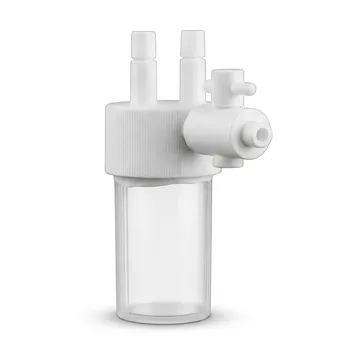
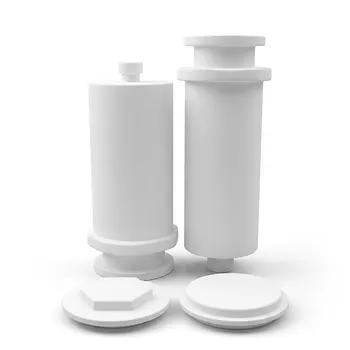
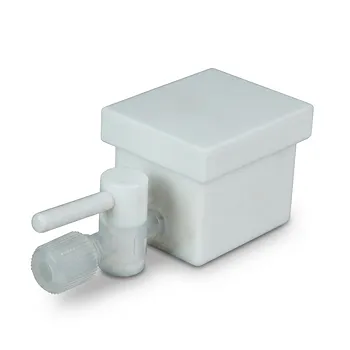
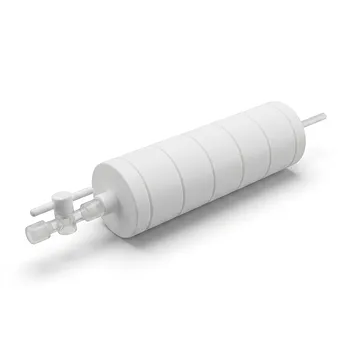
Achieving precise morphology in high-entropy sulfide nanorods requires a hermetic sealing environment capable of maintaining constant solvent partial pressure throughout the growth cycle. Specifically, you must use industrial-grade high-pressure reactors equipped with high-quality PTFE (polytetrafluoroethylene) sealing rings to ensure zero solvent leakage over durations typically lasting six hours or more. This rigorous containment prevents the volatilization of the ethanol and glycerol binary solvent system, which is essential for uniform pressure distribution and controlled nanorod assembly.
To successfully synthesize high-entropy sulfide nanorods, the experimental container must provide an absolute seal that prevents solvent loss. Maintaining a stable, leak-proof environment is the only way to ensure the consistent partial pressure required to avoid particle agglomeration and morphology defects.
The Essential Hardware for Solvent Containment
Industrial-Grade High-Pressure Reactors
The synthesis process involves a solvothermal environment where temperatures often exceed the boiling points of the solvents used. Only industrial-grade high-pressure reactors (autoclaves) provide the structural integrity needed to withstand internal pressure without mechanical deformation. These vessels ensure that the internal volume remains constant, which is a prerequisite for predictable chemical reactions.
High-Quality PTFE Sealing Rings
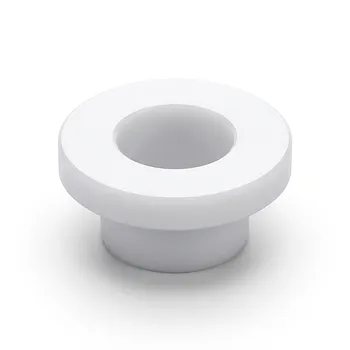
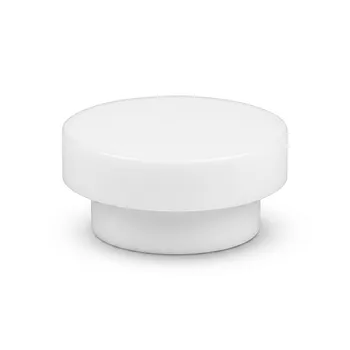
The primary barrier against solvent loss is the PTFE sealing ring, chosen for its exceptional chemical resistance and thermal stability. These rings must be inspected for surface imperfections before every use to ensure a perfect interface between the reactor body and the lid. Even microscopic gaps can lead to "wicking," where solvent vapor escapes, altering the internal chemistry.
The Role of Pressure in Morphology Control
Maintaining Constant Partial Pressure
The binary solvent system of ethanol and glycerol relies on a specific ratio to direct the growth of the nanorods. If the container is not perfectly sealed, the more volatile component (ethanol) will escape faster than the glycerol. This shift in solvent composition changes the partial pressure, directly disrupting the delicate balance required for high-entropy material formation.
Uniform Pressure Fields and Assembly
A leak-proof seal ensures a uniform pressure field within the reactor, which is critical for the "assembly" phase of the nanorods. When pressure remains constant, the precursors can deposit onto the nanorod structure at a controlled, predictable rate. Fluctuations caused by leaks lead to localized turbulence and inconsistent growth speeds across the batch.
Common Pitfalls and Technical Trade-offs
The Risk of Morphology Over-Assembly
If the sealing fails and solvent volatilization occurs, the concentration of solutes increases rapidly. This often leads to morphology over-assembly or agglomeration, where the intended nanorods clump together into irregular masses. This irreversible defect renders the high-entropy sulfide structurally useless for most applications.
Material Fatigue and Reusability
While PTFE is the standard for sealing, it is a "soft" material that undergoes cold flow or permanent deformation under high heat and pressure. Reusing a sealing ring too many times can lead to a gradual loss of sealing efficiency that is difficult to detect until a batch fails. You must balance the cost of frequent ring replacement against the high cost of losing a complex high-entropy synthesis run.
Implementing Effective Sealing Protocols
To ensure the success of your binary solvent assembly, your sealing strategy should be tailored to your specific experimental goals.
- If your primary focus is morphology precision: Prioritize the use of virgin PTFE seals for every run to ensure the most consistent pressure field possible.
- If your primary focus is long-duration synthesis (6+ hours): Utilize reactors with secondary mechanical tightening supports to prevent seal relaxation during extended heating cycles.
- If your primary focus is batch-to-batch reproducibility: Implement a strict "no-leak" validation protocol, weighing the reactor before and after the process to confirm zero mass loss.
By strictly adhering to these containment requirements, you ensure the thermodynamic stability necessary to produce high-quality, non-agglomerated high-entropy sulfide nanorods.
Summary Table:
| Feature | Requirement | Role in Nanorod Synthesis |
|---|---|---|
| Container Type | Industrial-grade high-pressure reactor | Withstands internal pressure without deformation |
| Sealing Material | High-quality PTFE (Polytetrafluoroethylene) | Provides chemical resistance and a hermetic seal |
| Solvent Integrity | Zero volatilization (6+ hours) | Maintains ethanol/glycerol ratio and partial pressure |
| Pressure Field | Constant and uniform | Prevents morphology defects and particle agglomeration |
| Validation | Mass-loss verification | Ensures batch-to-batch reproducibility and stability |
Elevate Your Synthesis Precision with KINTEK
Achieving the delicate balance required for high-entropy sulfide nanorod assembly demands uncompromising material performance. KINTEK provides the high-performance fluoropolymer solutions you need to ensure absolute containment and pressure stability.
From essential high-purity PTFE and PFA labware (beakers, crucibles, reagent bottles) to specialized hydrothermal synthesis liners, microwave digestion vessels, and custom-machined reaction apparatus, we manufacture virtually every laboratory supply required for advanced material science. Our end-to-end custom CNC fabrication allows us to deliver everything from complex non-standard parts to high-volume orders, all crafted with an exclusive focus on high-performance fluoropolymers.
Don't let seal failure ruin your complex synthesis. Contact us today to discover how KINTEK’s bespoke laboratory setups and precision-engineered components can enhance your research outcomes.
References
- Jiahao Liu, Shi‐Zhang Qiao. High‐Entropy Sulfides Catalyze Rate‐Determining Redox in Fast‐Charging Aqueous Zinc–Sulfur Batteries. DOI: 10.1002/anie.202503472
This article is also based on technical information from Kintek Knowledge Base .
Related Products
- Custom PTFE Sealing Tapes for Industrial and High Tech Applications
- Custom PTFE Insulating Gaskets and Corrosion Resistant Fluoropolymer Seals for Industrial Electrical Applications
- Custom PTFE Insulating Gaskets Corrosion Resistant Teflon Seals Tailored Engineering Plastic Components
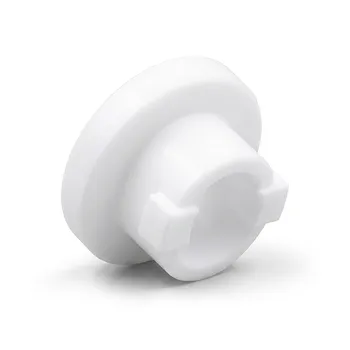
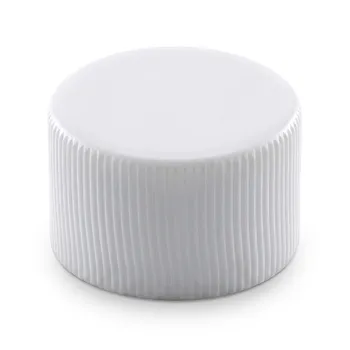
- Custom PTFE Sealing Caps and Corrosion Resistant Low Background Teflon Adapters
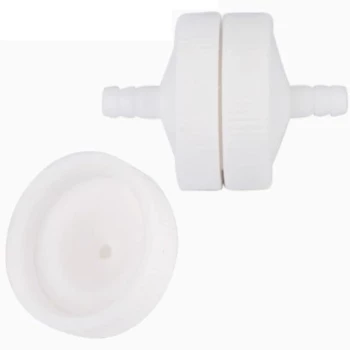
- Customizable PTFE Seals Filter Holders for Versatile Applications
People Also Ask
- How are custom PTFE parts used in the automotive sector? Enhance Vehicle Performance & Durability
- Why is PTFE's temperature stability important for sealing applications? Ensure Leak-Proof Performance from -200°C to 260°C
- Why is PTFE popular in the oil and gas industry? Withstand Extreme Heat, Pressure & Corrosion
- What is PTFE and why is it used for seals? The Ultimate Guide to High-Performance Sealing
- What are the key benefits of using PTFE for seals? Unlock Superior Performance in Extreme Conditions