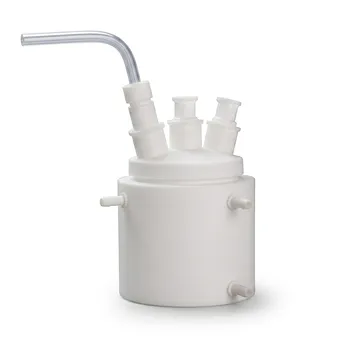
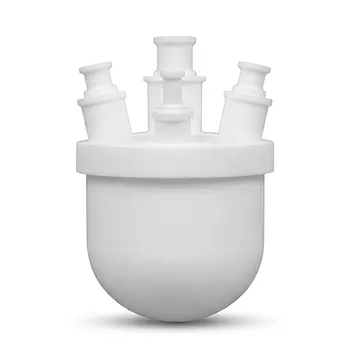
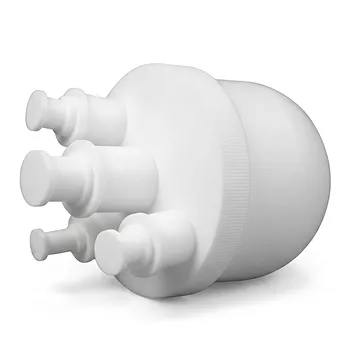
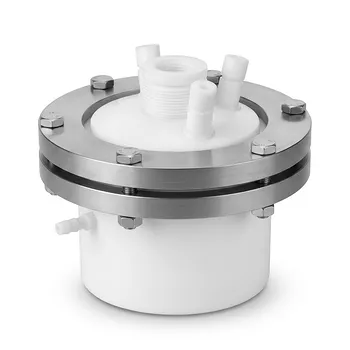
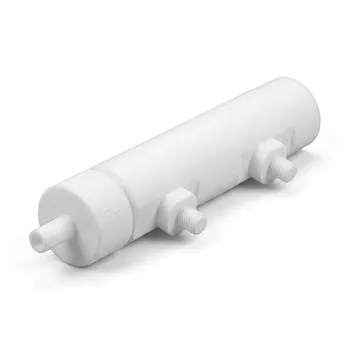
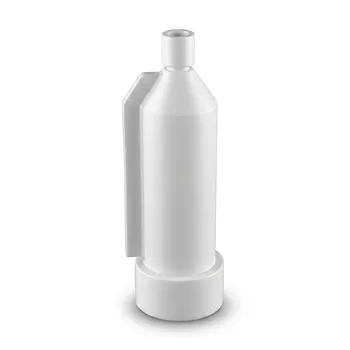
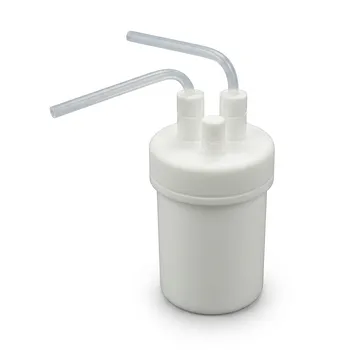
PTFE microchannel reactors are specialized continuous-flow devices defined by their microscale architecture and the use of Polytetrafluoroethylene (PTFE) as the primary structural substrate. These reactors feature internal channels with lateral dimensions typically ranging between 10 and 1000 micrometers. They leverage PTFE's unique molecular properties to provide near-universal chemical resistance, high thermal stability (with a melting point exceeding 327°C), and ultra-low surface energy that prevents reagent adhesion and fouling during complex chemical syntheses.
Core Takeaway: PTFE microchannel reactors combine the high surface-area-to-volume ratio of microfluidics with the extreme chemical inertness of fluoropolymers. This synergy allows for the safe, continuous processing of highly aggressive reagents that would typically corrode or degrade conventional metal and glass reactor systems.
Structural Foundations of PTFE Reactors
Dimensional Confinement and Scale
The defining structural feature of these reactors is the microscale channel network, usually featuring hydraulic diameters between 100 and 1000 micrometers. This extreme confinement ensures a high surface-area-to-volume ratio, which dramatically enhances heat and mass transfer compared to traditional batch reactors.
Fabrication Methods: CNC vs. Capillary
Structural integrity is achieved through two primary fabrication methods: CNC machining and capillary integration. CNC machining carves precise, interconnected channels directly into solid PTFE blocks to create hermetic "chips," while capillary versions utilize PTFE tubing coiled into helical patterns for modular flow systems.
Internal Geometry and Connectivity
The internal architecture is designed as an interconnected network that can include mixing zones, residence time units, and thermal exchange sections. These systems are often modular, allowing researchers to chain multiple PTFE components together to create complex, multi-step reaction sequences.
Material Properties of Polytetrafluoroethylene
Universal Chemical Compatibility
PTFE is selected for its near-total chemical inertness, making it resistant to nearly all strong acids, alkalis, and organic solvents. This allows for the safe handling of highly reactive organometallics and corrosive reagents that would destroy stainless steel or leach impurities from glass.
Surface Dynamics and Anti-Fouling
The material possesses one of the lowest coefficients of friction of any known solid, resulting in a "non-stick" surface. This low surface energy is critical in microfluidics as it prevents the adhesion of solids and minimizes fouling, ensuring that the narrow channels do not become blocked over time.
Thermal Profiles and Insulation
PTFE maintains structural integrity across a massive temperature range, from -196°C to a continuous operating limit of approximately 260°C. Additionally, its low thermal conductivity allows it to act as a natural insulator, which is advantageous for maintaining localized temperature zones within a flow system.
Understanding the Trade-offs
Thermal Transfer Limitations
While PTFE’s low thermal conductivity is excellent for insulation, it can be a disadvantage when rapid heating or cooling of the reaction fluid is required. In these cases, the reactor wall acts as a thermal barrier, necessitating longer residence times or higher temperature gradients to achieve the desired internal temperature.
Structural Rigidity and Pressure Limits
PTFE is a relatively soft fluoropolymer compared to metals or ceramics, which limits the maximum operating pressure of the reactor. At elevated temperatures, the material may be prone to "creep" or deformation, requiring external reinforcement or specialized housing to maintain the integrity of the microchannels.
Bonding and Sealing Challenges
Because PTFE is designed to be non-stick, achieving a hermetic seal between plates can be technically difficult. Traditional adhesives do not bond well to the surface, often requiring mechanical clamping or specialized thermal diffusion bonding to prevent leaks under flow conditions.
Making the Right Choice for Your Goal
How to Apply This to Your Project
- If your primary focus is aggressive reagent handling: Utilize CNC-machined PTFE blocks to ensure a robust, leak-proof system that can withstand concentrated acids or bases.
- If your primary focus is rapid prototyping or modularity: Opt for PTFE capillary-based reactors, as they allow for easy adjustment of residence times and are simpler to replace if a blockage occurs.
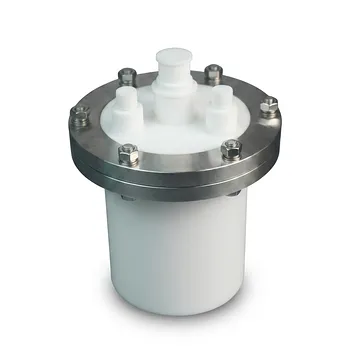
- If your primary focus is high-pressure synthesis: Ensure your PTFE reactor is encased in a secondary high-strength housing (such as stainless steel) to prevent material deformation and channel expansion.
By understanding the synergy between microscale geometry and fluoropolymer science, you can deploy PTFE microchannel reactors to achieve chemical transformations that are otherwise impossible in traditional laboratory hardware.
Summary Table:
| Feature | Specification | Key Benefit |
|---|---|---|
| Channel Dimensions | 10 to 1000 μm | Superior heat and mass transfer |
| Chemical Resistance | Near-universal | Safely handles aggressive acids and solvents |
| Operating Temp | -196°C to +260°C | Maintains integrity across extreme ranges |
| Surface Energy | Ultra-low (Non-stick) | Prevents reagent adhesion and channel fouling |
| Fabrication Type | CNC Machined / Capillary | Customizable for modular or chip-based flow |
Precision-Engineered PTFE Solutions from KINTEK
Elevate your laboratory’s performance with KINTEK’s high-performance fluoropolymer expertise. From everyday basics like beakers, crucibles, and reagent bottles to advanced fluid transfer components (tubing, valves, fittings) and sophisticated reaction apparatus like microchannel reactors, hydrothermal synthesis liners, and electrochemical cells, we provide the tools necessary for the most demanding chemical environments.
Our end-to-end custom CNC fabrication enables us to deliver everything from complex, non-standard machined parts to high-volume orders with an absolute focus on PTFE and PFA purity. Contact us today to discuss your specific application needs and discover how KINTEK can enhance your lab's safety and efficiency.
Related Products
- Customizable Polytetrafluoroethylene PTFE Reactor and Corrosion Resistant Teflon Flask
- PTFE 10L Reaction Vessel with Stirring Paddle Customizable Corrosion Resistant High Temperature Reactor for Biopharmaceutical and Chemical Processing
- Custom PTFE Multilayer Reaction Apparatus High Temperature Corrosion Resistant Threaded Modular Sieve System
- Custom PTFE Volatile Matter Condensation Reflux Reaction Device Corrosion Resistant Pressure Resistant
- High Performance Customizable PTFE Reaction Vessel and Corrosion Resistant Polytetrafluoroethylene Flask for Chemical Laboratory Use
People Also Ask
- What functional advantages do PTFE reactors provide over glass? Achieve Superior Purity and Safety in Synthesis
- What are the primary fabrication methods for capillary-based and monolithic PTFE reactors? Expert Production Insights
- Why are PTFE or PFA reaction vessels required for the selective etching process of MXene using hydrofluoric acid (HF)?
- Why is a Teflon-lined (PTFE) reactor vessel required for the hydrothermal synthesis of V2O5 and SnO2 nanomaterials?
- What is the role of high chemical inertness reaction vessels in the organic synthesis of acylhydrazone ligands? | Guide