Perfluoroalkoxy alkane (PFA) labware is primarily limited by a maximum continuous service temperature of 260°C and a susceptibility to surface abrasion. While it is exceptionally inert, exceeding 300°C triggers chain scission, leading to the release of trace fluorocarbons and a loss of structural integrity. Physically, its lower scratch resistance compared to PTFE means that improper cleaning can create microscopic sites for sample contamination.
PFA is the gold standard for ultra-trace analysis due to its purity, but it is not indestructible. Its limitations are defined by a specific thermal ceiling and a delicate surface profile that requires non-abrasive handling to maintain its "non-stick" and low-adsorption properties.
Thermal and Atmospheric Thresholds
The 260°C Continuous Service Limit
The most critical physical limitation of PFA is its maximum operational temperature. While it remains stable in cryogenic conditions down to -270°C, it should not be used continuously above 260°C.
Exceeding this limit compromises the dimensional stability of the labware. This can lead to the deformation of seals, threads, and joints, potentially resulting in leaks or vessel failure.
Chemical Decomposition and Chain Scission
If PFA is exposed to temperatures exceeding 300°C for prolonged periods, it undergoes a process called chain scission. This involves the breaking of polymer bonds, which releases trace fluorocarbons into the environment or the sample.
Exposure to direct flames or temperatures near its melting point will cause the material to decompose. This not only destroys the labware but can also release hazardous vapors.
Gas Permeability at High Temperatures
At standard temperatures, PFA is an excellent barrier. However, at very high temperatures, the material exhibits increased permeability to certain gases.
This can be a significant limitation in sensitive analytical applications where gas exchange could contaminate a sample. Users must account for this "breathability" when heating volatile substances over long durations.
Mechanical Vulnerabilities
Lower Scratch Resistance vs. PTFE
Despite its superior strength and stiffness, PFA has lower scratch resistance than PTFE. The surface is relatively soft and can be easily marred by metal spatulas or stiff brushes.
Mechanical abrasion must be strictly avoided during cleaning. Scratching the surface increases the surface roughness, which creates potential adsorption sites where contaminants can "hide" and resist rinsing.
Deformation Under Load (Creep)
While PFA has better creep resistance than many other fluoropolymers, it is still susceptible to deformation under load, especially at elevated temperatures. This is a critical consideration for pressurized systems or heavy vessels.
If a PFA container is subjected to constant mechanical stress while hot, it may slowly change shape. This can affect the accuracy of volumetric labware or the integrity of mechanical fittings.
Susceptibility to Specific Chemical Attack
While nearly universal in its resistance, PFA is not entirely inert. It can be aggressively attacked by molten alkali metals such as sodium or potassium.
It is also vulnerable to strong fluorinating agents, such as elemental fluorine, particularly when combined with high temperatures and pressures. These reagents can break down the fluorinated carbon backbone.
Understanding the Trade-offs
Cost vs. Longevity
PFA labware carries a significantly higher initial cost than polypropylene or borosilicate glass. While its extended service life often lowers the total cost of ownership, the high entry price can be a barrier for general-purpose labs.
Optical Translucency vs. Transparency
PFA is translucent, not transparent. While it allows for the visual monitoring of liquid levels and reactions, it does not offer the crystal-clear clarity of glass or certain other plastics.
Mechanical Flexibility vs. Rigidity
PFA is valued for its mechanical toughness and ability to withstand repeated flexing (ten times better than FEP). However, this flexibility means it lacks the absolute rigidity required for certain structural laboratory setups or high-torque mechanical assemblies.
Applying This to Your Laboratory Workflow
Recommendations for Use
- If your primary focus is ultra-trace element analysis: Only clean PFA with dilute acids and soft cloths to avoid creating adsorption sites through scratching.
- If your primary focus is high-temperature reactions: Ensure your heat source is regulated to stay below 260°C to prevent dimensional warping and fluorocarbon release.
- If your primary focus is pressurized systems: Regularly inspect fittings for "creep" or deformation, especially if the system undergoes frequent thermal cycling.
- If your primary focus is sample storage: Be aware of gas permeability at elevated temperatures if you are storing oxygen-sensitive or highly volatile compounds.
By respecting the thermal boundaries and surface fragility of PFA, you ensure the highest levels of sample integrity and the longest possible lifespan for your high-performance labware.
Summary Table:
| Limitation Category | Specific Threshold/Detail | Impact on Labware Performance |
|---|---|---|
| Thermal Limit | Max 260°C continuous service | Dimensional warping and seal failure |
| Decomposition | >300°C (Chain scission) | Release of trace fluorocarbons and loss of integrity |
| Mechanical | Lower scratch resistance than PTFE | Microscopic sites for sample contamination |
| Stress Response | Susceptible to "creep" | Deformation under constant load or pressure |
| Chemical | Molten alkali metals & fluorine | Breakdown of the fluorinated carbon backbone |
Optimize Your High-Performance Lab Setup with KINTEK
Don't let material limitations compromise your ultra-trace analysis or high-purity workflows. KINTEK specializes in high-performance fluoropolymer solutions, offering an exhaustive range of PFA and PTFE labware designed for the most demanding environments.
From everyday basic labware (beakers, measuring cylinders, crucibles, reagent bottles, and digestion tubes) and comprehensive fluid transfer components (tubing, fittings, valves) to advanced derivative and reaction apparatus like standard or custom electrochemical cells, battery testing fixtures, and microwave digestion vessels, we manufacture virtually every laboratory supply you need.
Backed by end-to-end custom CNC fabrication, KINTEK is equipped to deliver everything from complex non-standard machined parts to high-volume orders, maintaining an exclusive focus on high-performance materials to ensure your lab’s success.
Ready to upgrade your lab's durability and purity?
Contact KINTEK Today to Discuss Your Custom Requirements!
Related Products
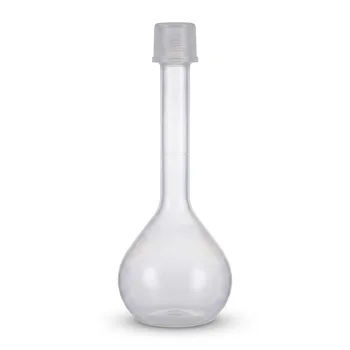
- High Purity PFA Volumetric Flask 1000ml 2000ml Constant Volume Bottle Acid Resistant Trace Analysis Custom Laboratory Labware
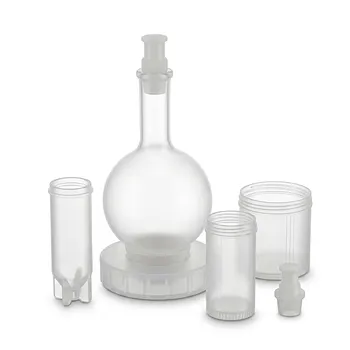
- Custom PFA Pear Shaped Flask High Purity Corrosion Resistant Labware Custom Molded Fluoropolymer Flask Glass Replacement Solution
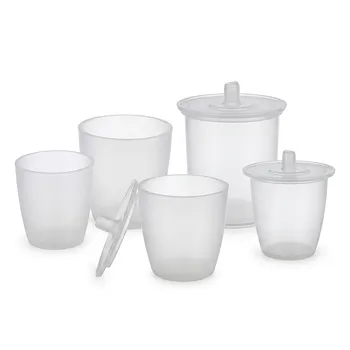
- High Purity PFA Crucible and Corrosion Resistant PTFE Beaker for Trace Analysis and Custom Laboratory Applications
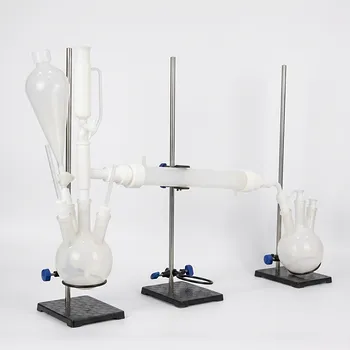
- High Purity PFA Constant Pressure Condensation Reaction System Acid Resistant High Temperature Customizable Teflon Labware
- High Purity PFA Sample Dissolution Cups Acid Resistant Chemical Digestion Vessels with Lids Trace Analysis Labware
People Also Ask
- What are the advantages of using high-purity PFA vs. glassware? Achieve Unmatched Accuracy in Trace Analysis
- Why use high-purity PFA bottles for Carbon Quantum Dots? Ensure Ink Stability and Prevent Fluorescence Quenching
- Why is high-purity PFA trace analysis labware used for MXene? Ensure Superior Material Integrity in Research
- Why is high-purity PFA trace analysis labware used for sample processing when preparing Mo2CTx@MoS2? Ensure Material Purity
- Why is high-purity PFA labware necessary for Znx@LS-2 zeolite ICP-OES analysis? Ensure Trace-Level Precision