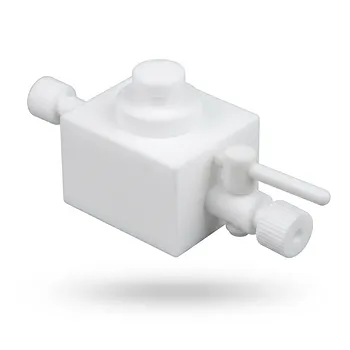
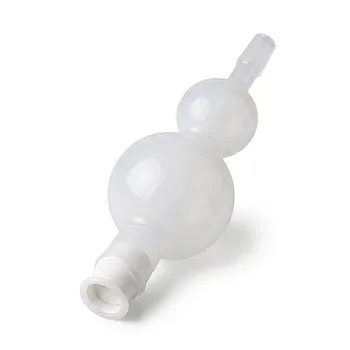
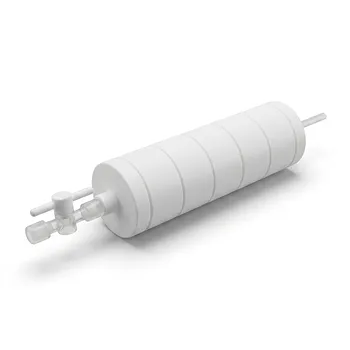
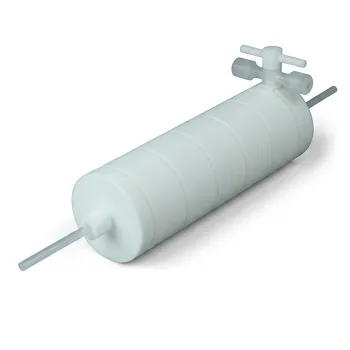
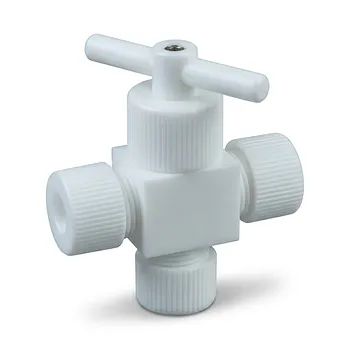
PTFE and PFA differ most in how they can be manufactured. PTFE’s extremely high melt viscosity prevents conventional melt molding, so custom laboratory components are typically compression-molded, sintered, paste-extruded, or CNC-machined from stock shapes. PFA is a fully fluorinated, melt-processible copolymer that can be conventionally molded and extruded, allowing more complex, seamless, transparent or translucent components while retaining chemical resistance and continuous-use temperatures comparable to PTFE.
The material choice determines the practical design space: PTFE is generally favored for robust, machined laboratory bodies and vessels, while PFA is better suited to intricate fluidic geometries, molded fittings, valves, tubing, and high-purity vessels.
Why Manufacturing Behavior Is the Key Difference
PTFE Does Not Flow Like a Conventional Thermoplastic
PTFE has an exceptionally high melt viscosity, approximately 1 to 10 GPa·s in the referenced processing range. Although it melts in a thermal sense, it does not flow readily enough for standard injection molding or conventional extrusion.
Manufacturers therefore form PTFE powder through compaction and sintering, use paste extrusion for suitable products, or machine finished stock shapes with precision CNC equipment.
PFA Is Melt-Processible
PFA is a copolymer of tetrafluoroethylene and perfluoroalkyl vinyl ether. The comonomer structure reduces melt viscosity sufficiently for conventional injection molding, extrusion, and related melt-processing methods.
This difference enables PFA to be formed directly into intricate geometries rather than first producing a simple block, rod, or tube and removing material afterward.
Both Materials Retain Fluoropolymer Performance
Both PTFE and PFA provide outstanding chemical resistance, high-temperature stability, dielectric performance, low surface energy, and low ionic contamination potential. Both are commonly associated with continuous-use temperatures around 260°C, subject to the specific grade, design, load, and operating environment.
PFA therefore does not trade away the central chemical and thermal advantages of PTFE simply to gain processability.
How PTFE Manufacturing Influences Component Design
Design Around Stock Shapes and Material Removal
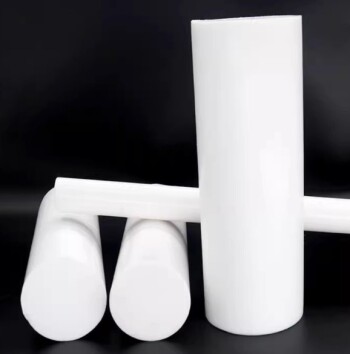
A PTFE component is often produced from a compression-molded or sintered billet, rod, sheet, or tube. The design must therefore accommodate the dimensions and availability of the starting stock.
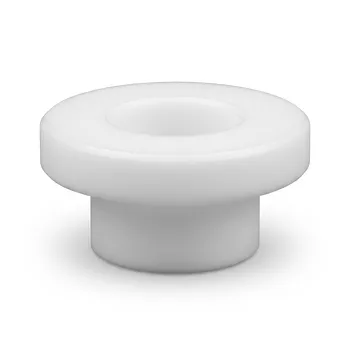
CNC machining can create precise bores, threads, sealing faces, channels, and electrochemical-cell features, but every removed feature adds machining time, tooling requirements, and material waste.
Favor Robust, Accessible Geometries
PTFE is well suited to reaction vessels, electrochemical cell bodies, heavy-duty labware, microwave digestion components, and custom structural parts. These applications often benefit from thick walls and geometries that can be reached by standard cutting tools.
Deep internal channels, enclosed cavities, sharp transitions, and highly intricate networks are more difficult when the component must be machined from a solid shape.
Account for Machining and Dimensional Behavior
Custom-machined PTFE parts require careful control of tolerances, wall thickness, threads, and sealing interfaces. The design should be reviewed for tool access and for the behavior of the material during machining and subsequent thermal exposure.
For critical assemblies, the designer should specify the functional tolerance and sealing requirement rather than imposing unnecessarily tight tolerances on every surface.
Use PTFE When Structural Simplicity Supports Purity
PTFE can be an effective choice when the apparatus needs a chemically inert, stable body with a relatively direct machined form. A machined design can also avoid unnecessary molded features, inserts, or complex joining operations.
This makes PTFE attractive for custom apparatus where chemical purity, structural stability, and durability matter more than intricate molded fluid paths.
How PFA Manufacturing Influences Component Design
Use Molding for Complex Fluid Paths
PFA can be injection-molded or otherwise melt-processed into fittings, valves, manifolds, connectors, and specialized fluid-transfer components. Features that would require multiple machining operations in PTFE can often be formed directly in the mold.
This allows designers to integrate bends, ports, connection features, and internal passages into a single component.
Design for Seamless or Melt-Sealed Construction
PFA’s melt-processability supports tubing and vessels with smooth, continuous surfaces and, where appropriate, melt-sealed geometries. This is valuable when minimizing joints, crevices, dead volume, and potential contamination paths.
For high-purity fluid handling, fewer assembled interfaces can simplify cleaning and reduce the number of locations where residue or leaks may develop.
Exploit Transparency or Translucency
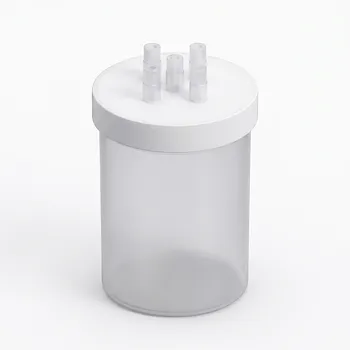
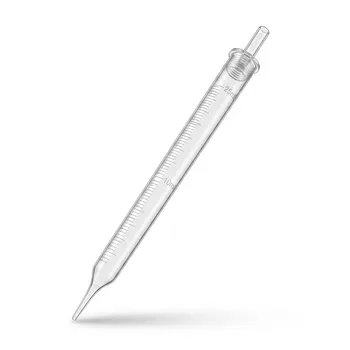
PFA can be produced in transparent or translucent forms, making it useful for digestion vessels, tubing, storage containers, and process components where visual inspection is important.
A designer may be able to observe liquid level, flow, bubbles, precipitates, or color changes without opening the apparatus. PTFE is generally selected when visibility is less important or when a machined opaque body better suits the application.
Integrate Features That Are Difficult to Machine
PFA is particularly useful for vessels and fittings with complex three-dimensional forms. Molded geometry can support compact layouts, integrated ports, and specialized interfaces without assembling many separate machined pieces.
The design still needs to account for molding constraints, including material flow, mold parting, draft, wall uniformity, and the location of gates or weld lines where relevant.
Design Priorities for Custom Laboratory Apparatus
Chemical Purity and Contamination Control
Both polymers are appropriate for highly corrosive or high-purity chemical environments, but the manufacturing route affects the final contamination risk. PFA’s ability to form seamless or integrated components can reduce joints and trapped volumes.
PTFE remains valuable for machined parts where a simple, chemically inert structure is preferred. In either case, the specified grade, processing cleanliness, surface finish, and post-manufacturing cleaning procedure matter as much as the polymer family.
Thermal Exposure
The similar high-temperature capability of PTFE and PFA means that temperature alone does not always determine the choice. The full design must also consider pressure, mechanical loading, thermal cycling, dimensional stability, and the behavior of seals or connected materials.
A component rated for high temperature in isolation may still be unsuitable if its fittings, joints, or support structure fail at a lower temperature.
Geometry and Assembly
PTFE is usually the more practical option for a component that is essentially a machined body with accessible features. PFA becomes more attractive as the design requires intricate passages, integrated fittings, flexible tubing, or a transparent vessel.
The manufacturing method should be selected before finalizing the geometry, because the same nominal shape may be economical and reliable in PFA but difficult and expensive to produce in PTFE.
Sealing and Connections
PTFE parts commonly use machined threads, compression interfaces, gaskets, or mechanical fittings. PFA parts can also use mechanical connections, while melt-processing may enable specialized welded or sealed constructions.
The choice depends on whether the apparatus must be repeatedly disassembled, permanently sealed, sterilized, pressure-tested, or inspected during operation.
Understanding the Trade-offs
PFA’s Processability Does Not Eliminate Molding Constraints
PFA can be molded and extruded, but complex molding still requires tooling, design validation, and attention to flow and cooling behavior. For a one-off component, the tooling cost may outweigh the advantages of molding.
A machined PTFE part may be faster and more economical for a small prototype or a highly customized design.
PTFE Machining Offers Flexibility but Can Become Costly
CNC machining avoids dedicated molding tools and is well suited to prototypes and low-volume custom apparatus. However, complex internal features can require specialized tools, multiple setups, or compromises in geometry.
The more the design resembles a molded fluidic network, the less attractive conventional PTFE machining becomes.
PFA and PTFE Are Not Interchangeable in Every Design
Comparable chemical resistance and temperature capability do not mean that the materials behave identically in service. Differences in processing, geometry, stiffness, surface finish, and dimensional behavior can affect the performance of the finished component.
Material selection should therefore evaluate the complete apparatus rather than relying only on a chemical compatibility chart.
Avoid Choosing Material Before Choosing the Fabrication Route
A common mistake is to specify PTFE or PFA first and attempt to force the design into an unsuitable manufacturing process. The correct sequence is to define the chemical, thermal, mechanical, purity, visibility, and volume requirements, then select the material and fabrication route together.
This approach prevents a component from becoming unnecessarily complex, expensive, or difficult to qualify.
Making the Right Choice for Your Goal
Choose the material and manufacturing method according to the dominant requirement of the apparatus:
- If your primary focus is robust custom-machined vessels or structural laboratory bodies: Use compression-molded and CNC-machined PTFE when the geometry is accessible and maximum chemical inertness and thermal stability are central requirements.
- If your primary focus is intricate fluid handling: Use melt-processible PFA for molded valves, fittings, manifolds, tubing, and integrated passages.
- If your primary focus is visual monitoring: Prefer transparent or translucent PFA for vessels and tubing where observing the process is important.
- If your primary focus is low-volume prototyping: Evaluate machined PTFE first because it can avoid the tooling investment required for molded PFA.
- If your primary focus is minimizing contamination and dead volume: Consider PFA designs that reduce joints, crevices, and assembled interfaces through molded or melt-sealed construction.
The best choice is the one whose manufacturing process naturally supports the apparatus geometry, purity requirements, operating conditions, and expected production volume.
Summary Table:
| Aspect | PTFE | PFA |
|---|---|---|
| Manufacturing methods | Compression molding, sintering, paste extrusion, CNC machining | Injection molding, extrusion, melt processing |
| Melt processability | Very high melt viscosity, not melt-processible | Fully fluorinated, melt-processible |
| Design flexibility | Limited to stock shapes; better for simpler, machined geometries | High flexibility for complex, molded geometries |
| Transparency | Opaque | Can be transparent or translucent |
| Typical applications | Reaction vessels, heavy-duty labware, structural parts | Fittings, valves, manifolds, tubing, high-purity vessels |
| Prototyping | Lower tooling cost for low volumes | Higher tooling cost for low volumes |
Both materials offer excellent chemical resistance and high-temperature stability (~260°C). The choice depends on geometry, purity requirements, and production volume.
Ready to optimize your lab apparatus with expert PTFE and PFA manufacturing? At KINTEK, we specialize in custom fluoropolymer components, from machined PTFE vessels to intricate molded PFA fluidics. Our end-to-end CNC machining and molding capabilities ensure precise, high-purity solutions tailored to your needs. Contact us today to discuss your project and discover how our expertise can enhance your lab's performance and reliability. Get in touch with KINTEK now!
Related Products
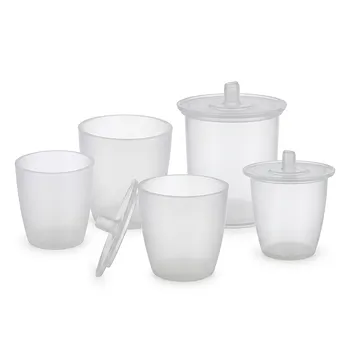
- High Purity PFA Crucible and Corrosion Resistant PTFE Beaker for Trace Analysis and Custom Laboratory Applications
- PTFE PFA Vacuum Filtration System Corrosion Resistant Customizable Shatterproof Laboratory Device
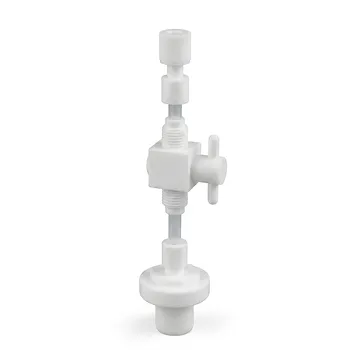
- High Purity PFA PTFE Flare Stop Valves Customizable 2-Way 3-Way Reducing Fluoropolymer Fluid Control Solutions
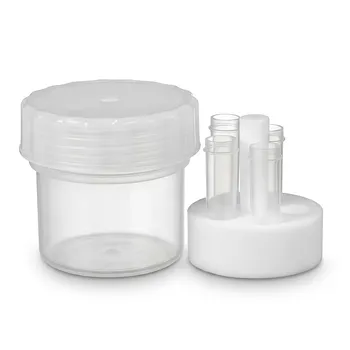
- Corrosion Resistant PTFE Support with PFA Transparent Reaction Tank and High Purity PFA Sampling Tube for Trace Analysis
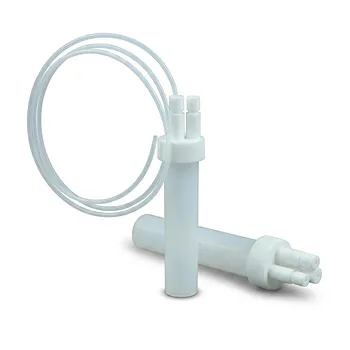
- High Purity PFA Coiled Tubing Custom PTFE Machining PFA Welding and Precision Bending Solutions
People Also Ask
- Why are high-purity vessels critical for BiFeO3 synthesis? Ensuring Phase Purity
- Why is the use of high-purity PFA or PTFE labware critical during TiO2 nanoparticle purification? Protect Sample Purity
- Why is high-purity PFA trace analysis labware recommended for trace element detection? Achieve Gold Standard PPT Accuracy
- Why is high-purity PFA trace analysis labware used for MXene? Ensure Superior Material Integrity in Research
- Why is high-purity PFA labware necessary for Znx@LS-2 zeolite ICP-OES analysis? Ensure Trace-Level Precision