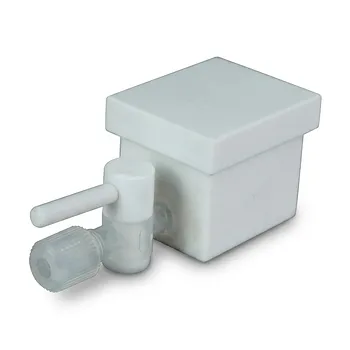
The ion exchange membrane (IEM) is the critical separator in an H-type cell that facilitates selective ion transport while preventing unwanted chemical crossover. In this configuration, the membrane ensures electrical circuit continuity by allowing specific charge carriers—such as protons or anions—to pass between chambers to maintain charge neutrality. Simultaneously, it acts as a robust physical barrier that prevents reactants and products from migrating between the anode and cathode, which is essential for maximizing reaction efficiency and ensuring the accuracy of analytical measurements.
The primary function of an ion exchange membrane in an H-type cell is to decouple the anode and cathode environments, enabling charge balance via selective ion transport while safeguarding chemical purity and Faradaic efficiency.
Maintaining Electrical and Chemical Equilibrium
Sustaining Circuit Conductivity
The membrane serves as a bridge that completes the electrochemical circuit by allowing ions to flow between the two half-cells. Without this ionic movement, charge would build up in the electrolytes, leading to a rapid increase in resistance and the eventual cessation of the reaction.
Selective Ion Permeation for Charge Balance
IEMs are engineered to be selective, allowing only specific types of ions to pass through while blocking others. For example, a Proton Exchange Membrane (PEM) facilitates the movement of $H^+$ ions, while an Anion Exchange Membrane (AEM) allows anions like sulfate to pass, ensuring the system remains electrically neutral during redox processes.
Decoupling Chemical Environments
By physically separating the chambers, the membrane allows the anode and cathode to operate in different chemical conditions if necessary. This decoupling is vital for complex reactions where the ideal pH or electrolyte composition for the oxidation half-reaction differs significantly from that of the reduction half-reaction.
Preventing Cross-Contamination and Side Reactions
Inhibiting Product Re-oxidation
In CO2 reduction or similar processes, products generated at the cathode (such as carbon monoxide or hydrogen) must be kept away from the anode. The membrane prevents these products from diffusing to the anode, where they would be re-oxidized, a "shuttling" effect that severely degrades overall system efficiency.
Blocking Reactant Crossover
The membrane acts as a barrier to large reactant molecules, such as hydroxymethylfurfural (HMF), or metal cations like copper and zinc. Blocking this migration prevents direct chemical reactions between reactants and the opposing electrode, which could lead to cell failure or the formation of unwanted byproducts.
Protecting the Cathode from Anode Interference
Oxygen gas produced at the anode can migrate to the cathode and interfere with the desired reduction reaction. The IEM blocks this oxygen crossover, ensuring that the cathodic current is utilized solely for the target reaction, thereby maintaining high Coulombic efficiency.
Enhancing Analytical Precision
Enabling Accurate Faradaic Efficiency Calculations
Separation of the gas and liquid phases in each chamber allows for the precise quantification of products. This is critical for techniques like online gas chromatography, as it ensures that the measured gases originated solely from the electrode being studied.
Supporting Electrochemical Characterization
The H-type cell is frequently used for Electrochemical Impedance Spectroscopy (EIS) to analyze the membrane itself. By isolating the electrolytes, researchers can measure the specific electrical resistance and capacitance of the membrane to understand its internal ion permeation channels.
Understanding the Trade-offs
Ohmic Resistance and Voltage Loss
While the membrane is essential, it introduces internal resistance to the cell. This resistance causes a voltage drop (IR drop), which can increase the energy required to drive the reaction and generate heat, potentially impacting the stability of sensitive catalysts.
Species Crossover and Membrane Degradation
No membrane is a perfect barrier; over time, small molecules or ions may still leak through, a phenomenon known as crossover. Additionally, harsh chemical environments or high current densities can degrade the membrane's polymer structure, leading to a loss of selectivity and increased cell resistance.
Making the Right Choice for Your Goal
How to Apply This to Your Project
Choosing the correct ion exchange membrane depends entirely on your specific electrochemical application and the species involved.
- If your primary focus is Proton Transport (e.g., Water Electrolysis): Utilize a perfluorosulfonic acid-based Proton Exchange Membrane to ensure high conductivity and chemical stability.
- If your primary focus is CO2 Reduction or Anionic Balance: Select an Anion Exchange Membrane (AEM) to facilitate the movement of anions while blocking the crossover of liquid reduction products like acetate.
- If your primary focus is Preventing Metal Ion Interference: Ensure the membrane's pore size and charge selectivity are specifically rated to block the migration of cations like $Cu^{2+}$ or $Zn^{2+}$.
- If your primary focus is High-Precision Analytics: Prioritize a membrane with the lowest possible crossover rates to ensure that Faradaic efficiency measurements are not skewed by product migration.
The ion exchange membrane is the silent regulator of the H-type cell, balancing the conflicting needs of ionic connectivity and chemical isolation.
Summary Table:
| Function | Mechanism | Key Benefit |
|---|---|---|
| Ion Transport | Facilitates flow of specific charge carriers (H+, anions) | Maintains circuit continuity & charge balance |
| Chemical Separation | Physical barrier between anode and cathode chambers | Prevents reactant crossover & product re-oxidation |
| Environment Decoupling | Isolates electrolytes with different pH or compositions | Allows independent optimization of half-reactions |
| Analytical Precision | Isolates gas and liquid phases for quantification | Enables accurate Faradaic efficiency measurements |
Elevate Your Electrochemical Research with KINTEK Precision
Maximize the efficiency and accuracy of your electrochemical experiments with high-performance laboratory supplies from KINTEK. Whether you are working with everyday basic labware like beakers and reagent bottles or specialized reaction apparatus, we provide the ultimate in chemical resistance and purity.
Our extensive range includes:
- Advanced Reaction Systems: Standard and custom H-type electrochemical cells, battery testing fixtures, and hydrothermal synthesis liners.
- Fluid Transfer & Filtration: High-purity PFA/PTFE tubing, fittings, valves, filters, and separatory funnels.
- General Consumables: Digestion tubes, stirring bars, O-rings, and trace analysis instruments.
Backed by end-to-end custom CNC fabrication, KINTEK specializes in high-performance fluoropolymer materials, delivering everything from complex non-standard machined parts to high-volume orders tailored to your specific research needs.
Ready to optimize your lab setup? Contact us today to explore our bespoke solutions and experience the KINTEK advantage!
References
- Juntao Zhang, Guangfu Liao. Dual Co Sites in n─n Type Heterojunction Enable Selective Electrochemical Co‐Valorization of HMF and CO <sub>2</sub>. DOI: 10.1002/anie.202511448
This article is also based on technical information from Kintek Knowledge Base .
Related Products
- Square PTFE Electrochemical Cell for Silicon Wafer Processing and Hydrofluoric Acid Resistance in Semiconductor and New Energy Research
- Corrosion Resistant PTFE Electrochemical Cell for New Energy Research Inert Insulating Customizable Lab Reaction Vessel
- High Purity Custom PTFE Reaction Cell Electrolytic Tank for Semiconductor and Polysilicon Industrial Applications
- Custom PTFE Electrolytic Cell Corrosion Resistant Low Background Reaction Vessel with Inlet Outlet Ports
- White PTFE Electrolytic Cell with Movable Slider and Insulated Lid for Fluorine Corrosion Resistance
People Also Ask
- What makes PTFE an ideal construction material for custom electrochemical cells and electronic analytical instrumentation housings? Discover superior chemical resistance and electrical insulation
- How do custom PTFE electrochemical cells improve the accuracy of stability testing for alkaline catalysts compared to glass cells?
- How does the hydrophobicity of PTFE benefit electrochemical measurements? Enhance Stability and Precision in Your Lab
- Why must seawater electrolysis test cells have high corrosion resistance? Protect catalyst stability & data accuracy.
- Why is voltage stability critical in SQD exfoliation? Ensure Uniform Size and High Photoelectric Efficiency