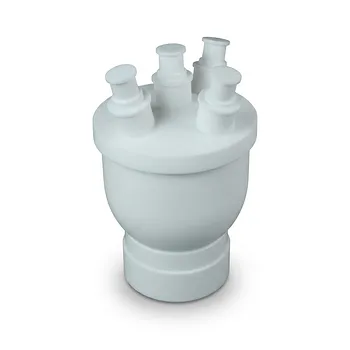
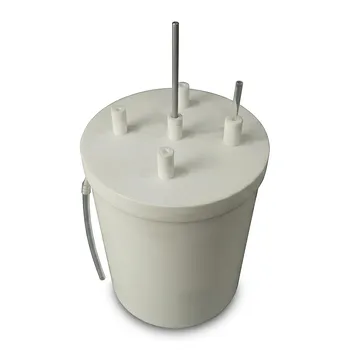
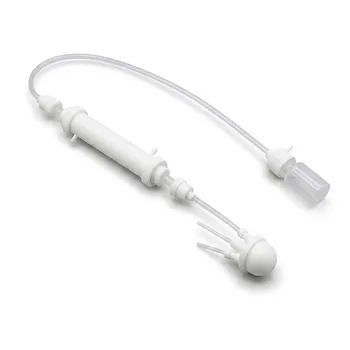
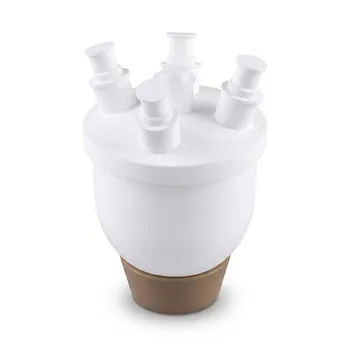
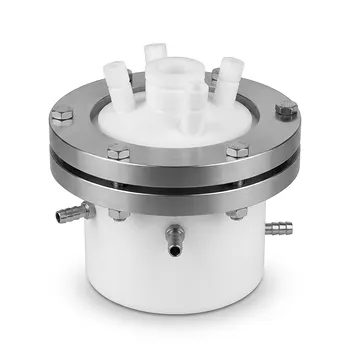
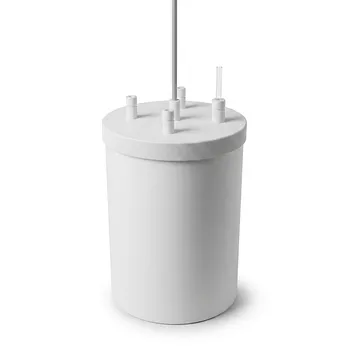
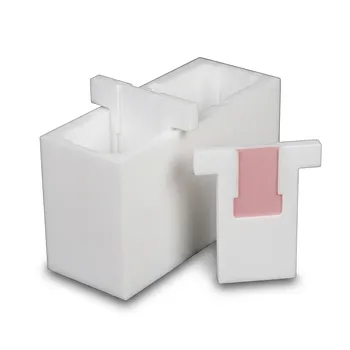
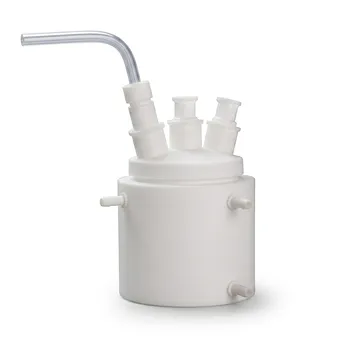
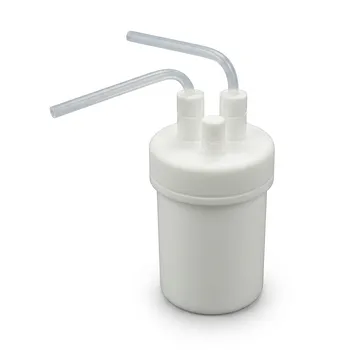
PTFE microchannel reactors are defined by internal channel architectures with lateral dimensions typically ranging from 10 to 1,000 micrometers (1 mm). These continuous-flow devices utilize the unique chemical and physical properties of polytetrafluoroethylene to facilitate reactions that require extreme inertness and resistance to fouling. They are commonly constructed either as modular systems using PTFE capillaries or as hermetic chips fabricated through CNC milling of solid PTFE blocks.
Core Takeaway: PTFE microchannel reactors prioritize chemical compatibility and anti-fouling surfaces over mechanical strength, providing a specialized environment for processing aggressive reagents at the microscale.
Dimensional Standards and Channel Geometry
Lateral Dimensions and Confinement
The defining characteristic of these reactors is the confinement of fluid within channels featuring hydraulic diameters between 100 and 1,000 µm. While some specialized designs can reach as low as 10 µm, the primary goal is to maintain a high surface-area-to-volume ratio to enhance mass transfer.
Internal Structural Configurations
The internal network consists of an interconnected series of microchannels that can be straight, coiled, or helical. These paths are often formed by coiling capillary tubing or by machining intricate patterns directly into PTFE plates and blocks to create a compact reaction environment.
Critical Material Characteristics
Exceptional Chemical Inertness
PTFE provides near-universal resistance to a wide array of aggressive substances, including strong acids, bases, and reactive organometallics. This lack of reactivity ensures that the reactor material does not interfere with the chemical process or degrade over time.
Low Surface Energy and Fouling Resistance
The "slick," non-stick surface of PTFE is a result of its extremely low surface energy. This physical trait prevents the adhesion of solids and minimizes fouling, which is critical in microchannels where even minor blockages can lead to significant pressure spikes or system failure.
Thermal Stability and Insulation
PTFE remains stable in very low temperatures and has a high melting point exceeding 350°C. For continuous operation, these reactors are generally rated for use up to approximately 260°C, though their low thermal conductivity means they often act as insulators during external heating processes.
Structural Forms and Fabrication
CNC-Machined Solid Blocks
One common physical form is the monolithic chip, created by CNC milling precise channel geometries into solid PTFE plates. These plates are then bonded or mechanically clamped to create hermetic, reusable reaction environments capable of handling complex flow patterns.
Modular Capillary Systems
In modular setups, the reactor is constructed using PTFE tubing or helical capillaries. This approach allows for greater flexibility in reactor length and volume, leveraging the material's durability and high impact strength in a more adaptable format.
Understanding the Trade-offs
Mechanical Strength and Pressure Limits
A primary limitation of PTFE is its moderate pressure rating, typically restricted to a few bar. Because the material is relatively soft, it can deform under high pressure or temperature; consequently, high-pressure applications often require PTFE to be used as a liner or coating inside a metallic or silicon substrate.
Heat Transfer Efficiency
While PTFE is thermally stable, its low thermal conductivity can be a disadvantage when rapid heat exchange is required. Unlike metallic microreactors, PTFE systems may require longer residence times or specialized heating elements to achieve precise temperature control within the fluid stream.
Applying PTFE Reactors to Your Project
Recommendations Based on Goal
- If your primary focus is handling highly corrosive reagents: Utilize a solid-block CNC-milled PTFE reactor to ensure maximum material thickness and "near-universal" chemical resistance.
- If your primary focus is preventing channel blockages or fouling: Leverage PTFE’s low surface energy to process reactions that involve particulates or sticky intermediates.
- If your primary focus is high-pressure synthesis: Deploy PTFE-lined metallic reactors to combine the chemical inertness of the polymer with the structural integrity of metal.
- If your primary focus is rapid prototyping or modularity: Use PTFE capillary-based systems to easily adjust path lengths and residence times without expensive machining.
By balancing PTFE's unmatched chemical resistance against its mechanical and thermal limitations, you can design a flow system that is both durable and highly effective for specialized chemical synthesis.
Summary Table:
| Feature | Specification / Detail |
|---|---|
| Channel Diameter | 10 µm to 1,000 µm (typically 100-1,000 µm) |
| Material | High-performance PTFE (Polytetrafluoroethylene) |
| Operating Temp | Continuous use up to 260°C (Stability >350°C) |
| Chemical Resistance | Near-universal (Strong acids, bases, organometallics) |
| Surface Property | Low surface energy; highly resistant to fouling |
| Fabrication Types | CNC-milled monolithic chips or modular capillary systems |
Elevate Your Lab with KINTEK’s High-Performance Fluoropolymer Solutions
Are you looking for the ultimate chemical resistance and precision in your flow chemistry? At KINTEK, we maintain an exclusive and absolute focus on high-performance fluoropolymer materials, manufacturing virtually all imaginable laboratory supplies crafted from PTFE and PFA.
From everyday basic labware—including beakers, measuring cylinders, crucibles, reagent bottles, and digestion tubes—to advanced components like microchannel reactors, electrochemical cells, and battery testing fixtures, we provide the tools you need for success. Our capabilities extend to comprehensive fluid transfer components (tubing, fittings, valves) and sample prep tools (filters, pipettes, tweezers), all backed by end-to-end custom CNC fabrication for complex, non-standard machined parts.
Ready to optimize your experimental setup? Contact us today to discuss your bespoke laboratory requirements or high-volume orders with our material experts!
Related Products
- Customizable Polytetrafluoroethylene PTFE Reactor and Corrosion Resistant Teflon Flask
- PTFE 10L Reaction Vessel with Stirring Paddle Customizable Corrosion Resistant High Temperature Reactor for Biopharmaceutical and Chemical Processing
- Custom PTFE Multilayer Reaction Apparatus High Temperature Corrosion Resistant Threaded Modular Sieve System
- Custom PTFE Volatile Matter Condensation Reflux Reaction Device Corrosion Resistant Pressure Resistant
- High Performance Customizable PTFE Reaction Vessel and Corrosion Resistant Polytetrafluoroethylene Flask for Chemical Laboratory Use
People Also Ask
- What functional advantages do PTFE reactors provide over glass? Achieve Superior Purity and Safety in Synthesis
- What are the primary fabrication methods for capillary-based and monolithic PTFE reactors? Expert Production Insights
- Why are PTFE or PFA reaction vessels required for the selective etching process of MXene using hydrofluoric acid (HF)?
- Why is a Teflon-lined (PTFE) reactor vessel required for the hydrothermal synthesis of V2O5 and SnO2 nanomaterials?
- What is the role of high chemical inertness reaction vessels in the organic synthesis of acylhydrazone ligands? | Guide