The solution–diffusion mechanism determines gas transport by balancing molecular mobility against polymer affinity. In a dense fluoropolymer membrane, a gas first sorbs into the upstream surface, diffuses through the polymer, and desorbs downstream. Its permeability is P = D × S, where D is the diffusion coefficient and S is the sorption or solubility coefficient.
Core takeaway: For dense fluoropolymer gas-separation membranes, performance depends on both permeability and selectivity, but size-based diffusion selectivity often dominates gas-pair separation. Fractional free volume, microcavity dimensions, membrane thickness, and pressure difference determine whether a laboratory tool favors high throughput, strong molecular discrimination, or low gas permeation.
How Solution–Diffusion Controls Gas Transport
Sorption is the first transport step
Gas molecules at the feed side dissolve into the fluoropolymer surface according to their chemical affinity for the polymer.
A gas with greater solubility has a higher S value and can contribute disproportionately to total permeability, even if its diffusion rate is modest.
Diffusion occurs through transient free volume
After sorption, molecules move through interconnected, temporary spaces within the polymer matrix.
The diffusion coefficient D reflects how easily a molecule moves through these spaces. Smaller molecules generally diffuse more rapidly when the polymer’s microcavities impose effective size discrimination.
Desorption completes permeation
At the low-pressure or permeate side, dissolved molecules leave the polymer and enter the downstream gas phase.
Under a concentration-gradient approximation, the flux of gas species i through a membrane of thickness ℓ is:
[ J_i = \frac{D_i S_i \Delta p_i}{\ell} ]
Thus, flux increases with permeability and pressure difference but decreases as the membrane becomes thicker.
Why Fluoropolymer Structure Matters
Fractional free volume sets transport capacity
Fractional free volume (FFV) represents the portion of polymer volume available for molecular motion.
Increasing FFV generally increases gas diffusivity and permeability, but excessive free volume can reduce size-sieving precision by allowing more gas species to pass through.
Microcavity architecture governs molecular discrimination
Fluoropolymer chain packing creates a distribution of molecular-scale cavities rather than uniform cylindrical pores.
A carefully controlled cavity structure can allow smaller molecules to diffuse more readily than larger ones, producing high diffusivity selectivity.
Fluorination supports chemical stability
Fluorinated backbones and functional groups provide strong chemical resistance, low surface energy, and structural stability in demanding laboratory environments.
This is important for components exposed to aggressive gases, solvents, acids, bases, or high-purity analytical streams. Chemical inertness, however, does not eliminate permeation; it mainly helps preserve the membrane’s structure and properties.
How Selectivity Is Established
Ideal selectivity combines two effects
For gases A and B, ideal selectivity is:
[ \alpha^*_{A/B} = \frac{P_A}{P_B} ]
Because permeability equals diffusivity multiplied by solubility, selectivity can be separated into:
[ \alpha^*_{A/B}
\frac{D_A}{D_B} \times \frac{S_A}{S_B} ]
This distinction identifies whether separation is primarily caused by molecular mobility or polymer–gas affinity.
Diffusivity selectivity is often dominant
For gas pairs such as He/CH₄ or H₂/CO₂, differences in molecular size and mobility can make the diffusion ratio the principal source of selectivity.
Engineering FFV and microcavity architecture is therefore central when the objective is size-based gas separation rather than simply maximizing total gas uptake.
Solubility can still reverse expectations
A gas that interacts more strongly with the fluoropolymer may sorb preferentially and achieve higher permeability despite slower diffusion.
Therefore, diffusivity should not be treated as the only design variable. The correct material choice requires evaluating both D and S for the actual gas mixture, pressure, and temperature.
What This Means for Laboratory Tools
Dense membranes enable controlled gas separation
A dense fluoropolymer membrane can separate gases without relying on open pores or macroscopic channels.
This is useful when the laboratory objective is selective permeation, controlled gas exchange, or reducing cross-contamination between gas streams.
Tubing and containers act as gas barriers
PTFE and PFA tubing, storage vessels, and gasket materials also transport gases through their dense polymer walls according to solution–diffusion principles.
Low permeability helps limit atmospheric ingress, reagent loss, outgassing, and contamination of trace analytical systems.
Wall thickness changes the practical result
Because flux is inversely proportional to thickness, a thicker fluoropolymer wall reduces gas transmission for a given pressure difference.
This improves barrier performance but can slow intentional gas exchange. Laboratory designs must therefore distinguish between a component intended to block permeation and one intended to provide controlled permeation.
Dense Membranes and Porous Filters Are Not the Same
Dense separation uses solution–diffusion
In a dense membrane, gas molecules dissolve into the polymer and migrate through its molecular-scale free volume.
The relevant design variables are permeability, diffusivity, solubility, FFV, selectivity, pressure difference, and thickness.
Porous filtration uses pore transport
Porous fluoropolymer materials, such as expanded PTFE, contain interconnected physical pores.
Gas flow, gas–liquid exchange, de-aeration, and particle retention are then governed primarily by pore size, porosity, tortuosity, wetting, and pressure—not by solution–diffusion through an otherwise continuous polymer film.
The distinction matters in laboratory selection
A porous PTFE filter may be chemically inert and highly effective for sterile filtration or gas exchange, but it should not be evaluated using dense-membrane permeability alone.
Use solution–diffusion parameters for dense gas-separation films and barrier walls; use pore-structure and breakthrough data for porous filtration devices.
Understanding the Trade-offs
Higher permeability can reduce selectivity
Increasing FFV or disrupting polymer chain packing can raise gas flux by increasing molecular mobility.
However, a broader or less restrictive cavity distribution may reduce the difference in diffusion rates between gas species.
More thickness improves barrier performance but lowers throughput
A thicker wall increases the diffusion path and reduces flux.
That is beneficial for storage and containment, but undesirable when rapid gas equilibration or high permeate flow is required.
Sorption can cause operating-condition sensitivity
Changes in gas composition, pressure, or temperature can alter the amount of gas dissolved in the polymer.
Strongly sorbing species may also change polymer dimensions or mobility, so permeability and selectivity measured under one condition should not automatically be transferred to another.
Chemical resistance does not equal zero contamination
Fluoropolymers are highly inert, but gases can still permeate them and volatile species can still be released from surfaces or manufacturing residues.
For trace analysis and air-sensitive work, evaluate actual permeation, outgassing, cleanliness, and material grade rather than relying on the fluoropolymer label alone.
Making the Right Choice for Your Goal
The solution–diffusion model gives a practical framework for matching membrane structure to laboratory function:
- If your primary focus is selective gas separation: Compare both (D_A/D_B) and (S_A/S_B), with particular attention to FFV and microcavity architecture because kinetic diffusion often controls size-based selectivity.
- If your primary focus is gas containment or barrier performance: Choose a chemically stable fluoropolymer grade and increase wall thickness where appropriate, while accounting for the resulting reduction in permeation rate.
- If your primary focus is porous gas exchange or de-aeration: Evaluate pore size, wetting resistance, pressure tolerance, and liquid breakthrough rather than dense-membrane permeability.
- If your primary focus is trace analytical integrity: Characterize gas ingress, outgassing, sorption, and component cleanliness under the actual temperature, pressure, and chemical exposure conditions.
By separating dense-membrane solution–diffusion from porous-filter transport, you can select fluoropolymer laboratory tools for the performance they actually need to deliver.
Summary Table:
| Factor | Dense Membrane (Solution-Diffusion) | Porous Membrane (Pore Flow) |
|---|---|---|
| Transport Mechanism | Sorption, diffusion, desorption through polymer free volume | Flow through interconnected physical pores |
| Key Variables | Permeability (D × S), diffusivity, solubility, FFV, selectivity, thickness, pressure | Pore size, porosity, tortuosity, wetting, pressure |
| Gas Separation | Based on diffusivity and solubility selectivity | Based on pore size exclusion and Knudsen diffusion |
| Example Applications | Gas separation membranes, barrier tubing, containers | Sterile filtration, gas exchange, particle retention |
| Evaluation Criteria | Dense-film permeability and selectivity data | Pore structure and breakthrough data |
Optimize your lab's gas separation and barrier performance with high-purity PTFE and PFA components from KINTEK. Our custom CNC machining and comprehensive labware ensure precise control over solution-diffusion and porosity for your exact needs. From gas separation membranes to storage vessels and filtration tools, we deliver reliable, chemically inert solutions. Contact us today to discuss your application and get a tailored quote!
Related Products
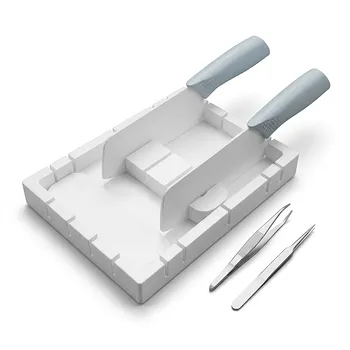
- High Purity PTFE Square Membrane Cutter and Filter Aliquot Device for Trace Analysis and Cleanroom Laboratory Applications
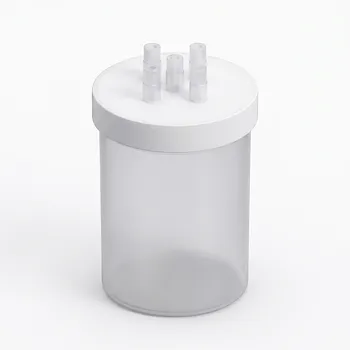
- High Purity 4L PFA Reaction Tank for Proton Exchange Membrane Electrolysis Water Oxygen Separation Systems
- High Purity PFA Chromatography Column with Collection Bottle Corrosion Resistant Fluoropolymer Filtration System for Trace Analysis
- Custom PFA Tubing 1/4 Inch High Purity Corrosion Resistant Fluoropolymer Tube with Welding and Machining Services
- Custom PTFE Insulating Gaskets and Corrosion Resistant Fluoropolymer Seals for Industrial Electrical Applications
People Also Ask
- What are the structural characteristics and manufacturing principles of Polytetrafluoroethylene (PTFE) filter membranes?
- What is the chemical composition and temperature resistance of PTFE filter membranes? Essential Specs for Labs
- How does the inherent hydrophobicity of PTFE filter membranes affect liquid and gas separation? Optimize Performance
- What are the performance advantages of PTFE filter membranes vs depth filters? Boosting Lab Purity and Efficiency
- What is the thermal stability range for PTFE filter membranes? Master Extremes from -200°C to +260°C