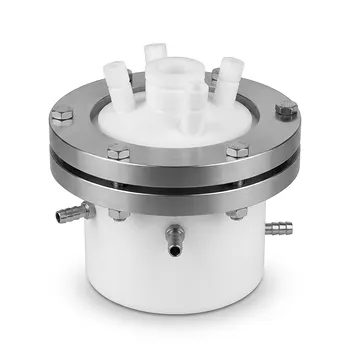
Scaling microfluidic processes requires a fundamental departure from traditional chemical engineering. The numbering-up principle scales Teflon microchannel reactors by operating multiple identical channels in parallel rather than increasing the physical dimensions of a single channel. This method ensures that the precise heat and mass transfer characteristics optimized at the lab scale remain unchanged during industrial production.
The numbering-up principle eliminates the unpredictability of traditional scale-up by maintaining identical micro-scale physics across an industrial array. By keeping channel dimensions constant, engineers preserve the optimized reaction kinetics and safety profiles developed during laboratory testing.
The Mechanics of Numbering-Up
Maintaining Microscale Hydrodynamics
In traditional scale-up, increasing the size of a vessel often alters flow patterns, leading to turbulence or "dead zones" that decrease efficiency. Numbering-up avoids this by keeping the Reynolds number and flow profile constant, as the fluid experiences the exact same geometry in every channel.
Consistent Heat and Mass Transfer
The high surface-area-to-volume ratio of Teflon microchannels is their primary advantage for highly exothermic or fast reactions. By replicating channels instead of widening them, the thermal control remains as precise in a thousand-channel system as it was in a single lab prototype.
Preservation of Optimized Kinetics
When a reaction is optimized in a single microchannel, the residence time and mixing rates are precisely tuned. Because numbering-up does not change the diffusion distances, the chemical yields and selectivity achieved in the lab are directly translated to the factory floor.
Why Teflon is Central to This Approach
Chemical Inertness and Precision
Teflon (PTFE/PFA) provides exceptional resistance to corrosive reagents that would degrade metal reactors. Its properties allow for the fabrication of smooth, non-reactive channels that behave predictably when duplicated across a large-scale manifold.
Predictable Scaling Paths
Because the internal environment of every channel is identical, the transition from milliliters to liters of output is a linear calculation. This significantly reduces the need for expensive and time-consuming pilot plant testing phases, as the "unit cell" has already been validated.
Understanding the Trade-offs
Manifold Complexity and Flow Distribution
The primary challenge in numbering-up is ensuring equal fluid distribution across all parallel channels. If the inlet manifold design is flawed, some channels may receive more reactant than others, leading to inconsistent product quality or "hot spots."
Increased Maintenance and Clogging Risks
Multiplying the number of channels increases the number of potential failure points. A single blockage in one microchannel can disrupt the pressure balance of the entire array, necessitating sophisticated monitoring systems to detect and isolate failures.
Applying Numbering-Up to Your Production Goals
Implementing this principle requires a shift from volume-based engineering to a focus on throughput-based design.
- If your primary focus is process consistency: Utilize a modular numbering-up design to ensure that every microliter of product experiences the exact same thermal and mixing history.
- If your primary focus is rapid time-to-market: Minimize development time by perfecting a single "unit cell" and simply adding identical modules as production demand increases.
By mastering the geometry of a single channel, you gain total control over the scalability and safety of your entire industrial operation.
Summary Table:
| Feature | Traditional Scaling-Up | Numbering-Up (Teflon Microreactors) |
|---|---|---|
| Geometry | Increases vessel size/volume | Replicates identical parallel channels |
| Heat/Mass Transfer | Often decreases with size | Remains constant and optimized |
| Reaction Kinetics | Unpredictable (requires pilot plants) | Linear and predictable scalability |
| Fluid Dynamics | Risk of turbulence and dead zones | Consistent Reynolds number/flow profile |
| Primary Risk | Loss of process control | Manifold distribution and clogging |
Unlock Precision Scalability with KINTEK’s Fluoropolymer Solutions
Ready to transition from laboratory discovery to industrial production without losing process control? KINTEK provides the high-performance PTFE and PFA equipment necessary to master the numbering-up principle. Our exclusive focus on fluoropolymer materials ensures your reactors withstand the most corrosive reagents while maintaining the thermal precision your chemistry demands.
From advanced microchannel reactors, reaction apparatus, and hydrothermal synthesis liners to essential fluid transfer components like tubing, valves, and fittings, KINTEK manufactures virtually every laboratory supply imaginable. Whether you require everyday labware (beakers, digestion tubes, spatulas), high-purity trace analysis instruments, or bespoke electrochemical cells, our end-to-end custom CNC fabrication is equipped to deliver non-standard machined parts and high-volume orders tailored to your unique specifications.
Eliminate the uncertainty of scale-up. Contact our experts today to discuss your custom laboratory setup and see how our high-performance fluoropolymer products can enhance your production efficiency.
Related Products
- Customizable Polytetrafluoroethylene PTFE Reactor and Corrosion Resistant Teflon Flask
- High Performance Customizable PTFE Reaction Vessel and Corrosion Resistant Polytetrafluoroethylene Flask for Chemical Laboratory Use
- High Purity PTFE Reaction Vessel with Electric Stirring System and Customizable 5L Tank including Buchner Funnel Filtration Assembly
- High Temperature Teflon Continuous Reaction System and HF Resistant Three Neck Flask for Petrochemical Processing
- High Temperature Corrosion Resistant PTFE Reaction Flask Custom Multi Neck Laboratory Vessel with Flat or U Bottom
People Also Ask
- Why are PP or PTFE reactors preferred over glass in tribocatalysis? Maximize Charge Separation & Catalytic Efficiency
- What functional advantages do PTFE reactors provide over glass? Achieve Superior Purity and Safety in Synthesis
- What are the primary fabrication methods for capillary-based and monolithic PTFE reactors? Expert Production Insights
- Why are PTFE or PFA reaction vessels required for the selective etching process of MXene using hydrofluoric acid (HF)?
- Why is a Teflon-lined (PTFE) reactor vessel required for the hydrothermal synthesis of V2O5 and SnO2 nanomaterials?