The node-and-fibril structure gives ePTFE membranes an unusual combination of high flow, precise filtration, and mechanical durability. Solid PTFE nodes provide structural support, while extremely thin fibrils create interconnected pores. Because expansion controls node spacing and fibril geometry, manufacturers can tune pore size, porosity, permeability, and particle retention for demanding filtration applications.
ePTFE works like a strong, adjustable three-dimensional sieve: its fibrils create high-volume flow paths, while the node spacing determines which particles are retained. The result is a porous membrane that preserves much of solid PTFE’s chemical, thermal, and hydrophobic performance.
How the Microstructure Improves Filtration Performance
High porosity with controlled pore size
The fibrils connect neighboring nodes without filling the entire membrane volume. This creates a highly porous matrix, with air volume reaching approximately 90% in some structures.
At the same time, the internodal distance and fibril arrangement control the effective pore size. This allows ePTFE to provide high permeability without sacrificing fine particle retention.
High fluid and gas throughput
The interconnected pores form continuous pathways through the membrane. Fluids and gases can pass through with relatively low pressure drop compared with denser, less porous materials.
This is valuable in filtration systems where high throughput, rapid processing, or low energy consumption matters.
Precise particle retention
Particles are captured as they encounter the membrane’s interconnected pore network. A controlled node-and-fibril geometry helps produce a predictable pore-size distribution and more consistent separation performance.
The structure can therefore be engineered for applications ranging from particulate removal to fine laboratory sample filtration and gas venting.
Efficient capture through a tortuous pathway
The pores do not form simple, straight channels. Instead, the interconnected fibrils create a tortuous three-dimensional path that makes it difficult for particles and contaminants to pass through.
This increases the probability of particle capture while retaining open pathways for the desired liquid or gas flow.
Why ePTFE Remains Strong Despite Its Porosity
Nodes act as structural anchors
The solid polymeric nodes provide the principal load-bearing framework. The fibrils distribute forces between nodes, helping the membrane resist stretching, deformation, and handling damage.
This is a key advantage over porous structures that achieve permeability primarily by sacrificing mechanical integrity.
Expansion creates an engineered network
During mechanical expansion, the original PTFE structure is transformed into a network of nodes and fibrils. Uniaxial expansion elongates the nodes predominantly perpendicular to the stretching direction, while biaxial expansion produces a more diagonally oriented and uniform network.
This orientation affects strength, pore geometry, and dimensional stability.
Fine fibrils create a large functional surface
The fibrils are extremely small—on the order of approximately 100 nanometers in cross-sectional width, with thicknesses that can reach the sub-nanometer scale in the stated structure.
Their fine dimensions create substantial internal surface area for interacting with particles and contaminants while preserving a large open volume for flow.
How the Structure Benefits Filtration Tools and Components
Chemical compatibility is preserved
Although ePTFE is porous, its polymer remains PTFE. It therefore retains PTFE’s broad chemical inertness and can be used with aggressive solvents, concentrated acids, and other demanding reagents.
This reduces the risk of membrane degradation, extractables, or sample contamination in high-purity laboratory work.
Hydrophobicity supports gas venting and liquid control
ePTFE is strongly hydrophobic. It can allow air or gas to pass while resisting the penetration of many liquid droplets.
This makes the material useful for vent filters, gas-sensor protection, contamination barriers, and other components that need gas exchange without unrestricted liquid ingress.
Thermal and mechanical stress resistance
The fluoropolymer matrix maintains its functional advantages across a broad temperature range and under chemically severe conditions. The node-and-fibril network also helps the material withstand handling and operating pressure.
The exact operating limit depends on the membrane design, support structure, pressure, temperature, and chemical environment.
Consistent performance in laboratory devices
For filtration tools, the controlled porous network supports reproducible flow and particle retention. This is particularly important in sample preparation, high-purity liquid processing, and analytical workflows where variable filtration behavior can affect results.
What Controls ePTFE Membrane Performance
Internodal distance
The distance between adjacent nodes is one of the main structural parameters governing pore size. Smaller or more closely spaced features generally support finer filtration, while larger spacing can increase permeability.
The correct value depends on whether the priority is fine retention, high flow, or a balance of both.
Fibril geometry
Fibril length, thickness, orientation, and density influence the membrane’s void fraction, strength, and flow resistance. A denser fibril network can improve retention but may increase pressure drop.
A more open network can improve throughput, but it may provide less effective capture of very small particles.
Expansion direction and uniformity
Uniaxial and biaxial expansion create different orientations within the porous matrix. Biaxial expansion can produce a more uniform porous structure, while directional expansion may create anisotropic mechanical or flow properties.
Uniform manufacturing is important when the membrane must deliver consistent filtration across its entire area.
Understanding the Trade-offs
Maximum flow and maximum retention are competing goals
A membrane with very high porosity and large flow paths typically offers lower resistance, but it may not retain the smallest particles as effectively as a finer-pored structure.
Conversely, a tighter fibril network can improve retention while increasing pressure drop and the risk of clogging.
Porosity does not eliminate the need for mechanical support
Highly porous ePTFE can be strong for its weight, but thin membranes may still require a backing layer, support screen, or carefully controlled pressure differential.
The membrane should be evaluated as part of the complete filtration assembly, not as an isolated material.
Pore size is not the only selection criterion
Two membranes with similar nominal pore ratings can behave differently because of differences in thickness, tortuosity, surface condition, hydrophobicity, and support structure.
Application testing is important when flow stability, chemical exposure, or particle retention is critical.
Manufacturing consistency matters
Small variations in fibril spacing or membrane thickness can affect flow distribution and filtration repeatability. Engineered ePTFE grades with controlled geometry are preferable for demanding laboratory and industrial tools.
Making the Right Choice for Your Goal
The best ePTFE design is the one that balances pore structure, pressure drop, chemical exposure, temperature, and mechanical loading.
- If your primary focus is high flow rate: Choose a highly porous, relatively open node-and-fibril structure that minimizes pressure drop while providing the required level of retention.
- If your primary focus is fine particle retention: Select a membrane with tightly controlled internodal spacing and a sufficiently dense fibril network, while accounting for higher flow resistance.
- If your primary focus is chemical compatibility: Use ePTFE to preserve PTFE’s chemical inertness when handling aggressive solvents, acids, or high-purity liquids.
- If your primary focus is gas venting or liquid exclusion: Use the hydrophobic porous structure to pass air or gas while resisting liquid droplets and particulate contamination.
- If your primary focus is mechanical durability: Select a membrane and support configuration whose node orientation, thickness, and fibril density match the operating pressure and handling requirements.
By engineering the node spacing and fibril network, ePTFE turns PTFE’s chemical durability into a controllable, high-performance porous filtration platform.
Summary Table:
| Feature | Benefit |
|---|---|
| High porosity (up to ~90% air volume) | Enables high fluid/gas throughput with low pressure drop |
| Controlled internodal distance | Allows precise tuning of pore size for specific particle retention needs |
| Tortuous 3D pathway | Captures particles effectively while maintaining flow |
| Solid nodes act as anchors | Provides mechanical strength and durability |
| Fine fibrils (~100 nm cross-section) | Creates large internal surface area for contaminant interaction |
| Preserves PTFE's chemical inertness | Resists aggressive solvents and acids, reducing contamination risk |
| Hydrophobicity | Supports gas venting and liquid exclusion applications |
| Manufacturable via uniaxial/biaxial expansion | Offers structural customization for diverse filtration requirements |
Optimize your filtration with advanced ePTFE solutions from KINTEK. Our high-performance membranes are engineered for superior flow, precise retention, and chemical resistance. From lab-scale to high-volume production, KINTEK provides custom PTFE/PFA components and filtration tools. Contact us today to find the ideal solution for your specific needs!
Related Products
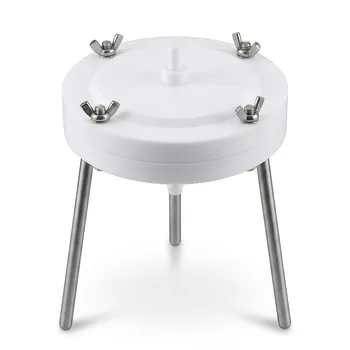
- PTFE Filter Membrane Holder for Hydrogen Chloride and Water Filtration 90mm Environmental Sampling Clamp Customizable
- PTFE Membrane Filter Holder for Aerosol Environmental Monitoring and Low Concentration Particulate Matter Sampling Chemical Resistant Air Quality Analysis Component
- PTFE Filter Membrane Holder 47mm Leak Proof Corrosion Resistant Environmental Sampling Unit Customizable
- High Purity PTFE Filter Membrane Cutter with Ceramic Blade for PM2.5 Analysis and Customizable Laboratory Filter Paper Splitter
- Custom PTFE Water Quality Filter 202mm Diameter 142mm Membrane Corrosion Resistant Holder
People Also Ask
- What are the structural characteristics and manufacturing principles of Polytetrafluoroethylene (PTFE) filter membranes?
- What is the thermal stability range for PTFE filter membranes? Master Extremes from -200°C to +260°C
- What is the chemical composition and temperature resistance of PTFE filter membranes? Essential Specs for Labs
- What are the performance advantages of PTFE filter membranes vs depth filters? Boosting Lab Purity and Efficiency
- How does the inherent hydrophobicity of PTFE filter membranes affect liquid and gas separation? Optimize Performance