F-POSS improves moisture resistance by combining fluorinated hydrophobicity with nanoscale interfacial blocking. When fluoroalkyl polyhedral oligomeric silsesquioxanes are dispersed in a semifluorinated polymer, their fluorinated surfaces interact competitively with fluorinated polymer segments and can enrich at air-polymer and substrate-polymer interfaces. This lowers surface energy, disrupts water-penetration routes, and reduces vapor diffusion, solvent uptake, and moisture-induced swelling.
Core takeaway: F-POSS acts as both a hydrophobic surface modifier and an interfacial nanoreinforcement. By stabilizing interfaces and making water molecules follow more difficult diffusion paths, it improves water vapor barrier performance and preserves dimensional and chemical stability in humid or corrosive environments.
How F-POSS Changes the Polymer Structure
Fluorinated groups reduce water affinity
The fluoroalkyl groups in F-POSS are highly nonpolar and have low surface energy. Their incorporation reinforces the matrix's fluorinated character, making the material less attractive to water and reducing moisture adsorption at exposed surfaces.
This effect complements the intrinsic moisture resistance of semifluorinated polymers, where replacing more polar C-H environments with C-F-rich structures generally lowers hydrophilicity and water uptake.
The silsesquioxane cage provides nanoscale reinforcement
POSS molecules contain rigid, inorganic silsesquioxane cages surrounded by organic substituents. The cage limits local chain mobility and can occupy free-volume regions that would otherwise provide easier routes for water vapor or solvent molecules.
The benefit depends on dispersion. Well-distributed F-POSS creates many nanoscale obstacles, whereas large agglomerates can introduce defects rather than eliminate them.
Why Interfaces Matter
F-POSS can enrich at macroscopic interfaces
The primary mechanism is competitive interfacial behavior between F-POSS nanoparticles and fluorinated polymer segments. When the material encounters moisture, entropic and interfacial forces can drive F-POSS toward the air-polymer and substrate-polymer boundaries.
This migration forms a fluorine-rich, low-energy interfacial region. The resulting surface is less wettable and less receptive to water condensation or absorption.
Interfacial enrichment closes vulnerable routes
Polymer coatings commonly permit moisture ingress through surface micro-defects, domain boundaries, and poorly bonded substrate interfaces. F-POSS enrichment modifies the surface energy and internal boundary structure, reducing the continuity of these penetration routes.
At a substrate interface, this can also reduce moisture accumulation and the associated swelling or osmotic pressure that promotes debonding and coating failure.
The interface becomes more stable during exposure
Reduced water uptake limits plasticization and volumetric expansion of the polymer. That helps preserve adhesion, dimensional stability, and barrier performance during repeated exposure to humidity, solvents, and corrosive fluids.
For valves, fittings, tubing, and laboratory components, this stability is important because dimensional changes can affect sealing, flow control, and contamination risk.
How Water Vapor Diffusion Is Reduced
F-POSS increases diffusion resistance
Water vapor does not pass through a nanocomposite solely according to its bulk chemical composition. It also encounters the distribution of rigid nanofillers, polymer domains, and interfacial regions.
Dispersed F-POSS lengthens and complicates the effective diffusion path. Instead of moving directly through the matrix, permeant molecules must move around nanoscale obstacles and less permeable fluorine-rich regions.
Hydrophobicity and tortuosity work together
Hydrophobic fluorinated groups reduce the material's tendency to absorb water, while the POSS cages and altered domain boundaries restrict molecular transport. The first mechanism reduces water entry; the second slows movement after entry.
This combined effect is more useful than relying on surface hydrophobicity alone. A water-repellent surface can still have poor vapor resistance if internal free volume and defects remain connected.
Swelling is suppressed
Moisture absorption can separate polymer chains, increase free volume, and cause swelling. By reducing water uptake and restricting chain rearrangement, F-POSS helps maintain a denser and more stable matrix.
Lower swelling preserves the geometry and mechanical response of fluoropolymer films and components exposed to sustained humidity.
Why the Effect Is Valuable in Fluoropolymer Applications
Coatings retain adhesion and barrier function
In protective coatings, water often reaches the substrate through defects or along the coating-substrate boundary. F-POSS can reduce interfacial wetting and moisture transport, improving resistance to blistering, delamination, and chemical attack.
The result is a more stable protective layer in humid or corrosive service.
Laboratory components maintain dimensional consistency
High-purity labware and fluid-handling components must resist moisture without releasing contaminants or changing dimensions. Reduced absorption and swelling help maintain predictable fit, flow behavior, sealing, and chemical performance.
This is particularly relevant for tubing, fittings, valves, and components used in trace analysis or aggressive chemical media.
Surface wear can also decrease
Fluorinated and siloxane-containing structures can provide low friction in addition to moisture resistance. A smoother, lower-energy surface can reduce mechanical wear and abrasion-related particle generation during repeated operation.
That benefit is complementary to the vapor barrier: the component is less likely to absorb moisture and less likely to introduce wear debris into a fluid system.
Understanding the Trade-offs
Excess F-POSS can create defects
F-POSS is effective only when it remains adequately dispersed and compatible with the semifluorinated matrix. Excess loading or poor processing can cause aggregation, voids, roughness, or weak interfacial regions that increase permeability.
The optimum concentration must therefore be established experimentally for the specific polymer, molecular architecture, and processing conditions.
Interfacial migration must remain controlled
Interfacial enrichment can improve surface protection, but uncontrolled migration may produce nonuniform composition or weaken bulk reinforcement. Long-term exposure, thermal cycling, and contact with solvents may also alter the distribution of F-POSS.
Barrier testing should therefore include aging and chemical-exposure conditions that reflect actual service.
Barrier improvement is not determined by hydrophobicity alone
A low contact angle or low surface energy does not fully predict water vapor transmission. Internal free volume, crystallinity, filler orientation, coating defects, and substrate adhesion can be equally important.
Other nanofillers, including platelet-shaped materials, can further reduce permeability by creating a tortuous path. However, they may affect transparency, flexibility, surface finish, or processability.
Surface treatments solve different problems
Plasma patterning, hydroxylation, or fluoroalkoxy-group modification can tailor wetting or chemical functionality at the surface. These approaches are useful for microfluidics, printing, or biomolecule immobilization, but they do not automatically provide the same bulk vapor-barrier reinforcement as dispersed F-POSS.
The treatment should match the failure mechanism being addressed.
Making the Right Choice for Your Goal
Choose the formulation and validation strategy according to the dominant requirement:
- If your primary focus is water vapor resistance: Use well-dispersed F-POSS to combine low water affinity with increased diffusion tortuosity, then verify performance through water vapor transmission and humidity-aging tests.
- If your primary focus is dimensional stability: Prioritize reduced moisture uptake and swelling, and measure mass change, volume change, and mechanical properties after prolonged humidity exposure.
- If your primary focus is coating durability: Optimize F-POSS distribution at both the air-polymer and substrate-polymer interfaces, then evaluate adhesion, blistering, and delamination after wet and corrosive exposure.
- If your primary focus is laboratory fluid handling: Balance barrier performance with low friction, wear resistance, chemical compatibility, and low particle generation during repeated operation.
- If your primary focus is optical or mechanical flexibility: Keep F-POSS loading low enough to avoid aggregation, haze, brittleness, or processing defects.
The most reliable design uses F-POSS as part of a controlled nanocomposite architecture, where fluorinated chemistry, interfacial stability, dispersion, and diffusion-path geometry are optimized together.
Summary Table:
| Mechanism | Effect on Moisture Resistance |
|---|---|
| Fluorinated groups | Reduce water affinity and surface energy |
| Silsesquioxane cage | Provides nanoscale reinforcement, blocks free volume |
| Interfacial enrichment | Forms fluorine-rich barrier at surfaces, disrupts water ingress |
| Increased tortuosity | Lengthens diffusion paths for water vapor |
| Swelling suppression | Maintains dimensional stability and adhesion |
Ready to elevate your fluoropolymer components with superior moisture resistance? At KINTEK, our PTFE/PFA labware and custom machined parts are engineered with advanced nanocomposite technologies for unmatched durability and performance. From high-purity beakers to complex fluid handling systems, our products are designed to excel in humid and corrosive environments. Contact us today at #ContactForm to discuss your specific needs and discover how our solutions can benefit your lab.
Related Products
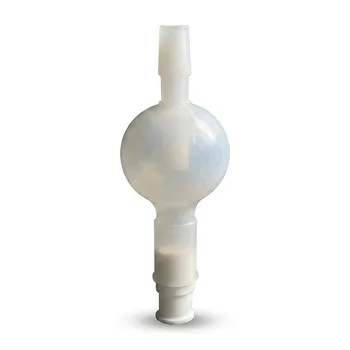
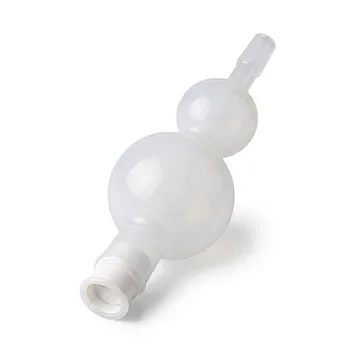
- High Purity PFA Chromatography Column with Collection Bottle Corrosion Resistant Fluoropolymer Filtration System for Trace Analysis
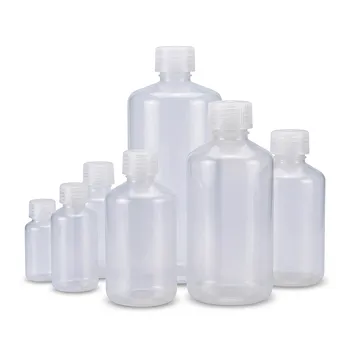
- Semiconductor Electronic Grade PFA Sampling Bottle for Ultrapure Reagent Storage and Trace Analysis
- High Purity PFA Chromatography Columns and Collection Bottles Corrosion Resistant Fluoropolymer Filtration Systems for Trace Analysis
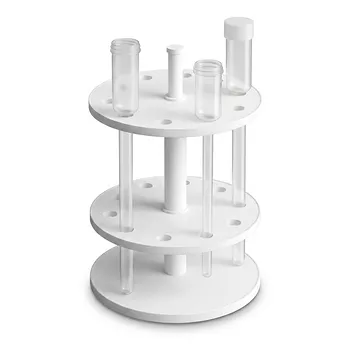
- Custom PFA Micro Column Rack and PTFE Machined Storage Solutions for Trace Analysis
- High Purity PFA Chromatography Column Double Layer Constant Pressure Filter Column with Sieve Plate Acid Resistant Fluoropolymer Filtration System
People Also Ask
- Why is the chemical stability of polymer endgroups critical when selecting melt-processible fluoropolymers like PFA for high-purity laboratory apparatus? Choose Stable Endgroups for Reliable Performance
- What are the characteristics of PFA material? A Guide to Its High-Performance Balance
- Why is Perfluoroalkoxy alkane (PFA) preferred over glass or stainless steel in pharmaceutical process development? Pure Yield
- Why is PFA superior for cleaning and preventing cross-contamination? The Gold Standard for Ultra-Trace Lab Hygiene
- What are the key properties of PFA (PerFluoroAlkoxy)? A Guide to Extreme Chemical and Thermal Resistance